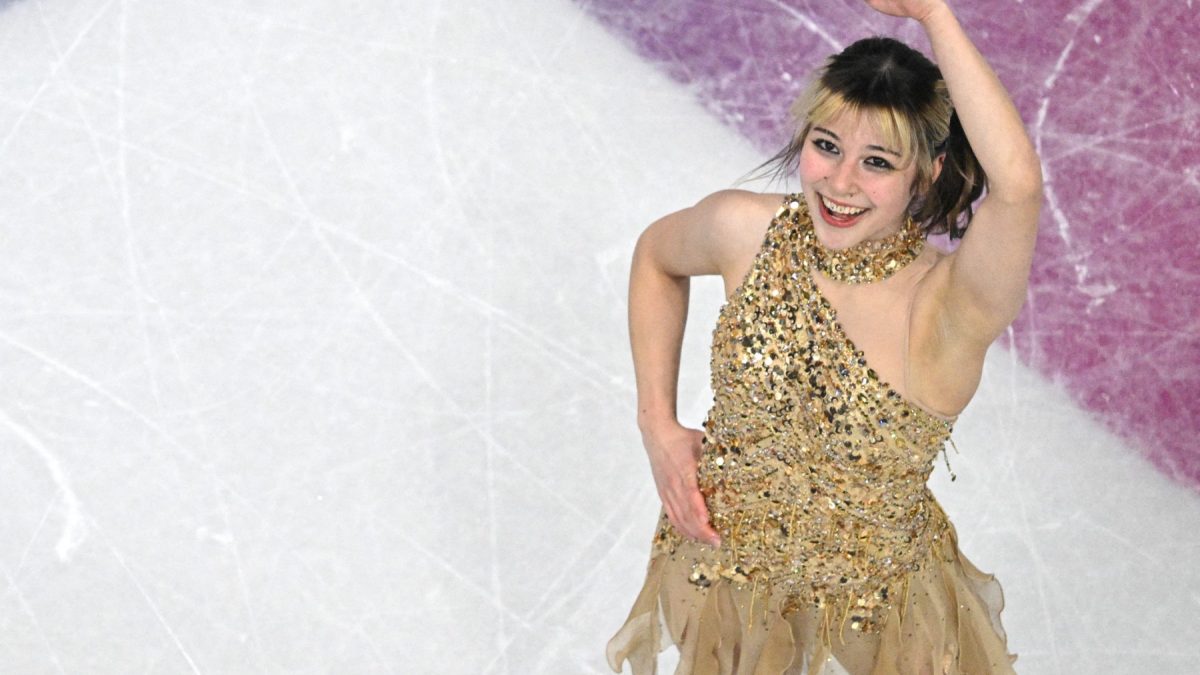
 "USA's Alysa Liu competes in the figure skating women's single free skating final during the Milano Cortina 2026 Winter Olympic Games. File Photo/AFP")
There is something quietly disruptive about watching Alysa Liu skate. She steps onto the ice with halo hair that she describes as growing in rings like a tree marking time, a self-pierced smiley glinting beneath an almost mischievous grin, and proceeds to inhabit a discipline that has long demanded obedience and containment, as if it were simply another medium to experiment with.
At 20, Liu is America’s first Olympic women’s figure skating gold medalist in 24 years. But the reason she feels electric has less to do with the medal and more to do with the manner in which she arrived at it.
The prodigy who chose to leave
Born in 2005 in the San Francisco Bay Area, Liu entered the sport’s mythology early. At 13, she became the youngest U.S. national champion in history, landing triple Axels with an ease that made commentators reach for superlatives usually reserved for generational talents. By the time she competed at the Beijing 2022 Winter Olympics, she had already been cast as the future of American figure skating. She finished sixth. Weeks later, she won world bronze.
Then, at 16, she retired.
Elite figure skating is an architecture of control. What you eat, what you weigh, what you wear, what music you are allowed to interpret — all of it exists within a framework that rewards compliance. Liu has spoken about how suffocating that structure felt, particularly after the pandemic disrupted the rhythm of competition. She realised she did not want to return to the rink simply because the sport expected her to. She wanted to be 16; she wanted college. She wanted the ordinary freedoms prodigies are rarely afforded.
Quick Reads
View AllIn stepping away, she chose absence in a culture that romanticises endurance above all else.
Returning on her own terms
When Liu announced her comeback less than two years later, it did not feel like a redemption arc. It felt like recalibration. Within 24 months, she was back on the Olympic podium, this time with gold around her neck, not as a prodigy propelled by expectation but as an athlete who had interrogated her own desire to be there.
Her music choices tell the story as clearly as any interview. She has skated to Joji, to a Lady Gaga medley, to PinkPantheress’s “Stateside,” and most memorably to Laufey’s “Promise,” the routine that secured her second Olympic gold. In a sport that once leaned heavily on Tchaikovsky and Puccini, these selections are not gimmicks; they are generational signals.
Laufey, in particular, feels like a mirror. The Icelandic artist has revived jazz and classical traditions for a streaming-native audience, becoming one of the most-listened-to artists in the world without abandoning the discipline’s roots. Liu operates in a similar register. She’s not rejecting the sport’s rigour. She’s making it feel more like her.
Her halo hair and piercings are not costumes layered on top of performance; they are extensions of self. In a discipline that historically regulated appearance through implicit dress codes and unspoken expectations of femininity, that self-definition carries weight.
She carries alt-girl energy into an arena built on symmetry and control. Not to disrupt it theatrically, but to inhabit it differently. For the girls who were told they were “too much” or “too specific” for certain rooms, Liu reads as reassurance: you don’t have to sand yourself down to belong.
Choosing joy over expectation
What makes Liu especially resonant for Gen Z is not simply that she looks different or skates to different music. It is her indifference to the metrics that once defined her. She has spoken candidly about returning without being consumed by scores or placements, about wanting only to make the team and share her artistry on a global stage.
In the aftermath of Olympics that have repeatedly exposed the psychological toll of high-performance sport, her mindset provides a contrast. Where previous eras framed suffering as the price of greatness, Liu reframes joy as a legitimate motivation.
During her hiatus, she trekked to Everest Base Camp. She travelled with friends, explored college life. She existed beyond the rink, and in doing so, loosened the sport’s claim over her identity.
That looseness translates on the ice. There is less visible strain, less urgency to prove. She skates as though she could leave again, and that possibility makes her authority feel different. It is not desperation that powers her performances, but choice.
Being a girl being real
The internet’s attachment to Liu is not incidental. Gen Z’s radar is finely tuned to authenticity, especially in the age of AI, to the subtle difference between branding and being. Liu’s embrace of girlhood, the refusal to flatten herself into a singular archetype, registers as real.
She represents a version of access that is conditional on self-definition. As a young woman in a sport that has historically dictated the terms of participation, she models a different approach: you can leave, you can return, and you can do so without surrendering yourself.
That she is currently the best in the world almost feels beside the point. The gold medal proves her technical brilliance, but it doesn’t fully explain why she resonates. What does resonate is the sense that she stepped into one of the most tradition-bound spaces in global sport and quietly widened it, without waiting for permission. In an era that feels starved of sincerity, choosing your own terms might be the most radical choreography of all.