

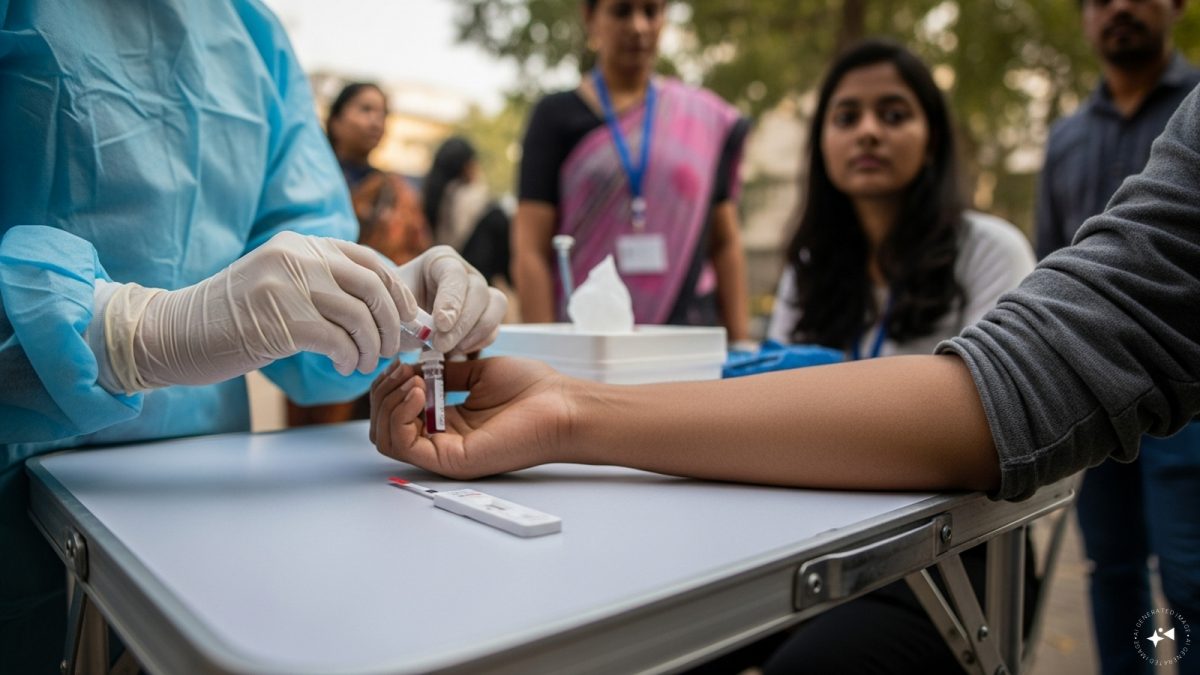
 "World AIDS Day: India at a crossroads as rising youth infections challenge gains in HIV control")
As the world marks World AIDS Day, 2025 brings a mixed picture for India’s fight against HIV/AIDS. On one hand, expanded testing, widespread treatment and strengthened public-health systems have helped drive down new infections, AIDS-related deaths and mother-to-child transmission, reflecting the gains of sustained national efforts.
On the other hand, a new wave of infections among teens and young adults’ risks undermining decades of progress, especially in Tier 2 and Tier 3 cities where stigma and late testing continue to cast long shadows. Experts warn that a rising tide of new infections among adolescents and young adults particularly driven by misinformation, delayed testing and social stigma threatens to stall progress.
Gains so far: treatment expansion and declining deaths
India has made significant strides under the National AIDS Control Organisation (NACO) and the current phase of the National AIDS Control Programme (NACP 2021–26). According to government data, annual new HIV infections have nearly halved since 2010 and AIDS-related deaths have dropped by more than 80 per cent. Mother-to-child transmission has also fallen dramatically.
HIV testing increased from 4.13 crore tests in 2020–21 to 6.62 crore in 2024–25; the number of people on lifelong antiretroviral therapy (ART) rose from 14.94 lakh to 18.60 lakh over the same period. Viral load testing, critical to monitor treatment success, nearly doubled.
Global-level data from World Health Organisation (WHO) confirm that HIV, while incurable, is now a manageable chronic condition when detected early and treated consistently, enabling people to live long, healthy lives.
HIV is chronic and manageable but awareness lags
Medical professionals in India echo this transformation. Both WHO and national data confirm that timely detection and uninterrupted antiretroviral therapy (ART) allow individuals to live healthy, productive, and stigma-free lives. “Today’s HIV is chronic but can be managed well…patients live a normal life span, working full-time, getting married and raising their families very safely,” said Dr. Arvind Aggarwal, Sri Balaji Action Medical Institute (Delhi) who emphasised that social stigma and late testing are the main barriers, not clinical capability.
Routine screening and sustained treatment can reduce viral loads to undetectable levels, eliminating the risk of transmission, according to WHO guidance. Despite scientific reassurance, social stigma still discourages people from coming forward for tests and therapy.
Adolescents at risk: The quiet challenge
According to NACO surveillance (2024), individuals aged 19–28 are showing a “very notable” increase in new HIV diagnoses. Many of these new infections are linked to unsafe sexual practices, limited awareness about preventive options, and reliance on myths and misinformation.
India’s AIDS-related deaths have fallen thanks to widespread ART and awareness campaigns, but the latest NACO surveillance reveals a troubling spike in new diagnoses among 19–28-year-olds. Dr. Rohit Sharma, Apollo Spectra Hospital, Jaipur, says “Young people are highly informed online, yet poorly educated about HIV. They rely on myths from social media instead of scientific facts…Routine testing is the only reliable safeguard.”
Quick Reads
View AllExperts like Dr. Manohar K N, SPARSH Hospital, Bangalore, call for stronger school and college-based programs, “especially those addressing safe sexual practices, consent, and destigmatising HIV testing.”
Maternal transmission: A window of prevention
Experts warn that while improvements have been achieved in prevention of mother-to-child transmission, antenatal screening remains inconsistent in many parts of North India.
India has made major strides in preventing mother-to-child HIV transmission, but antenatal testing rates remain inconsistent, especially in North India. “Every pregnant woman should undergo HIV screening in the first trimester. Early diagnosis and ART support reduce mother-to-child transmission to less than 1%,” says Dr. Megha Mittal, Obstetrics & Gynaecology at Apollo Spectra, Delhi.
Dr Charu Lata Bansal, Senior Consultant, Obstetrics & Gynaecology, Cocoon Hospital (Jaipur) says: “We still meet expectant mothers who usually believe that HIV cannot affect them. Early antenatal testing is usually non-negotiable – it ensures that both mother and baby remain protected. With the help of proper ART intervention, mother-to-child transmission drops to negligible levels. But the window of prevention closes very fast if testing is continuously delayed.”
Reducing stigma: The road ahead
Doctors unanimously agree: India’s next phase in HIV control must centre around stronger, youth-friendly awareness, routine screening for sexually active adults, and widespread understanding of preventive tools like PrEP and PEP.
As Dr Ashish Mehrotra, Senior Consultant – Internal Medicine, Apollo Spectra Hospital (Kanpur) said: “In Tier-2 cities, stigma continues to remain the biggest challenge. People hesitate to go to testing centers because they fear being judged. Unless we break the social and family-level stigma, medical progress will stay limited. In today’s time HIV is fully manageable with timely ART — there is no reason for people to hide or delay treatment.”
What is clear, say experts, is that India already possesses the scientific tools, infrastructure and medical capability to manage HIV effectively. What remains is open conversation, early diagnosis and a health-system that supports individuals — not pushes them into silence. Through collective responsibility, India can move towards a future where HIV transmission is controlled and ultimately, eliminated.


 "Zelenskyy to discuss 'key issues' with Trump after 'significant progress' in Florida talks")
 "'Deeply concerned': PM Modi reacts to ex-Bangladesh PM Khaleda Zia’s critical health, offers ‘all possible support’")
 "Vladimir Putin's India visit: From Independence to Ukraine war, how ties between countries remain strong")
 "Exclusive | ‘Please support us, we play for India too’: India captain Deepika TC on winning Women’s T20 World Cup for blind")
 "Zelenskyy to discuss 'key issues' with Trump after 'significant progress' in Florida talks")
 "'Deeply concerned': PM Modi reacts to ex-Bangladesh PM Khaleda Zia’s critical health, offers ‘all possible support’")
 "Vladimir Putin's India visit: From Independence to Ukraine war, how ties between countries remain strong")
 "Exclusive | ‘Please support us, we play for India too’: India captain Deepika TC on winning Women’s T20 World Cup for blind")



