

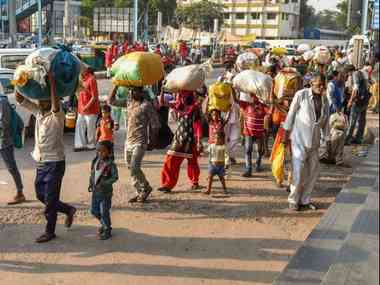
 "Coronavirus threatens world population, but for migrant labourers in India hunger and poverty still loom large")
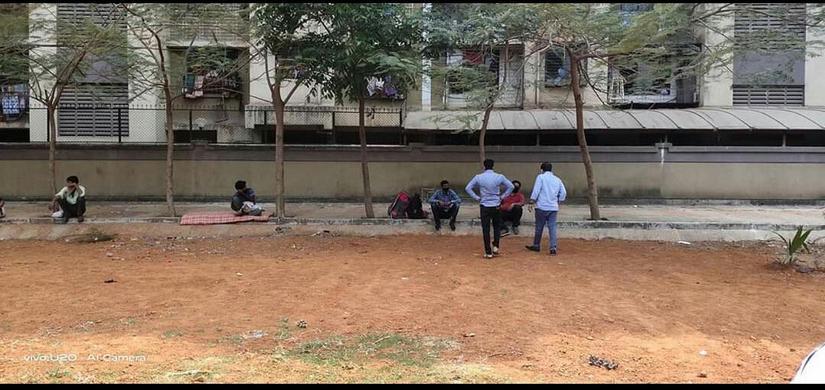
The poor in India are in a fix. They don’t know which is a bigger killer: the novel coronavirus or hunger which has been thrust upon them due to an unprecedented crisis. A group of 25 to 26 men, aged between 35 and 50, wait near a makeshift shanty that they have erected near the railway crossing near Idgah Chowk in Meerut’s Sakhoti Tanda in Uttar Pradesh. Some are pacing restlessly, the reporter is told. “We had no idea all this would unfold so fast,” said Ajay Prasad, 38-year-old migrant labourer who works for a private construction company, along with others, on a contract basis. Ajay and the 24 others hail from Jharkhand’s Latehar district. They were working on a project commissioned by the Indian Railways when the “Janta curfew” — the trial lockdown — was announced by Prime Minister Narendra Modi at 8 pm on 21 March. “Sochein ek din ka bandi hai, nikal jayenge kal parso tak,” said Ajay when asked why he didn’t leave after the lockdown was announced. According to social activists — who are working to rescue migrant workers stranded in other states — workers from Jharkhand and Bihar are stuck in Maharashtra, Gujarat, West Bengal, Uttar Pradesh, Rajasthan and Karnataka. Ramdeo Vishwabandhu, a social activist based in Jharkhand’s Giridih, explains that several were unaware of Modi’s second address to the nation where he announced the 21-days lockdown. [caption id=“attachment_8202421” align=“alignnone” width=“825”]
 Migrant workers in Mumbai’s Chembur without accommodation. Image procured by author.[/caption] “Governments are doing everything they can, but daily wage labourers are not watching news like us. They had no idea. When they found out and decided to leave it was too late. Some couldn’t leave, others who managed to leave were stopped around border areas and were told to go back where they came from. Now, the plan is to ensure they have food. That is the biggest problem.” According to Ajay and the others stuck in Uttar Pradesh, their maalik did not tell them about the 21-day lockdown. “Pata hi nahi chala, jab tak sochein niklenge, saari gaadiyan cancel ho gayin (It all happened too fast. By the time we decided to leave, all the trains had been cancelled),” said one of the 25 workers. For now, the men are just about surviving, eating and sleeping in that congested shanty area. When asked about their living arrangement, they described it thus. “We don’t have a rented place here. So, we erected this tarpaulin shed and now, we stay and cook here,” said Ajay. “But, we have six beds, not too wide. So four men have to sleep on one bed. And the cook sleeps on the floor,” he said, but quickly adds, “Lekin sab saaf suthra hai.” Almost as if predicting the next question, another labourer chimed in “Bol rahein hain ki Corona sankraman se phailta hai. Hum safai maante hain (They are saying corona is infectious and is spreading fast. We follow good hygiene because of that.)” The plight of stranded migrant labourers across the country in states including Maharashtra, Gujarat, Andhra Pradesh, Telangana has been splashed all over newsprint and TV screens, as social media was simultaneously exploding with maudlin testimonies of daily wage labourers who have travelled thousands of kilometres to find work and are now stuck without food or shelter. Help, however, was given almost immediately. Small village communities, district authorities, private volunteers and good Samaritans wasted no time in reaching out to those in need and provided them with food supplies and basic amenities. “They gave us 6 kg aata, 7 kg rice, half kg dal, a packet of spices and salt. The police and the district authorities have been very helpful. We don’t have to worry about food, for sure,” said Teknarayan Oraon, one of the 25 men living with Ajay. “But it still doesn’t help us completely, you know,” he added, with some palpable guilt. Apart from their own condition, the workers are worried about their own families back home. “I have an old mother, two little children and a wife. We live in a small village in Latehar. I don’t know what they will do. I don’t even know when I will go back home,” Ajay said. His wife Babita is equally scared of the uncertainties that the situation has thrown up. “My mother-in-law is 85 years old and asthmatic. They are saying senior citizens should be more careful. Ration at home will get over in a couple of days. Usually, when my husband visits every month or so, he does the shopping. They have even shut all the shops due to this lockdown.”

State govts that could get message across to migrant workers not to head back to native villages will b able to restart supply chains & manufacturing in public & pvt enterprise in 2 weeks. They moved quickly, food & help immediately. UP bearing brunt of the panic in other states pic.twitter.com/GkcxwUxZey
— Smita Prakash (@smitaprakash) March 28, 2020
Minutes before it began to rain, the migrant labourers were on the road, marching their way home.
— Marya Shakil (@maryashakil) March 27, 2020
God be merciful! #CoronaLockdown #CoronavirusOutbreak pic.twitter.com/SW64zvicBk
The internet is full of such harrowing examples. Most of them are likely ignorant of the dangers they are subjecting themselves to. But what is the solution? While a few state governments, including Odisha and Andhra Pradesh, are making efforts to get some of the workers back to their home states, authorities and many activists are strongly discouraging workers from going back. Union minister Nitin Gadkari, in fact, tweeted on Saturday: “I have advised Chairman NHAI and Highway Concessioners/ Toll Operators to consider providing food, water or any kind of support to migrant workers/citizens who are trying to reach to their respective native places.” “Wherever they are stranded, they should remain there. Walking doesn’t make sense from a public health point of view. At this point, people should have food and shelter,” said Benoy Peter, executive director, Centre for Migration and Inclusive Development (CMID). CMID, which has been working with migrant workers stuck in Kerala, is of a strong opinion that lockdown and restricting movement is the only way to contain the spread of the coronavirus, which according to health experts, is extremely contagious. “It is not a pleasant situation, but a necessary one,” said Benoy. It’s easy to criticise the Centre for everything, he said, “but the state governments, who are claiming to get their people back, are going to trigger a rural epidemic by being populist and emotional right now.” Benoy and his team, along with health officials are ensuring that the migrants who are stuck in Kerala are getting food and basic amenities. “If they are allowed to travel now, they will bridge the gap between rural and urban as far as COVID-19 positive cases are concerned. “It will spiral a rural epidemic and rural India is not equipped to even handle the crisis with their crumbling healthcare. The only way is to stay put where you are,” said Benoy. [caption id=“attachment_8202451” align=“alignnone” width=“825”] 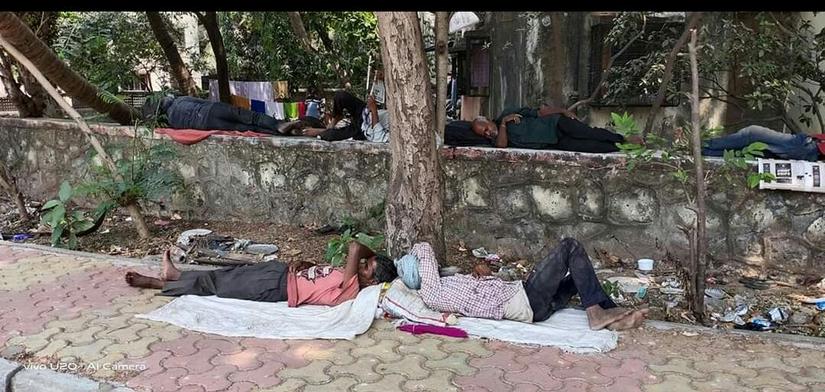 The plight of migrant labourers has been splashed across print and TV media. Image procured by author.[/caption] Reports, in fact, have noted that migrant workers who returned faced discrimination and were viewed with suspicion by locals and a few authorities. “Hundreds of kilometres away in the western Odisha district of Kalahandi, 12 migrant workers who returned from Kerala had to stay under polythene sheet for several days before being allowed in their village,” The Hindu reported. Pooja Yadav, a social activist with Mumbai-based Youth for Unity and Voluntary Action or YUVA, said that there is extreme confusion and anxiety among those stuck in Mumbai and Pune. “The government has extended help and they are honestly doing what they can. But the unregistered workers, which form a major chunk of the migrant population in Maharashtra, have been left in the lurch. So, we are trying to reach out to them as soon as we get information.” According to a rough estimate by YUVA, at least 600 migrant workers, hailing from states including West Bengal, Uttar Pradesh and Bihar, are stuck in the Thane district of Maharashtra alone. Madhukant Pathariya, president of Nirman Mazdoor Sanghatna based in Maharashtra, said that the station in Kalyan was jam-packed the day the Centre announced the second lockdown. “They were not leaving from Mumbai. These were migrant workers from Pune and other districts of Maharashtra who were rushing out to get back to their home states. No one was there to test them or to enforce social distancing. There is no way to guess the number of people coming in and going out,” Madhukant said. Firstpost reached out to state and district authorities in Maharashtra, Uttar Pradesh and Andhra Pradesh and Telangana, who are working with migrant workers, and all of them said pretty much the same thing: we will get them food and supplies. No one will go hungry. But, they should reconcile with the idea that they might not return home for a while.


 "Charlie Kirk, shot dead in Utah, once said gun deaths are 'worth it' to save Second Amendment")
 "From governance to tourism, how Gen-Z protests have damaged Nepal")
 "Did Russia deliberately send drones into Poland’s airspace?")
 "Netanyahu ‘killed any hope’ for Israeli hostages: Qatar PM after Doha strike")
 "Charlie Kirk, shot dead in Utah, once said gun deaths are 'worth it' to save Second Amendment")
 "From governance to tourism, how Gen-Z protests have damaged Nepal")
 "Did Russia deliberately send drones into Poland’s airspace?")
 "Netanyahu ‘killed any hope’ for Israeli hostages: Qatar PM after Doha strike")



](https://images.firstpost.com/wp-content/uploads/2020/03/82514.jpg)
](https://images.firstpost.com/wp-content/uploads/2020/03/82521.jpg)
](https://images.firstpost.com/wp-content/uploads/2020/03/82531.jpg)