By Kartikeya Tanna As expected, Gujarat Chief Minister Narendra Modi and his party have secured a thumping victory for the third time in Gujarat. While much of the media has focused on the next two years and the “road to Delhi”, one aspect of Modi’s campaign, nurtured carefully in the past few years, may well have played a crucial role in his emphatic victory. High stakes election campaigns are often fought on allegations and counter-allegations with each side laying down facts and figures to buttress its point. The 2012 US Presidential elections were full of adverts and television debates carrying facts that countered the half-truths and untruths of the opponent. While these charges and counter-charges happen in India too, a different ball-game pans out here. The sections which vote in large numbers and which are, therefore, targeted by political parties live in the hinterlands. For people struggling for a daily living, watching their netas spar on television isn’t something they have the luxury of indulging in. Politicians have to battle it out in the dust and heat of the inner lands. [caption id=“attachment_564594” align=“alignleft” width=“380”]
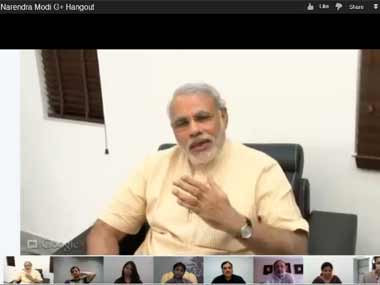 Modi’s use of social media has been unique in Indian politics. Screen grab from Modi’s Google+ hangout.[/caption]In the past few years though, a metamorphosis of sorts is rapidly taking place in the country’s information channels. In an
interview
with Newslaundry, R Jagannathan revealed how his plans to shift to the digital medium back in 2001-02 were unsuccessful. The time perhaps was not right. Access to internet was not as widespread as it is now. The sheer economic potential of the internet has resulted in technological developments and innovations revolutionising how India gets its information. Using Google’s path-breaking search engine, ‘liking’ and ‘following’ one’s chosen sources of information on social media sites, and ‘subscribing’ to Google alerts, websites, blogs and YouTube channels no longer requires one to switch on desktops and laptops. An exponential increase in tele-density coupled with attractive data plans in this click-of-a-button age of rapid information has signalled a paradigm shift. Smartphones bring you the world you choose to subscribe to! Gujarat Chief Minister Narendra Modi was one of the first, if not the first, mainstream politician to realise the potential of these technological developments. Indeed, the medium of internet was not quite a one-way street. A brutal rejection of one’s thoughts and ideologies could be proffered almost instantaneously by way of a blog or a comment. Nonetheless, this medium was free from editorial agendas or restrictions. Modi took to the internet around the same time the youth of India did. Initially, it started with his website which highlighted important government programmes and initiatives. As innovations became available for use, his social media accounts, YouTube channel and ‘subscriptions’ options were quickly created and a content-linking mechanism in this ‘digital structure’, if you will, was put in place. Modi’s enormous popularity, dismally absent in mainstream media coverage, resulted in lakhs of followers expressing their admiration through their keyboards. In a
blog
titled ‘Making a Difference through Social Media’, Modi expressed gratitude for what he learns from these “wonderful people” on social media. As the 2012 Gujarat Vidhan Sabha elections approached, the ‘digital structure’ was readied and popularised. While traditional campaigning was irreplaceable, what Modi saw with his digital structure was something far-sighted – the ability to tap the first-time voter and the youth in the youngest nation of the world. He knew where he would find them in their free time – hooked to emails and social media sites instead of prime-time television debates; on their laptops, phones or tablets and not at political rallies. As essential as these voters were in ‘swing constituencies’, Modi wanted their approval in favourable constituencies too. It wasn’t just about winning. It was about wedding the youth to what he, his party and his government stood for and promised them. Not just in these elections, but for the elections to come. Indeed, what also worked for Modi is that Gujarat, compared to other parts of India, is relatively more urbanised. Thus began the season of active campaigning on internet and social media. Penning his
thoughts
on topics such as Gujarat’s stability, BJP’s Sankalp Patra and historic voter turnout, he shared them almost exclusively for his supporters on the internet. “Lies” of the Congress were “
exposed
” in an aggressive manner, “Centre’s injustices”
highlighted
to illustrate Congress’ betrayal and UPA’s mis-governance
elaborated
to draw likely scenarios should voters elect the Gujarat Congress. That many key state leaders of the Congress lost their seats suggests that Modi was able to counter their claims effectively. Each point was supported by attaching documents and evidence containing verifiable data which was then interlinked in the digital structure in a rather impressive manner. The quickness and comprehensiveness with which Modi’s point on the Sir Creek issue was highlighted on it illustrates its sheer efficacy. In a major embarrassment to the Gujarat Congress, Modi’s team exposed several of its ads that lifted photos of a Sri Lankan child, a Rajasthani farmer and other non-Gujarati faces from the internet to highlight Gujarat’s problems. Clearly, the Gujarat Congress was miles behind Modi in effectively using the internet and social media. Not only that, while the Congress’ idea of highlighting Modi’s misgovernance and promising several freebies did generate interest, by the end of the campaign, one was left wondering how it all withered away. As one reflects back on how the campaign unfolded, one realises that Modi did not ‘react’ immediately to charges on misgovernance. He cleverly set the tone on other things – often unrelated to Gujarat – that he wanted the Congress to react to. And when Congress was sufficiently trapped in its defensiveness and woefully disintegrated with alarming breakaways – thus leaving the Gujarat electorate disillusioned with Congress’ dazzling promises – Modi responded to the Congress’ substantive charges both in his speeches and through the internet with charts and statistics. True, Modi’s oratory prowess gave audibility to the tone he set and the responses he chose to give at his time. His digital structure, however, gave it visibility in ink and permanence on the web. To what specific extent this internet and social media campaign influenced votes is an exercise that election analysts and psephologists should ponder over. But one thing is clear. Back in 2001, when Modi assumed the office of Chief Minister, he had, by his own admission, never fought even a school election. Scepticism in the BJP was in order. Eleven years hence, it won’t be surprising if case studies are formulated on the way his digital structure has played a role in integrating the youth of Gujarat with the political process.
Modi’s use of social media has been unique in Indian politics. Screen grab from Modi’s Google+ hangout.[/caption]In the past few years though, a metamorphosis of sorts is rapidly taking place in the country’s information channels. In an
interview
with Newslaundry, R Jagannathan revealed how his plans to shift to the digital medium back in 2001-02 were unsuccessful. The time perhaps was not right. Access to internet was not as widespread as it is now. The sheer economic potential of the internet has resulted in technological developments and innovations revolutionising how India gets its information. Using Google’s path-breaking search engine, ‘liking’ and ‘following’ one’s chosen sources of information on social media sites, and ‘subscribing’ to Google alerts, websites, blogs and YouTube channels no longer requires one to switch on desktops and laptops. An exponential increase in tele-density coupled with attractive data plans in this click-of-a-button age of rapid information has signalled a paradigm shift. Smartphones bring you the world you choose to subscribe to! Gujarat Chief Minister Narendra Modi was one of the first, if not the first, mainstream politician to realise the potential of these technological developments. Indeed, the medium of internet was not quite a one-way street. A brutal rejection of one’s thoughts and ideologies could be proffered almost instantaneously by way of a blog or a comment. Nonetheless, this medium was free from editorial agendas or restrictions. Modi took to the internet around the same time the youth of India did. Initially, it started with his website which highlighted important government programmes and initiatives. As innovations became available for use, his social media accounts, YouTube channel and ‘subscriptions’ options were quickly created and a content-linking mechanism in this ‘digital structure’, if you will, was put in place. Modi’s enormous popularity, dismally absent in mainstream media coverage, resulted in lakhs of followers expressing their admiration through their keyboards. In a
blog
titled ‘Making a Difference through Social Media’, Modi expressed gratitude for what he learns from these “wonderful people” on social media. As the 2012 Gujarat Vidhan Sabha elections approached, the ‘digital structure’ was readied and popularised. While traditional campaigning was irreplaceable, what Modi saw with his digital structure was something far-sighted – the ability to tap the first-time voter and the youth in the youngest nation of the world. He knew where he would find them in their free time – hooked to emails and social media sites instead of prime-time television debates; on their laptops, phones or tablets and not at political rallies. As essential as these voters were in ‘swing constituencies’, Modi wanted their approval in favourable constituencies too. It wasn’t just about winning. It was about wedding the youth to what he, his party and his government stood for and promised them. Not just in these elections, but for the elections to come. Indeed, what also worked for Modi is that Gujarat, compared to other parts of India, is relatively more urbanised. Thus began the season of active campaigning on internet and social media. Penning his
thoughts
on topics such as Gujarat’s stability, BJP’s Sankalp Patra and historic voter turnout, he shared them almost exclusively for his supporters on the internet. “Lies” of the Congress were “
exposed
” in an aggressive manner, “Centre’s injustices”
highlighted
to illustrate Congress’ betrayal and UPA’s mis-governance
elaborated
to draw likely scenarios should voters elect the Gujarat Congress. That many key state leaders of the Congress lost their seats suggests that Modi was able to counter their claims effectively. Each point was supported by attaching documents and evidence containing verifiable data which was then interlinked in the digital structure in a rather impressive manner. The quickness and comprehensiveness with which Modi’s point on the Sir Creek issue was highlighted on it illustrates its sheer efficacy. In a major embarrassment to the Gujarat Congress, Modi’s team exposed several of its ads that lifted photos of a Sri Lankan child, a Rajasthani farmer and other non-Gujarati faces from the internet to highlight Gujarat’s problems. Clearly, the Gujarat Congress was miles behind Modi in effectively using the internet and social media. Not only that, while the Congress’ idea of highlighting Modi’s misgovernance and promising several freebies did generate interest, by the end of the campaign, one was left wondering how it all withered away. As one reflects back on how the campaign unfolded, one realises that Modi did not ‘react’ immediately to charges on misgovernance. He cleverly set the tone on other things – often unrelated to Gujarat – that he wanted the Congress to react to. And when Congress was sufficiently trapped in its defensiveness and woefully disintegrated with alarming breakaways – thus leaving the Gujarat electorate disillusioned with Congress’ dazzling promises – Modi responded to the Congress’ substantive charges both in his speeches and through the internet with charts and statistics. True, Modi’s oratory prowess gave audibility to the tone he set and the responses he chose to give at his time. His digital structure, however, gave it visibility in ink and permanence on the web. To what specific extent this internet and social media campaign influenced votes is an exercise that election analysts and psephologists should ponder over. But one thing is clear. Back in 2001, when Modi assumed the office of Chief Minister, he had, by his own admission, never fought even a school election. Scepticism in the BJP was in order. Eleven years hence, it won’t be surprising if case studies are formulated on the way his digital structure has played a role in integrating the youth of Gujarat with the political process.
How the social media played a role in NaMo’s victory
FP Archives
• December 20, 2012, 15:40:51 IST
Modi’s understanding of the social media, which allowed him to appeal over the heads of the mainstream media, played a role in his win
Advertisement
 "How the social media played a role in NaMo’s victory")