

 "Women's T20I tri-series 2020: Little backup if they fail, but performance against Australia another example of Indian top four's worth")
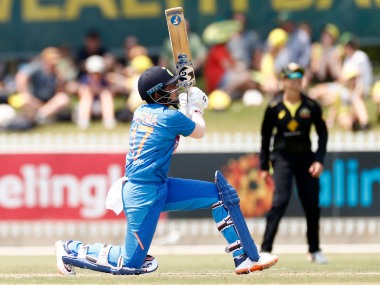
First-time viewers could not fathom the hype around Shafali Verma when she fell for a four-ball duck on debut. They were aware of her exploits in the Women’s T20 Challenge, when she countered world-class bowlers with ridiculous ease, but despite that, they wanted validation at international level. Hadn’t the likes of Mithali Raj and Danni Wyatt predicted early success for her? Her exploits in West Indies — 73 in 49 balls, 69 not out in 35, off consecutive innings — should have changed all that, but other than some Facebook Live coverage of questionable legality, live coverage was limited to fans back home. And West Indies are hardly the team they used to be in 2016. [caption id=“attachment_8018991” align=“alignnone” width=“825”] 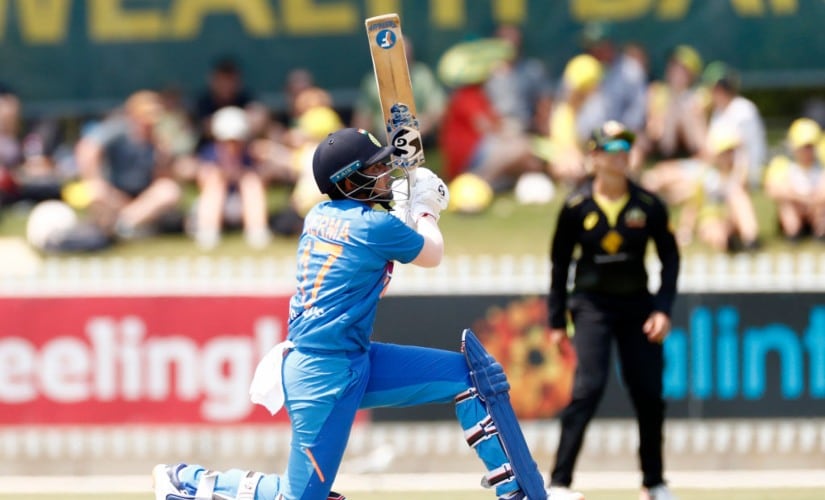 Shafali Verma slammed 49 off 28 as India made a record chase against Australia. Photo @ICC[/caption] This tournament, in Australia just ahead of the T20 World Cup, was supposed to test her. After a breezy 25-ball 30 in the first match, she got 5 and 8 in the next two. Now she was up against a target of 174 against Megan Schutt, Ellyse Perry, Jess Jonassen, and their ilk. Only twice has a bigger target been chased in Women’s T20Is, and none of them has been by India. As we have often discussed in these pages, India have only four world-class batters in the format including Verma. This meant that all four had to score runs as well as keep wickets in hand, for the middle order has failed to do anything major thrice in a row (and many, many times before). However, there was no point in saving wickets against something this big. The first over, bowled by Jonassen, was met with two fours. While hit in the air, both were calculated efforts, hit with the spin. While Mandhana unleashed one of her now-famous hits, over mid-wicket, Verma’s was slightly agricultural: she went down on one knee and still managed to hit over mid-off. Most teenagers would have been in awe of Perry, who, over the years, has perhaps tackled more aggressive batters than anyone in the format. Six days ago, Verma had been bowled, middle stump, by Perry when she had exposed the wicket to attempt an adventurous stroke. But then, this was no ordinary teenager. Perry was dispatched past cover-point, over mid-off, past square-leg for three fours in the same over. On came Schutt, the top-ranked bowler in the format, but who cared? Verma finally got on strike only after four balls – and promptly leg-glanced Schutt for four, then kept strike. Australia’s three main bowlers had conceded 34 in the first three overs. Verma had raced to 23 in 12. Surely she would slow down from here, for, given the Indian batting line-up, wickets were as important as the asking rate? Not quite. Sophie Molineux replaced Perry, and the first three balls were hit for fours, all of them on the off-side. Mandhana, probably feeling left out by now, now hit Delissa Kimmince for two fours. Now Meg Lanning had to resort to Schutt, who pulled things back somewhat with an eight-run over. However, the over included the most outrageous stroke of the match – if not the tournament. It was not overpitched, but Verma converted it into one by stepping out. The ball soared well over the cameraman perched for the angle from above the sightscreen.
A huge straight six from Verma!
— cricket.com.au (@cricketcomau) February 8, 2020
And a cheeky fist pump too from the Indian opener #AUSvIND pic.twitter.com/gJ5ksQyTI2
India reached an astonishing 70 in the powerplay overs. The carnage continued till Verma holed out to deep mid-wicket, leaving her teammates to chase 89 in 70 balls. Jemimah Rodrigues was perhaps a tad fortunate in getting to face a free hit off the third ball she faced. She promptly dispatched it to the mid-wicket fence. By the 12th over she had hit five four, the last two, off Nicola Carey, were the most special. First came a late cut as delectable as anyone can produce. Then Carey got one to bounce outside off four balls later, and Rodrigues unearthed an uppercut to finish the over just five runs behind Mandhana. India needed 52 from 46 balls when Rodrigues fell, chasing a ball from Schutt that she could have left alone. Her frustration — in complete contrast with her Twitter personality — was evident, and rightly so. While they had the asking rate under control at this stage, India had already lost two of their top four –— which meant that neither Mandhana nor Harmanpreet Kaur could get out anytime soon. Having lost two of her partners, Mandhana now decided to bat it out. Twice in the tournament had she departed while trying to clear the fielders; she would not do that again. Meanwhile, Kaur survived a certain leg-before call first ball. After Perry bowled a tight over, Lanning failed to run out Mandhana. They needed 43 from 32 when Kimmince did the unpardonable: she sent a full toss at Kaur. Six. It was an important stroke, for Kaur typically takes her time before that final explosion — a necessary choice given the fragility of the batters who typically follow her. The six, early in her innings, broke the shackles. Then she survived again, when Schutt dropped her at deep square leg. The asking rate was still seven and a half, but now Mandhana unleashed one of those inside-out shots you will see sprawled across the internet when you search for her images. By the time she fell, India were left with the formalities, which were fulfilled by Deepti Sharma with two no-holds-barred shots through the leg-side.
India chase down Australia's 173/5 in the last over with seven wickets to spare!
— ICC (@ICC) February 8, 2020
This is the visitors' highest successful run chase in women's T20Is 🔥 #AUSvIND pic.twitter.com/KPZz78KcKj
The chase demonstrated — for the second time in the tournament — what India Women are capable of when the top four all deliver, but how frequently is that likely to happen? The real problem still persists. The middle order from No 5 and below, has failed multiple times; they remained untested even today. Replacing Veda Krishnamurthy with Harleen Deol might have been refreshing, but it did not serve the purpose: she never got a chance to bat.

 "Charlie Kirk, shot dead in Utah, once said gun deaths are 'worth it' to save Second Amendment")
 "From governance to tourism, how Gen-Z protests have damaged Nepal")
 "Did Russia deliberately send drones into Poland’s airspace?")
 "Netanyahu ‘killed any hope’ for Israeli hostages: Qatar PM after Doha strike")
 "Charlie Kirk, shot dead in Utah, once said gun deaths are 'worth it' to save Second Amendment")
 "From governance to tourism, how Gen-Z protests have damaged Nepal")
 "Did Russia deliberately send drones into Poland’s airspace?")
 "Netanyahu ‘killed any hope’ for Israeli hostages: Qatar PM after Doha strike")



](https://images.firstpost.com/wp-content/uploads/2020/02/Shafali-Varma-825.jpg)