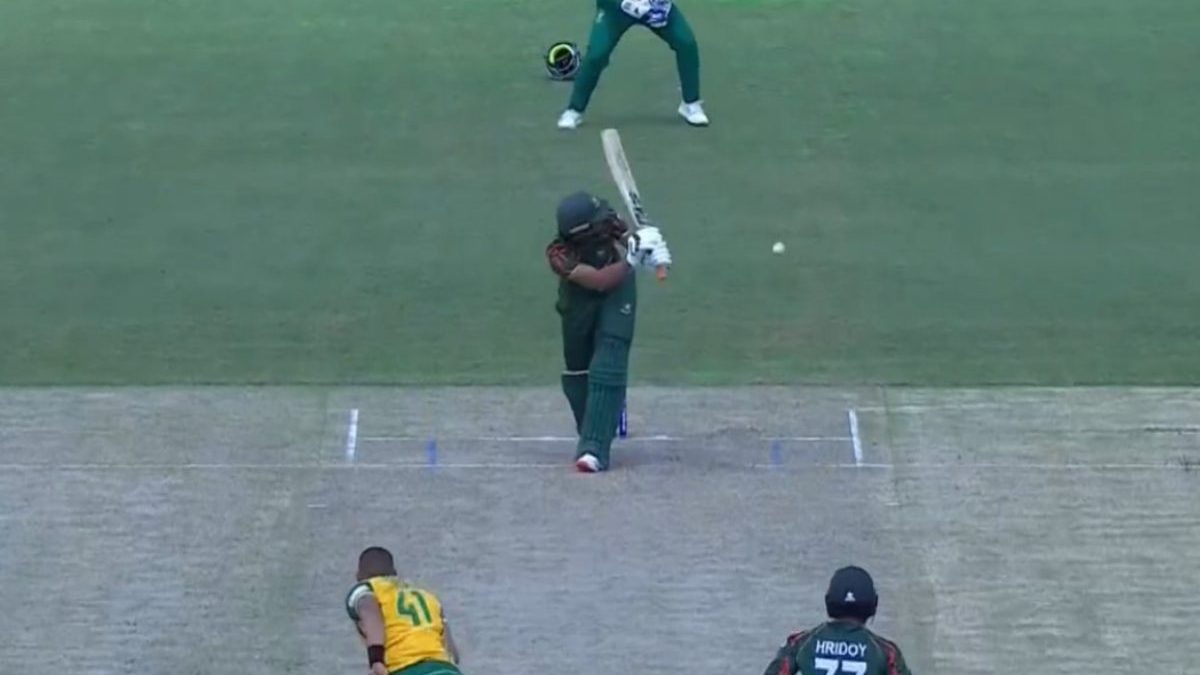
 "Bangladesh would have won against South Africa if the four leg-bye runs, which came when Mahmudullah was wrongly given out, had been counted. Image: Screenshot")
Bangladesh suffered a narrow 4-run defeat to South Africa in the T20 World Cup 2024 on Monday as the Proteas successfully defended the lowest total in the tournament history. Bangladesh were restricted to 109/7 chasing 113 but the Bangla Tigers have every right to feel they were robbed off a win. In the 17th over, an Ottneil Baartmann delivery hit Mahmudullah’s pads and went for four leg byes as South Africa appealed for LBW.
T20 World Cup 2024: News | Schedule | Results | Points Table
Umpire Sam Nogajski agreed with the Proteas and gave Mahmudullah out, however, the decision was reviewed by the Bangladesh batter and was overturned. But because Nogajski gave Mahmudullah before the ball crossed the boundary, the four leg-bye runs were not counted.
As per ICC rules, a ball is considered dead the moment a batter is given out by an umpire.
In Mahmudullah’s case, because Nogajski gave him out before the ball crossed the boundary the runs were not counted.
In the end, the difference between the two teams was four runs and the leg-bye runs could have helped Bangladesh win the match.
Impact Shorts
More ShortsThis, however, wasn’t the only controversial umpiring decision in the match. Even Towhid Hridoy’s lbw decision raised a lot of eyebrows.
Hridoy was Bangladesh’s top-scorer with 37 and was given out in the 18th over off Kagiso Rabada.
After Rabada got a ball to escape Hridoy’s bat and hit him on the pads, he made a half-hearted appeal with no fielders joining him but umpire Richard Illingworth had no doubts as he assertively gave the batter out.
The replays showed the ball would have clipped the leg stump bail (umpire’s call on hitting).
Hridoy even complained about not getting the leg-bye runs after Bangladesh’s defeat.
“To be honest that was not a good call for us in such a tight match. In my point of view, the umpire gave that out but it was pretty hard on us. Those four runs could have changed the match scenario,” Hridoy said following the game.
“The laws are not in my hands. In that time those four runs were really important. Umpires can make a call and they are human too and can make mistakes. They also didn’t give wides which were wides on a few occasions.”