

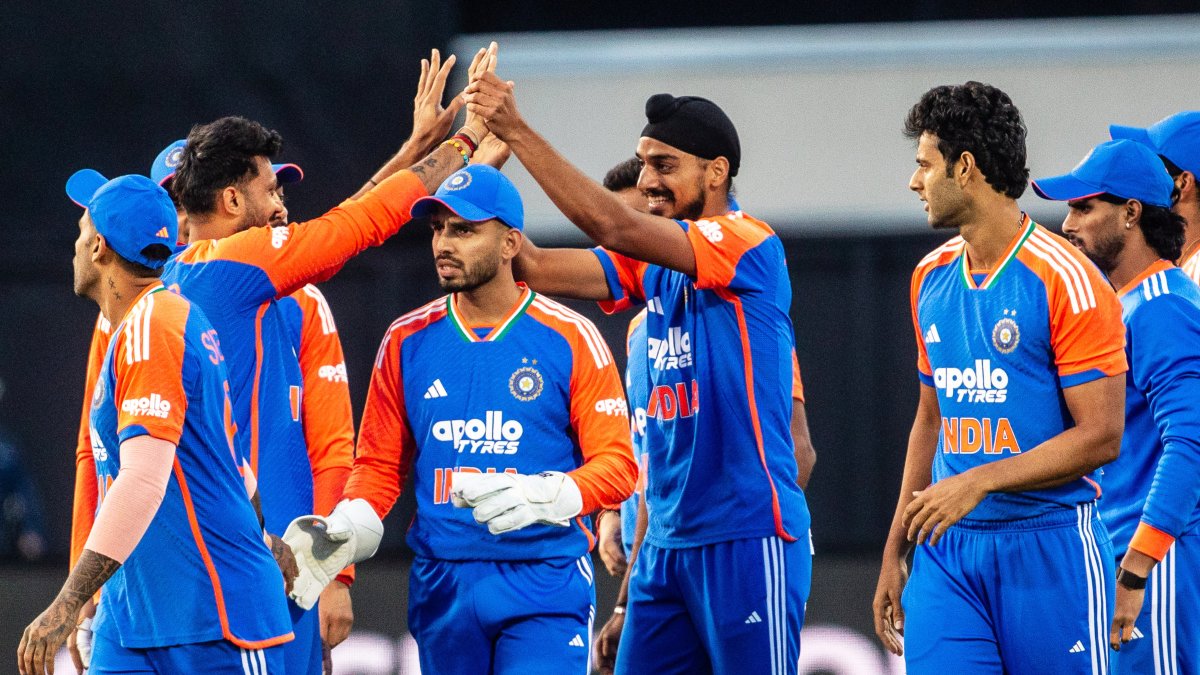
 "IND vs SA T20Is: Wicketkeeping conundrum, bowling depth and other areas Men in Blue need to focus on in series")
Becoming a world champion in any sport is not easy. Brazil have not scaled that peak in men’s senior football for 23 years now. South Africa, after countless heartbreaks, only ticked that box off in senior cricket a few months ago, and India, the most powerful and financially-rich cricketing nation, also had to endure a 13-year wait (in senior men’s cricket), up until last year.
But the only thing tougher than becoming a world champion is staying at the perch. Because world champions always have a target on their backs. They are the level others aspire to be, and to many, the example they want to follow.
India might be feeling that, right about now. They are the reigning champions in the shortest format, and in recent months, have pushed boundaries to unprecedented levels, with their propensity to attack, attack and attack refreshing and emblematic of where the game is currently headed.
All of that makes India favourites ahead of the men’s T20 World Cup in early 2026. But if India reckon that they can waltz through the pack, without breaking a sweat, well, they could not have read the brief more incorrectly.
Teams will come at them, as South Africa will over the next fortnight, and India, amidst that, will have to find a way. Not only to reaffirm their credentials and continue doing what they have been doing well, but also to smoothen out some of the rough edges that currently exist.
The wicket-keeping conundrum
None of those rough edges, at this juncture, stick out as much as their keeping conundrum. Partially because India have a plethora of talent in said department but more pertinently because it will lead to one of Jitesh Sharma or Sanju Samson being omitted.
That quandary is made trickier by the different roles Jitesh and Samson perform. Samson has played in the middle order before, but enjoys batting in the top three. India currently have Abhishek Sharma and Suryakumar Yadav/Tilak Varma there, and during the Asia Cup, they decided Shubman Gill was the right man to partner Abhishek (as opposed to Samson). Gill was also made vice-captain.
Quick Reads
View AllAnd if he is fit enough, which he reportedly is, all signs are that he will open. Which means Samson has to either bat in the middle order, where he is not as comfortable, or India need to start trusting Jitesh a little more because that is primarily the role he has fulfilled for years for Vidarbha (and for Baroda from this domestic season), and for the Punjab Kings and the Royal Challengers Bengaluru in the IPL.
Firecracker top order but finishers in danger of fizzling out?
Jitesh being deployed as a finisher could also solve a few other issues because there is no out-and-out finisher in the side otherwise. Which seems a little strange because of how much value this format places on finishers, and how often good finishers win matches from seemingly unsalvageable situations.
Rinku Singh had long been earmarked for that role but was excluded from the squad for the South Africa series. Hardik Pandya and Axar Patel can play that role, although the latter has flourished more as a floater in the IPL and in white-ball international cricket.
Hardik has performed that gig a little more frequently, but there is a school of thought that he struggles against hard length, when aimed at his body, and that he does not really fancy accessing the region behind the stumps.
Shivam Dube is another contender, but his six-hitting range is also limited, favouring hitting down the ground and predominantly to the leg-side, meaning that teams can tie him up. Oh, and most of his success at the Chennai Super Kings came when he was unleashed against spin, which he might not face a lot of at the death. Not to mention India’s top five is stacked.
Batting security versus bowling penetration and experience
If India are not as confident of their middle and lower middle order firepower, they may be prompted into having more batting security. Which will open the door for someone like Harshit Rana. Although chances are that this current regime would have persisted with him anyway.
Rana’s skill-set is very similar to Shardul Thakur, who played a lot of games for India because of the extra batting muscle he provided. That said, Rana, at this point, may be a more potent white-ball bowler than Shardul ever was, meaning there is merit in his inclusion.
But that conversation gets a little more nuanced when the pacer being left out is Arshdeep Singh, who just happens to be India’s leading wicket-taker in the format. Ever.
In a utopian scenario, India would have Arshdeep, Harshit and Jasprit Bumrah in the same attack. But with Dube and Hardik providing seam-bowling options, plus the fact that Kuldeep Yadav and Varun Chakravarthy are indispensable in the format (as is Axar due to his all-round abilities), India will have to take a tough call.
So far, Harshit has nudged himself ahead of Arshdeep. But if teams start taking down Harshit, India might have to lean towards Arshdeep again, given the latter can excel in the powerplay and at the death, thereby allowing Bumrah to be utilised as a proper trump card, rather than being asked to put out fires.
And that is why this series has perhaps come at the ideal time for India. To devise their contingency plans. To figure out what the right balance is. To evaluate the possibilities that might lie in wait. And to truly understand and arm themselves with the knowledge of what they are trying to do, and what they may have to do when teams come up with counter-measures.
India are now approaching the home straight. But like Lando Norris - after a race in which he only needed to finish on the podium to become a world champion - would testify, objects, teams and contenders are actually closer than they appear in the rear-view mirror, and that they often have an uncanny knack of sneaking up, especially if the foot is lifted off the pedal and if the circumstances are not sussed out adequately enough.
India, akin to Norris at the Yas Marina circuit in Abu Dhabi on Sunday, are the favourites. No doubt about that. But they still have to do what they need to do heading into the T20 World Cup. To ensure this aura they have created remains intact. To further the fear factor they have fashioned recently playing this bold and beautiful brand of cricket. And to ensure that they are champions at the end of it all.
Five home T20Is against South Africa, even if it will not be definitive or terminal at this stage, will help. More so because the Proteas are aiming to go one better, and do so possibly on the Indian patch and at India’s expense.
It will not be easy. Especially with all that has happened in this multi-format series already. But then again, defending a title and staying world champions rarely ever is.

 "‘Beggar thy neighbour’: The problem with cheap Chinese exports flooding the world")
 "India warns travellers to exercise 'discretion', seeks China's assurance after Arunachal woman’s ordeal")
 "Why countries are watching Australia's social media ban for children")
 "Trump's security document lands like a bucket of cold water on Europe")
 "‘Beggar thy neighbour’: The problem with cheap Chinese exports flooding the world")
 "India warns travellers to exercise 'discretion', seeks China's assurance after Arunachal woman’s ordeal")
 "Why countries are watching Australia's social media ban for children")
 "Trump's security document lands like a bucket of cold water on Europe")



