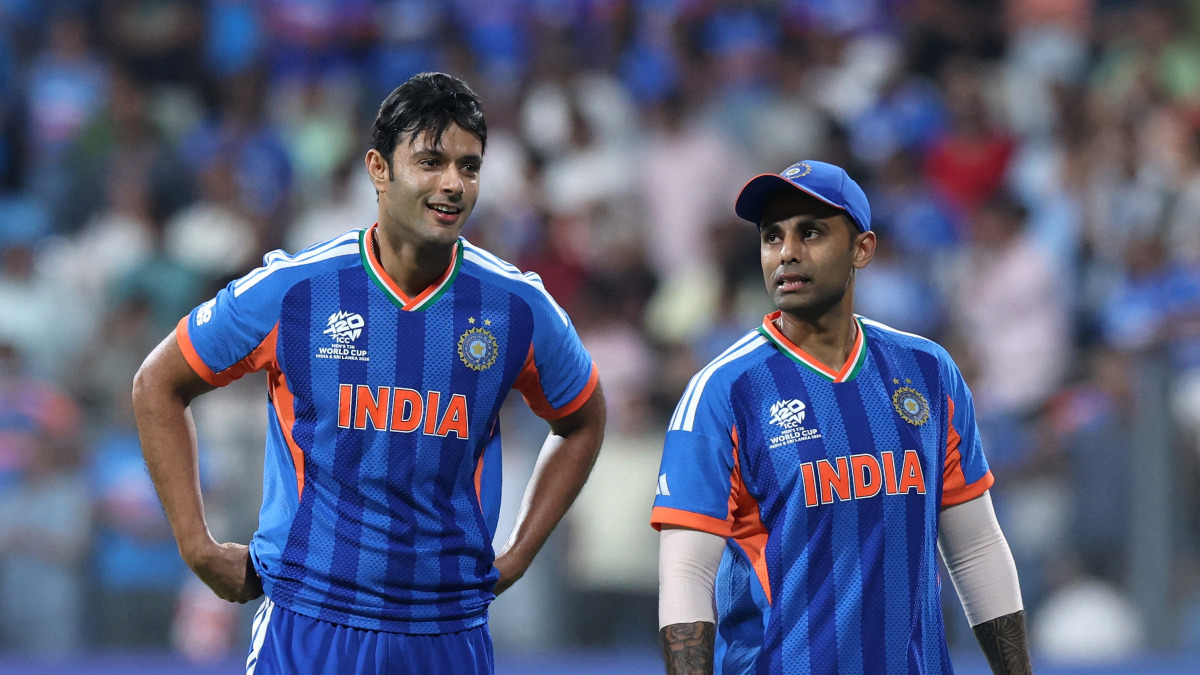
 "India captain Suryakumar Yadav handed the ball to Shivam Dube rather than Axar Patel with England needing 30 to win from the final over in their T20 World Cup semi-final in Mumbai. Reuters")
The second semi-final of the ICC T20 World Cup between India and England in Mumbai went down the wire despite the Men in Blue posting a humongous 253/7 on the board. Sanju Samson starred in an Indian victory for the second successive game, his 89 off 42 deliveries playing a key role in helping India cross 250 for the second time in this tournament.
Jasprit Bumrah and Hardik Pandya later played a key role with the ball , finishing as the only bowlers with an economy under 10, helping India reach the final of the T20 World Cup for the second consecutive time and for the fourth time in 10 editions.
Also Read | Samson dedicates Player of the Match award to Bumrah after India’s semi-final triumph
England, however, were going neck-and-neck with India for the most part of their chase, racing past the 200-mark inside 17 overs, needing another 45 to win from the last 18 deliveries to pull off the highest successful chase in T20 World Cup history.
India captain Suryakumar Yadav’s decision to bowl out Bumrah in the 16th and the 18th overs and give the crucial 19th over to Pandya worked in India’s favour, with the two seamers conceding a total of 23 runs in three overs for the loss of one wicket.
England, as a result, were left needing 30 to win from the final over with Jacob Bethell – who had picked the perfect occasion to bring up his maiden T20I century – at the crease. And Surya had two choices for the final over. Either spin-bowling all-rounder Axar Patel, who had conceded 35 runs in three overs while accounting for Tom Banton’s wicket. Or seam-bowling all-rounder Shivam Dube.
Why Surya picked Dube for the final over over Axar
And in the end, Surya decided to throw the ball towards Dube despite the fact that the right-arm seamer had a horror outing with the ball against Zimbabwe in Chennai, getting smashed for 46 runs in two overs while collecting a wicket.
And in just a space of three deliveries, Dube highlighted why he was the right choice for the final over. The Chennai Super Kings star bowled the first ball right into the blockhole for a well-set Bethell, who drilled the ball down the ground and was caught short of the striker’s end while dashing back for a second.
Quick Reads
View AllThe game was virtually done-and-dusted at that very moment. But 29 from five isn’t exactly an impossible task and Dube needed to finish the job. He did so by conceding no more than a single in each of the next two deliveries, executing his yorkers perfectly on both occasions.
With the equation down to 27 from three, all Dube had to do was to ensure he did not bowl a no-ball or concede too many wides. He did bowl a wide, and Jofra Archer did smash him for three sixes in the second half of the over, but it did not bother the Men in Blue as they managed to confirm their tickets to Ahmedabad.
Spin in death overs
This isn’t to suggest that spinners cannot bowl the crucial death overs, including the final over. Pakistan legend Saqlain Mushtaq was held back for the last five overs of an ODI at the height of his powers in the ’90s.
That said, it is a generally accepted rule in cricket that it is easier to hit a spinner for boundaries in a final over than dealing with the variations of a pacer. And the presence of the left-handed Bethell at the crease would have been an additional challenge for Axar, even if Bumrah and Pandya’s brilliance ensured he had plenty of cushion to try and seal a victory for India.
And looking back at the three overs that he had bowled today, the left-arm spinner was being put under pressure right away; Banton had struck him for back-to-back sixes in his first two deliveries of the evening while Will Jacks smashed him for a six and a four in the second and third deliveries of what proved to be his final over.
And had Bethell struck him for a six or two at the start of the 20th over, who knows how the game at the high-scoring Wankhede would have ended.