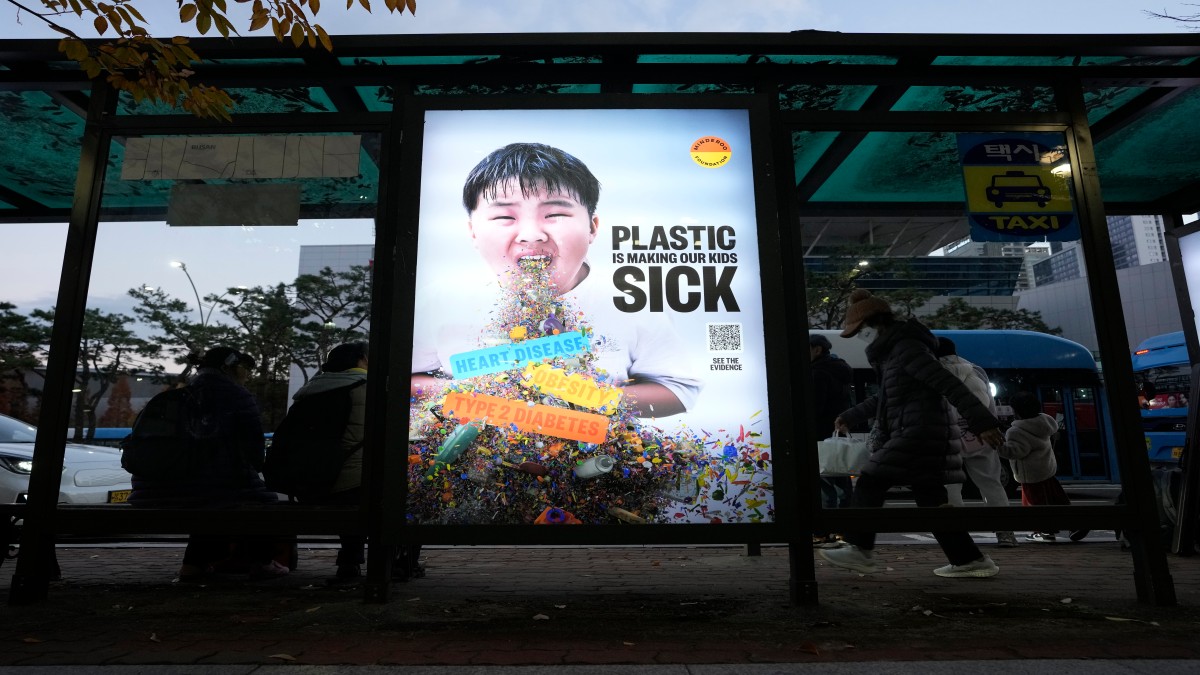
 "A display board shows a call for a reduction in plastic production during the fifth session of the Intergovernmental Negotiating Committee on Plastic Pollution, at a taxi station in Busan, South Korea. AP")
A deal to combat the global plastic pollution crisis will be finalised this weekend by countries across the world.
Several environmental groups have gathered in Busan, South Korea , where the meeting will conclude on Sunday or early Monday, to advocate for a treaty that will address the amount of production and harmful chemicals used in plastic products.
To increase pressure, Greenpeace claimed it sent four international activists to Daesan, South Korea, on Saturday. The activists boarded a tanker that was going into port to load chemicals used to create plastics.
The action, according to Graham Forbes, head of Greenpeace’s mission in Busan, is intended to remind world leaders that they have a simple decision to make: Sign a treaty that protects people and the environment, or support business and jeopardise the health of every living being and future generations.
Also read: Microplastics in human testicles: How this could affect fertility
Here’s what to know about plastics:
Global plastic production
Plastic is ubiquitous.
Globally, around 400 million tonnes of new plastic are produced each year.
The previous 30 years have seen a fourfold increase in the use of plastic.
Additionally, according to the UN, 2,000 garbage trucks’ worth of plastic are discarded into the world’s lakes, rivers, and oceans every day.
By the end of 2024, the majority of countries committed to signing the first legally binding global accord against plastic pollution, including that in the oceans.
Also read: Worried about microplastics? You should fear lead way more for your health
Too much plastic
Without improvements to laws, plastic production might increase by nearly 70 per cent by 2040.
By 2040, the UN Organisation for Economic Co-operation and Development predicts that 736 million tonnes of plastic will be produced and used worldwide.
As part of the deal, which has the backing of more than 100 nations, Panama is spearheading an initiative to combat the exponential development of plastic production.
The leader of Panama’s delegation, Juan Carlos Monterrey, stated that there is simply too much plastic.
“If we don’t have production in this treaty, it is not only going to be horribly sad, but the treaty may as well be called the greenwashing recycling treaty, not the plastics treaty,” he said in an interview. “Because the problem is not going to be fixed."
The biggest plastics players
China, the United States and Germany are the biggest plastics players.
According to the Plastics Industry Association, China was the biggest exporter of plastic products in 2023, followed by Germany and the United States.
According to the group, the three countries collectively make roughly 33 per cent of the globe’s plastics trade.
A senior member of the US delegation told The Associated Press on Saturday that the United States is in favour of including an article in the treaty that deals with the supply, or the production of plastic.
Most plastic ends up as waste
The recycling rate for plastics is less than 10 per cent.
The majority of plastic in the world gets burnt, polluted, or ends up in landfills.
According to Sarah Dunlop, the Minderoo Foundation’s head of plastics and human health, toxins are leaking out of plastics and “making us sick.”
On the sidelines of the discussions, the International Indigenous Peoples Forum on Plastics hosted a discussion on Saturday regarding the effects of plastics.
They want their rights and the universal human right to a safe, clean, healthy, and sustainable environment to be fully recognised in the treaty.
Juan Mancias, a member of the Texas Carrizo/Comecrudo Nation, talked of having a spiritual bond with the land.
“Five hundred years ago, we had clean water, clean air and there was no plastics,” he said. “What happened?”
Many plastics are used for packaging
According to the UN, packaging uses approximately 40 per cent of all plastics.
Water bottles, takeaway containers, coffee lids, straws and shopping bags are examples of single-use plastic food and beverage containers that frequently contribute to environmental pollution.
Inger Andersen, executive director of the UN Environment Programme, warned negotiators in Busan that this issue must be addressed in the treaty.
“Are there specific plastic items that we can live without, those that so often leak into the environment? Are there alternatives to these items? This is an issue we must agree on,” she said.
With inputs from The Associated Press