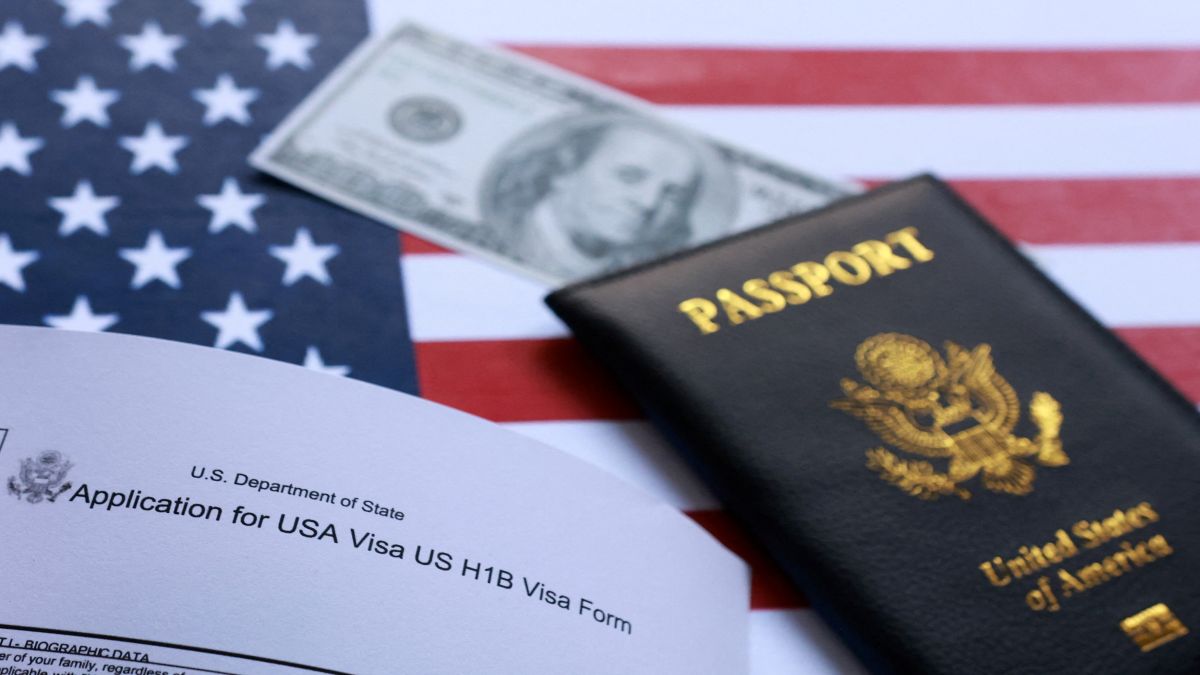
 "Amid growing Maga hate, how the Wisa Act could help H-1B visa holders in US")
In the United States, there’s a lot of hate aimed at H-1B visa holders. Supporters of MAGA (Make America Great Again) have repeatedly criticised the programme, arguing it takes jobs away from American workers.
Amid this environment, Democratic Congresswoman Bonnie Watson Coleman has introduced legislation in the US House of Representatives to undo some of the restrictions imposed by the Trump administration on H-1B visa holders.
Named the Wisa Act (Welcoming International Success Act), the bill seeks to make it easier for American companies, universities, and research institutions to hire highly skilled foreign workers by rolling back some of the tougher requirements imposed in 2025.
Here’s what we know about this legislation and its impact on H-1B visa holders.
Why has the US lawmaker introduced the Wisa Act?
On March 6, Congresswoman Bonnie Watson Coleman introduced the Wisa Act in the US House of Representatives to nullify some of the strict measures imposed on those seeking H-1B visas.
Representing New Jersey’s 12th congressional district, the Democratic lawmaker noted that the legislation would reaffirm the nation’s commitment to lawful, well-regulated immigration policies that strengthen our economy.
The US politician added, “Trump’s shortsighted proclamation has created significant barriers for US employers, universities, hospitals, and research institutions that rely on highly-skilled professionals,” said Watson Coleman. “The H-1B programme does not replace the domestic workforce; it serves as a bridge between US talent and global talent that fuels US economic growth.
“A combination of an aging workforce, Covid-related burnout, restrictions on H-1B visas, and the Trump administration’s recent limitations placed on federal student loans for nursing degrees has created a perfect storm for a nursing shortage in the coming years. The Welcoming International Success Act would ease this burden as demand for qualified healthcare professionals increases,” she was quoted as saying.
What does the Wisa Act aim to do?
As the name of the bill, the Welcoming International Success Act, suggests, the Wisa Act looks to overturn controversial restrictions placed on H-1B visa holders. The legislation seeks to rescind the September 2025 measures passed by the Trump administration on the visa programme.
Last year, US President Donald Trump introduced strict wage rules and imposed a $100,000 fee on employers sponsoring H-1B workers. At the time, the White House staff secretary Will Scharf said the H-1B non-immigrant visa programme is one of the “most abused visa” systems in the country’s current immigration system, and it is supposed to allow highly skilled labourers, who work in fields that Americans don’t work in, to come into the United States.
According to the Trump administration, the $100,000 fee would ensure that the people being brought into the country are “actually very highly skilled” and do not replace American workers. The move was aimed at protecting American workers while ensuring that companies have a pathway to hire “truly extraordinary people” and bring them to the United States.
However, the Wisa Act now seeks to reverse this policy. The Act reads, “The Proclamation entitled, ‘Restriction On Entry Of 4 Certain Nonimmigrant Workers’ and issued on September 19, 2025, shall have no force or effect and no federal funds may be obligated or expended to carry out such proclamation.”
If passed — it is in nascent stages, but has received support from other Democratic lawmakers — will make it simpler for employers to sponsor highly skilled foreign workers in fields such as technology, engineering, medicine and scientific research.
How will the proposed Wisa Act help Indians?
The Wisa Act by Bonnie Watson Coleman will come as a great boon for Indians, who use the H-1B visa programme as their entry to the US to live out the American Dream.
In 2024, Indians were a great beneficiary of the H-1B visa programme — of the 400,000 visas approved, 71 per cent of the recipients were Indians. China was a distant second at less than 12 per cent.
In 2025, too, the data reveals how Indians have gained from the H-1B visa programme. Immigration advocacy group FWD.us noted that there were as many as 730,000 H-1B visa holders living in the United States, along with an additional 550,000 dependents, including spouses and children. Of these, more than 70 per cent were from India.
This clearly shows that if passed, the Wisa legislation would benefit Indians.
How have H-1B visas been under threat in recent times?
The timing of the Wisa Act is significant. It comes at a time when the hostility toward the H-1B programme has increased drastically.
Several lawmakers have introduced legislation against the H-1B visa programme; as recently as February, a US Representative, Greg Steube proposed the Ending Exploitative Imported Labour Exemptions (Exile) Act, which aims to amend the Immigration and Nationality Act by ending the H-1B visa programme.
Earlier, Trump’s former ally, Marjorie Taylor Greene, also announced that she was introducing a bill to end “the mass replacement of American workers by aggressively phasing out the H-1B programme.”
US President Donald Trump has also overhauled the H-1B visa programme, making it more difficult to gain access to it. In September 2025, he signed a proclamation that stated that there would be a $100,000 fee for the H-1B visa. The decision triggered widespread anxiety among foreign professionals, particularly those from India, who form the largest group of H-1B holders. Moreover, he also said that the programme would now prioritise those who are higher-skilled and are paid more.
But experts note that restricting visas will only hurt the US; it will limit access to the best and brightest, resulting in fewer US jobs and weaker US companies.
With inputs from agencies

 "Iran War News Live Updates: Indian oil ministry forms panel as commercial LPG shortage hits home")
 "Trump says Iran’s Tomahawk hit school, killing 160. Does Tehran have this missile?")
 "From Saudi Arabia to Bahrain, US-Israeli war on Iran strikes at West Asia’s oil lifeline — full list")
 "Australia's Albanese announces missile deployment in UAE to bolster defences against Iran")
 "Iran War News Live Updates: Indian oil ministry forms panel as commercial LPG shortage hits home")
 "Trump says Iran’s Tomahawk hit school, killing 160. Does Tehran have this missile?")
 "From Saudi Arabia to Bahrain, US-Israeli war on Iran strikes at West Asia’s oil lifeline — full list")
 "Australia's Albanese announces missile deployment in UAE to bolster defences against Iran")