

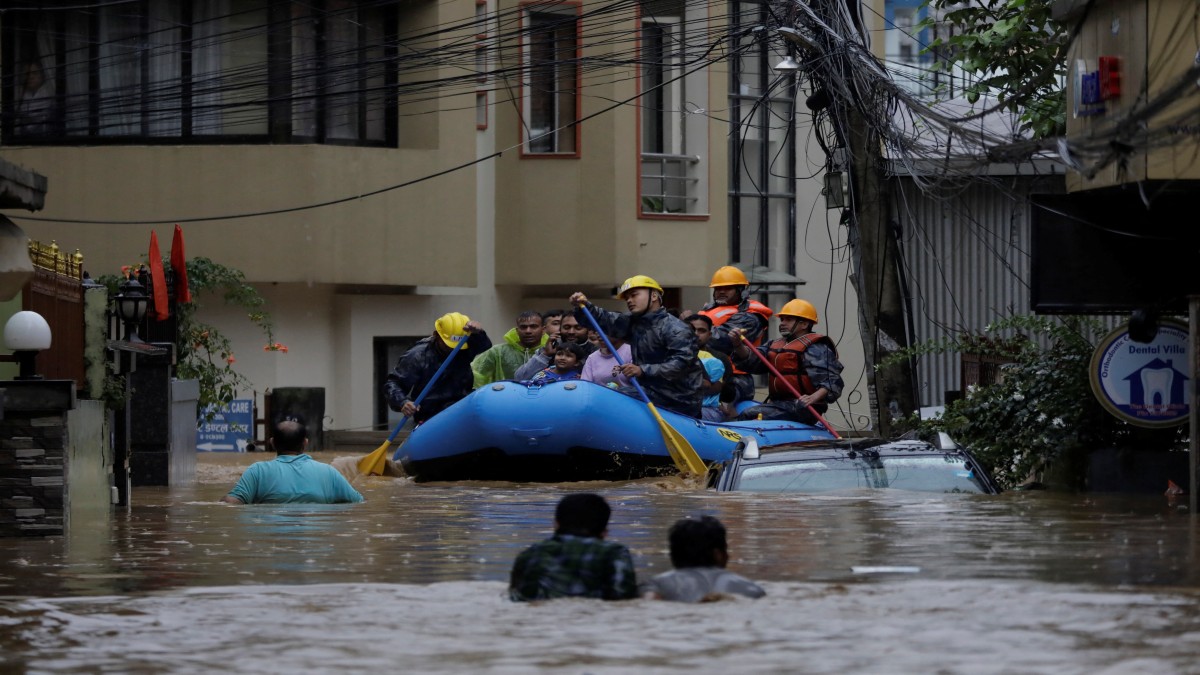
 "Nearly 200 killed, houses damaged, highways blocked: Why Nepal floods are so deadly")
The incessant rainfall from last Friday has triggered flooding and landslides, wreaking havoc in Nepal.
The number of people killed over the weekend reached nearly 200 on Monday, with at least 30 people still missing, the police say.
Life has been thrown out of gear in many parts, with many highways and road-stretches disrupted, hundreds of houses buried or swept away, and hundreds of families displaced.
Search and rescue operations are stepped up.
The death toll is rising
At least 192 people have been killed in the continuous rainfall, floods, landslides and inundation, officials from the Nepal Police said.
They said 94 others have also been injured nationwide in the disaster, while 30 others remain missing.
Kathmandu was the hardest hit by flooding, with over 34 people killed in the city.
A landslide killed three dozen people on a blocked highway about 16 kilometres from the capital. The landslide buried at least three buses and other vehicles where people were sleeping because the highway was blocked.
In Bhaktapur, which is located to the east of Kathmandu, five people, including a pregnant woman and a four-year-old girl, died when a house collapsed under a landslide, state media reported on Sunday.
Six football players were also killed by a landslide at a training centre operated by the All Nepal Football Association in Makwanpur, to the southwest of the capital.
Impact Shorts
More ShortsTrail of destruction
The rain-induced floods brought traffic and normal activity to a standstill in the Kathmandu valley.
Numerous roads throughout the Himalayan nation are severely damaged, and all routes leading to Kathmandu are still blocked, leaving thousands of travellers stranded, The Kathmandu Post reported. The three highways out of the city were blocked by landslides.
At least 322 houses and 16 bridges have been destroyed, as per PTI.
Residents in the southern part of the capital were cleaning up houses as water levels began to recede.
Kumar Tamang, who lives in a slum area by a riverbank, told AFP he and his family had to flee after midnight on Saturday as waters rushed into his shack. “This morning we returned and everything looks different,” the 40-year-old said, adding, “We couldn’t even open the doors to our house, it was jammed with mud. Yesterday we were afraid that the water would kill us, but today we have no water to clean.”
Bishnu Maya Shrestha, who lived in another inundated area of Kathmandu, told the news agency that they had to cut the roof of their homes to escape. “We jumped from one roof to another to safety and finally they came with boats to rescue us.”
The government earlier announced it was closing schools and colleges across Nepal for the next three days.
Some parts of Kathmandu reported rain of up to 322.2 millimetres, pushing the level of its main Bagmati river 2.2 metres (seven feet) past the danger mark, experts said.
The impact of the rains was aggravated by poor drainage due to unplanned settlement and urbanisation efforts, construction on floodplains, lack of areas for water retention, and encroachment on the Bagmati River, as per a statement by the International Centre for Integrated Mountain Development (ICIMOD).
Domestic flights also resumed in and out of Kathmandu by Sunday morning after having completely stopped on Friday evening, with more than 150 departures cancelled since then.
Rescue and recovery work
Improved weather has allowed rescue and recovery work to be stepped up.
Security agencies across the country have been deployed for search, rescue and relief efforts. More than 4,500 disaster-affected individuals have been rescued so far, the report said.
The lack of necessary equipment for rescue efforts has made the task difficult for the Nepal Army and Armed Police Force. They have been resorting to the use of primitive equipment like rubber boats, ropes, tubes, and shovels for rescue operations, The Kathmandu Post quoted Dijan Bhattarai, spokesperson of the National Disaster Risk Reduction and Management Authority under the Home Ministry.
Those injured are receiving free treatment, and food and other emergency relief materials have been provided to others affected.
With improved weather, workers were able to temporarily open up the key Prithvi highway, removing rocks, mud and trees that had been washed from the mountains.
The home minister also announced temporary shelters would be built for people who lost their homes. They have said monetary help would be available for the families of those killed and to the people who were injured by the flooding and landslides.
Prime Minister Khadga Prasad Oli was returning home on Monday from attending the UN General Assembly meeting and has called an emergency meeting, his office said.
Climate change
The summer monsoon brings South Asia 70-80 per cent of its annual rainfall.
While deadly rain-related floods and landslides are common across the region during this period, weather officials in the capital have blamed the rainstorms on climate change and a low-pressure system in the Bay of Bengal extending over parts of neighbouring India closer to Nepal.
Haphazard development amplifies climate change risks in Nepal, the climate scientists say.
“I’ve never before seen flooding on this scale in Kathmandu,” said Arun Bhakta Shrestha, an environmental risk official at the centre.
In a statement, the ICIMD scientists urged the government and city planners to “urgently” step up investment in, and plans for, infrastructure, such as underground stormwater and sewage systems, both of the “grey” or engineered kind, and “green” or nature-based type.
Flooding in Bangladesh
In northern Bangladesh, about 60,000 people were affected by flooding in low-lying areas because of rains and rising water from upstream India.
People have taken shelter on roads and flood protection embankments in Lalmonirhat and Kurigam districts, the English-language Daily Star reported.
The River Teesta that crosses the border was overflowing at some points and the Dharala and Dudhkumar rivers in the Rangpur region were rising but remained below danger levels, the Dhaka-based Flood Forecasting and Warning Centre said Monday.
Waters could start receding in a day or two, it said.
Bangladesh is a low-lying delta nation crisscrossed by about 230 rivers, including more than 50 that cross borders.
With inputs from agencies

 "Russian drones over Poland: Trump’s tepid reaction a wake-up call for Nato?")
 "As Russia pushes east, Ukraine faces mounting pressure to defend its heartland")
 "Why Mossad was not on board with Israel’s strike on Hamas in Qatar")
 "Turkey: Erdogan's police arrest opposition mayor Hasan Mutlu, dozens officials in corruption probe")
 "Russian drones over Poland: Trump’s tepid reaction a wake-up call for Nato?")
 "As Russia pushes east, Ukraine faces mounting pressure to defend its heartland")
 "Why Mossad was not on board with Israel’s strike on Hamas in Qatar")
 "Turkey: Erdogan's police arrest opposition mayor Hasan Mutlu, dozens officials in corruption probe")



