

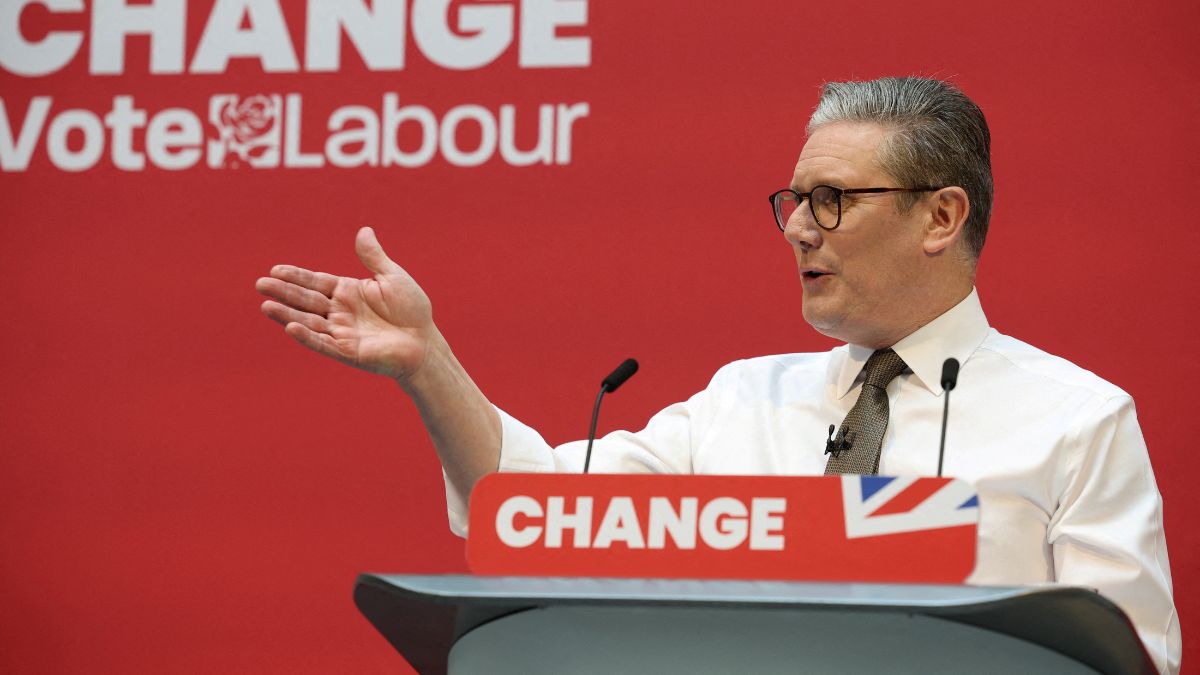
 "Why going to private schools in the UK will cost more if Keir Starmer's Labour wins")
The cost of attending private schools in the UK may increase significantly if the Labour Party wins the upcoming general election on 4 July.
Private schools, also known as independent schools in the UK, charge fees for most of their students. While elite institutions like Eton and Harrow charge around £50,000 per year, the average fee across the UK is approximately £15,000.
Private schools are currently exempt from charging value-added tax (VAT) on their fees due to a legal exemption for educational organisations. Additionally, about half of England’s private schools benefit from an 80 per cent reduction in business rates because of their charitable status.
What does Labour party’s manifesto say?
Labour’s manifesto pledges to end these exemptions and business rate reliefs for private schools, though it does not plan to remove their charitable status. The Institute for Fiscal Studies (IFS) think tank estimates that these measures would raise about £1.6 billion annually, with around £1.3-1.5 billion available for state school funding after accounting for children transitioning from private to state education.
Labour leader Sir Keir Starmer has clarified that children with legally-binding education health care plans (EHCPs) who attend fee-paying schools due to a lack of provision in the state sector would be exempt from the VAT increase.
However, concerns remain for other special educational needs (SEND) children without EHCPs who are currently taught in private schools. Former UK Conservative education minister Claire Coutinho criticised Labour for having “no plans” for these children, reported BBC.
How will this impact private schools?
The removal of the VAT exemption is expected to lead to an increase in private school fees, though not necessarily by the full 20 per cent VAT rate. The IFS suggests that the effective VAT rate for private schools would be closer to 15 per cent, as schools would be able to deduct VAT on their purchases of goods and services for the first time.
Impact Shorts
More ShortsThe average cost of private school fees has already risen by 20 per cent in real terms since 2010, and by 55 per cent since 2003, without VAT. This historical trend suggests that private school attendance might not drop significantly despite fee increases. However, the IFS projects a potential 3-7 per cent decline in attendance, equating to 20,000 to 40,000 pupils.
The Independent Schools Council (ISC), representing over 1,400 private schools, warns that Labour’s policy could lead to the closure of smaller institutions operating on tight margins.
They argue that the policy may make private schools “more exclusive” by reducing the number of fee-reducing bursaries. Julie Robinson, CEO of the ISC, emphasised the financial challenges, in a statement, said, “What we think will happen as a result is unfortunately tens of thousands of children will be displaced. They’ll have to seek another school, and on the whole, they’ll be going into the state system.”
Where did Starmer and Sunak go to school?
Starmer attended a voluntary-aided selective grammar school during his teenage years. This school transitioned into an independent fee-paying institution in 1976 while he was still a student. Starmer was exempt from paying fees until he turned 16 and then received a bursary from the school’s charitable foundation for his sixth-form studies, reported UK’s Standard.
Also Read: Who is Keir Starmer, the man standing between Rishi Sunak and 10 Downing Street?
Sunak attended the private boarding school Winchester College as a day student, eventually becoming the head boy of the college.
How have other political parties reacted?
Labour’s plan has garnered mixed reactions. Conservative leader and incumbent UK PM Rishi Sunak opposes the policy, arguing it penalises aspirational parents. “People who work hard and aspire to provide that education for their kids should have that freedom,” Sunak said. He labelled the policy a “class war” aimed at punishing aspirational parents.
Lib Dem leader Ed Davey has also expressed opposition, stating he has “never thought in principle that VAT should be applied to education.”
Reform UK advocates for maintaining tax relief for private schools to ease pressure on state schools.
The Green Party, on the other hand, supports removing private schools’ charitable status.
How has Labour justified this move?
Labour justifies its policy by highlighting the need to improve state education. Shadow Education Secretary Bridget Phillipson said, “Labour will invest in delivering a brilliant state education for children in every state school by recruiting over 6,500 new teachers, funded by ending tax breaks for private schools.”
Starmer highlighted the urgency of addressing teacher shortages in state schools, stating, “Let’s take maths: too many students are being taught maths by sports teachers, by supply teachers, and that’s not acceptable.”
Labour insiders have clarified that the proposed VAT changes would not take effect until September 2025 at the earliest, assuming Labour wins the general election.
Shadow Chancellor Rachel Reeves confirmed this timing, noting that independent forecasters require a ten-week notice before the budget’s formal introduction in Parliament. This delay aims to provide parents and schools with time to adjust.
How will this move affect state schools?
The IFS research indicates that the state sector could accommodate extra pupils resulting from a decline in private school attendance.
Overall pupil numbers in state schools are projected to fall by 700,000 by 2030, exceeding the total number of children currently attending private schools. However, this decline is not uniform across regions, and some state schools may face pressure on class sizes.
State schools are already grappling with a crisis in teacher recruitment and retention, driven by concerns over pay and workload. The National Foundation for Educational Research has highlighted significant shortfalls in teacher recruitment targets. Labour’s plan to recruit 6,500 new teachers aims to address these shortages, particularly in subjects with the most critical needs.
The IFS estimates that accommodating additional pupils from private schools will cost the public purse up to £300 million annually. Despite this financial strain, some experts believe state schools may welcome the influx due to the projected decline in overall pupil numbers.
Luke Sibieta, a research fellow at the IFS, stated, “People moving from the private sector to the state sector clearly causes a demand on the state sector. We don’t think it’ll be huge, though. Adding VAT would probably have a relatively small impact.”
While the policy has sparked significant debate, its long-term impact on private school attendance and the state education system remains uncertain.
A UK YouGov poll suggested that Labour could win with a 200-seat parliamentary majority, the largest for any party in a century. Another poll indicated that Sunak might become the first British prime minister to lose his own seat in a national election.
With inputs from agencies

 "Russian drones over Poland: Trump’s tepid reaction a wake-up call for Nato?")
 "As Russia pushes east, Ukraine faces mounting pressure to defend its heartland")
 "Why Mossad was not on board with Israel’s strike on Hamas in Qatar")
 "Turkey: Erdogan's police arrest opposition mayor Hasan Mutlu, dozens officials in corruption probe")
 "Russian drones over Poland: Trump’s tepid reaction a wake-up call for Nato?")
 "As Russia pushes east, Ukraine faces mounting pressure to defend its heartland")
 "Why Mossad was not on board with Israel’s strike on Hamas in Qatar")
 "Turkey: Erdogan's police arrest opposition mayor Hasan Mutlu, dozens officials in corruption probe")



