

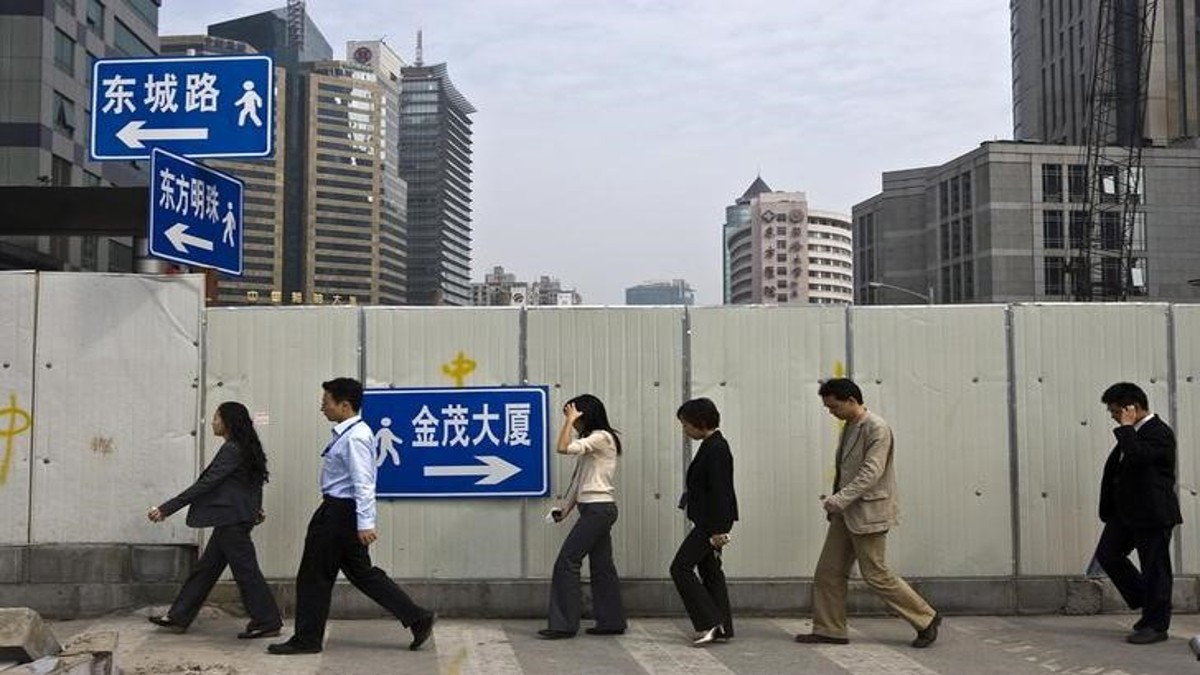
 "Why bosses in China could be penalised for ‘invisible overtime’")
Replying to endless texts about a new project or answering a phone call after leaving work, work is slowly seeking into people’s personal lives, especially since remote work became more convenient in the wake of the COVID-19 pandemic.
In order to protect the workers from such “invisible overtime,” neighbouring China is considering offering legal protection to employees forced to stay online even after work hours.
This development comes after Lyu Guoquan, head of the general office of China’s trade union federation, recommended the Chinese People’s Political Consultative Conference (CPPCC) last week that guidelines and a legal framework be made for “working overtime online.”
Let’s take a closer look.
‘The right to disconnect’
The right to disconnect is defined as “a worker’s right to be able to disengage from work and refrain from engaging in work-related electronic communications, such as emails or other messages, during non-work hours," according to the European Union (EU).
“Digital information technology in the internet era … has blurred the ‘boundaries’ between work and life, making invisible overtime increasingly normalised as ‘unpaid overtime’,” Lyu, who is also a member of the Political Bureau of the Communist Party of China (CPC) Central Committee said, according to the state-owned Workers’ Daily newspaper on Tuesday.
“The state of being ‘always online’ has left workers ‘trapped in the work system’, adversely affecting their physical and mental well-being,” he added.
According to South China Morning Post, he recommended putting limitations on hours for jobs that depend on online platforms and have variable schedules and heavy workloads, as well as amending standard working hours to explicitly identify online overtime and compensation.
Impact Shorts
More ShortsAccording to Lyu, the government should also strengthen supervision, penalise companies who engage in “invisible overtime,” and enhance the system that allows employees to safeguard their rights against arbitrary and unpaid overtime.
China’s labour rules provide that an employee should not work more than eight hours a day, or forty hours a week, on average.
Companies may decide to extend working hours, usually for no more than an hour a day, in response to production and business needs; however, overtime must be compensated.
He said that a number of governmental organisations and political advisory groups had approved the plan.
The top court supports the proposal
The matter, according to SCMP, was raised by the president of the Supreme People’s Court on 8 March, who talked about rewarding employees for the “invisible overtime” in his work report to the National People’s Congress, China’s rubberstamp parliament.
As per Bangkok Post, Chief Justice Zhang Jun told the NPC a person was considered to be working overtime if they “contributed substantive labour” to tasks that “evidently consume time” – a definition that included staying online.
“The standards guarantee that online (overtime) work is rewarded and offline rest is protected,” he said.
Various discussions in the past
This isn’t the first time, “invisible overtime” is being discussed.
Chinese courts in the recent years have addressed numerous cases related to overtime payments.
The Supreme Court highlighted one such case as exemplary for other judicial bodies to follow.
According to the report, case involved a director of a short video team, named Li, who sued their employer for unpaid overtime after being terminated in 2020. Initially, a lower court ruled that the time Li spent on WeChat for work-related communication during off-duty hours should be considered while calculating overtime compensation. However, the top court pointed out that quantifying such scattered time was challenging.
Lou Yu, director of the Social Law Institute at China University of Political Science and Law, expressed the likelihood of regulations being established to govern online overtime labour. “This is a very prominent labour and employment issue at present, and (the proposal) was recognised by different sectors,” he said, as per Bangkok Post.
He, however, noted that it will take at least two years to formulate a ministry-level regulation and “even longer” for a law under the State Council, the Chinese cabinet.
A norm in China
Invisible overtime has become a global phenomenon.
According to the Global Times, in December 2023, a woman from Southwest China’s Sichuan Province reportedly spent three hours and a half leaving over 600 WeChat work groups after she quit her job.
Her story ignited massive discussions on social media, with many commenting due to messages alert on work groups and calls anytime, they felt scared whenever their phones buzzed.
As per the 2023 survey by dtcj.com, over 90 per cent employees had invisible overtime, including 60 per cent who experienced it frequently.
The top three practices included responding to work messages after logging out, participating in training or competitions the company organised and standing by at any time despite without any task assigned.
The poll suggests over 73 per cent of people said they worked overtime to finish their workload.
Situation in other countries
With advanced technology, worldwide businesses are grappling with the rise of flexible work.
To battle this, many countries are tightening how much bosses can contact employees out of working hours.
In the United Kingdom, about 3.8 million people did unpaid overtime last year, putting in an average of 7.2 unpaid hours a week, as per the TUC survey published on 23 February. The poll estimates that was equivalent to £7,200 a year of wages going unpaid.
The High Court in Singapore heard a case involving a worker who requested overtime compensation over the legally-mandated threshold but was not reimbursed. The court determined that the Employment Act does not preclude an employee from seeking compensation for overtime hours surpassing the stipulated limit, according to HCAMAG.com.
Australia, is mulling over the planned legislation, known as the “right to disconnect,” which aims to limit the amount of unpaid overtime for staff. According to the country’s Centre for Future Work data, on average, workers do 5.4 hours of unpaid work each week – or 280 hours of unpaid overtime a year.
The country is taking cue from Belgium and other European countries, which introduced measures in 2022 to prohibit bosses from contacting workers outside of working hours.
According to the World Economic Forum, Belgium granted around 65,000 public sector employees like “the right to disconnect” to promote a better work-life balance, with restrictions on contacting employees beyond designated hours.
In 2016, France implemented the same policy, followed by Italy in 2017, Spain in 2018, and Ireland in 2021, as per India Times.
While Europe has taken significant steps to address such work-related issues, the US, the UK, and even India are still lagging behind.
With inputs from agencies

 "Russian drones over Poland: Trump’s tepid reaction a wake-up call for Nato?")
 "As Russia pushes east, Ukraine faces mounting pressure to defend its heartland")
 "Why Mossad was not on board with Israel’s strike on Hamas in Qatar")
 "Turkey: Erdogan's police arrest opposition mayor Hasan Mutlu, dozens officials in corruption probe")
 "Russian drones over Poland: Trump’s tepid reaction a wake-up call for Nato?")
 "As Russia pushes east, Ukraine faces mounting pressure to defend its heartland")
 "Why Mossad was not on board with Israel’s strike on Hamas in Qatar")
 "Turkey: Erdogan's police arrest opposition mayor Hasan Mutlu, dozens officials in corruption probe")



