

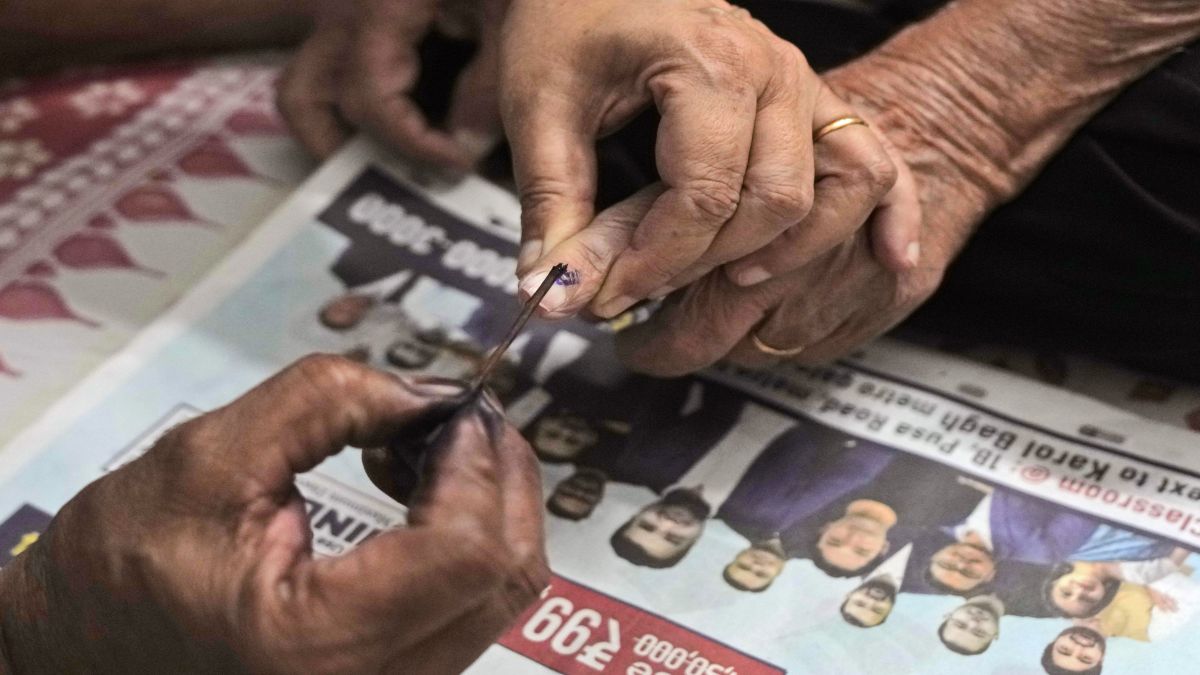
 "Why are exit polls released after all votes are cast? Why are they relevant?")
The Election Commission has ordered that no exit polls be conducted prior to 6.30 pm on 1 June. The seventh and final phase of the Lok Sabha polls is underway with 57 parliamentary constituencies set to cast their vote across eight states and union territories.
The counting for the Lok Sabha Elections 2024 will take place on 4 June.
But what do we know about exit polls? What is their history? Why are they relevant? And what about their rules?
Let’s take a closer look:
What are they?
Exit polls are essentially quick interviews with voters.
They are usually conducted right after voters exit the polls on voting day – as opposed to opinion polls which are conducted beforehand.
The idea behind them is to offer a snapshot of the voters’ concerns. They are aimed at predicting which party is likely to come to power.
Several news channels and agencies in India conduct exit polls – with varying degrees of success.
As per Business Standard, their accuracy depends on a slew of factors including structured questionnaires, in-person or telephonic interviews of random people for fairness, sample size, demographic representation, data compilation, and count method.
The first exit poll was conducted in 1957 by the Indian Institute of Public Opinion.
Impact Shorts
More ShortsThe group conducted an exit poll during the second Lok Sabha elections.
As per Hindustan Times, it was the Delhi-based Centre for the Study of Developing Societies (CSDS) that pioneered in the 1960s.
But it was another two decades before exit polls began being taken seriously in the media.
This is when psephologist Prannoy Roy teamed up with David Butler.
Roy, Butler and Ashok Lahiri would go on to publish a landmark book The Compendium of Indian Elections.
State-run Doordarshan asking the CSDS to conduct a countrywide exit poll in 1996 also brought exit polls further into the mainstream.
“Without a structured questionnaire, the data can neither be collected coherently nor be analysed systematically to arrive at vote share estimates,” Indian Express quoted Centre for the Study of Developing Societies (CSDS) director Sanjay Kumar as saying.
What are the rules for exit polls?
Exit polls are governed by The Representation of People Act, 1951.
Section 126 A of the act restricts publication and dissemination of exit polls results.
It states, “No person shall conduct any exit poll and publish or publicise by means of the print or electronic media or disseminate in any other manner, whatsoever, the result of any exit poll during such period, as may be notified by the Election Commission in this regard.”
It adds that in case of a general election, the period may commence from the beginning of the hours fixed for the poll on the first day and continue till half an hour after the closing of the poll in all the States and Union territories.
According to Business Standard, this is done so that exit polls don’t influence voters or voting patterns.
Those who violate this provision can be sentenced to a prison term of up to two years, a fine or both.
The Election Commission first issued guidelines on exit polls in 1998. The EC under Article 324 of the Constitution barred newspapers and television news channels from publishing or broadcasting results of opinion and exit polls between 5 pm on 14 February 1998 and 5 pm on 7 March 1998. The first phase in that year’s general elections began on 16 February 1998, and the final phase began on 7 March.
As per Economic Times, the EC in 2022 said news broadcasters must not air any final, formal and definite results “until such results are formally announced by the Election Commission of India, unless such results are carried with clear disclaimer that they are unofficial or incomplete or partial results or projections which should not be taken as final results.”
Why are exit polls relevant?
Because people want to know which party and candidates are likely to win – and quickly.
However, critics say that they are often left wanting when it comes to accuracy.
According to Business Standard, exit polls are also often condemned for being biased, relying on skewed data or improper sample size, and being sponsored or politically motivated.
The Economic Times quoted TK Arun as saying, “Exit polls are tricky in India. Indians are prudent people. Why would they tell a pollster anything other than what they figure out the pollster wants to hear? Suppose he voted Congress, and says so to the pollster, the BJP wins the election and extracts from pollsters details of all those who said they voted Congress, what mayhem might not follow? Why take the risk? Indians can be rational when the issue at stake is lack of faith as well.”
In the past, exit polls have had both hits and misses galore.
According to Hindustan Times, except for the 1998 and 2014 polls, at least four Lok Sabha polls have gotten it badly wrong.
This includes two back-to-back predictions in 2004 and 2009.
The 2004 exit polls in particular were a massive failure with the pollsters completely missing the Congress coming back to power as the Atal Bihari Vajpayee-led NDA with its ‘India Shining’ slogan lost its majority.
All exit polls predicted a win for the BJP.
Again in 2009, while most pollsters gave the edge to the UPA, they completely missed a huge swing in its favour.
The UPA added 40 more seats to its tally.
In 2014, the BJP won over 330 seats.
While most pollsters said then prime ministerial candidate Narendra Modi and the BJP-led NDA would cross the 272 mark, almost none of them forecast the decisive performance.
It was only pollster Chanakya, who predicted 340 seats for the NDA, that came close to getting it spot on.
In 2019, most pollsters predicted that the Bharatiya Janata Party-led NDA government would return – albeit with a reduced margin compared to the previous election. Of course, we know that the pollsters yet again underestimated the strength of the BJP-led NDA, which would nab 353 seats.
With inputs from agencies

 "Russian drones over Poland: Trump’s tepid reaction a wake-up call for Nato?")
 "As Russia pushes east, Ukraine faces mounting pressure to defend its heartland")
 "Why Mossad was not on board with Israel’s strike on Hamas in Qatar")
 "Turkey: Erdogan's police arrest opposition mayor Hasan Mutlu, dozens officials in corruption probe")
 "Russian drones over Poland: Trump’s tepid reaction a wake-up call for Nato?")
 "As Russia pushes east, Ukraine faces mounting pressure to defend its heartland")
 "Why Mossad was not on board with Israel’s strike on Hamas in Qatar")
 "Turkey: Erdogan's police arrest opposition mayor Hasan Mutlu, dozens officials in corruption probe")



