

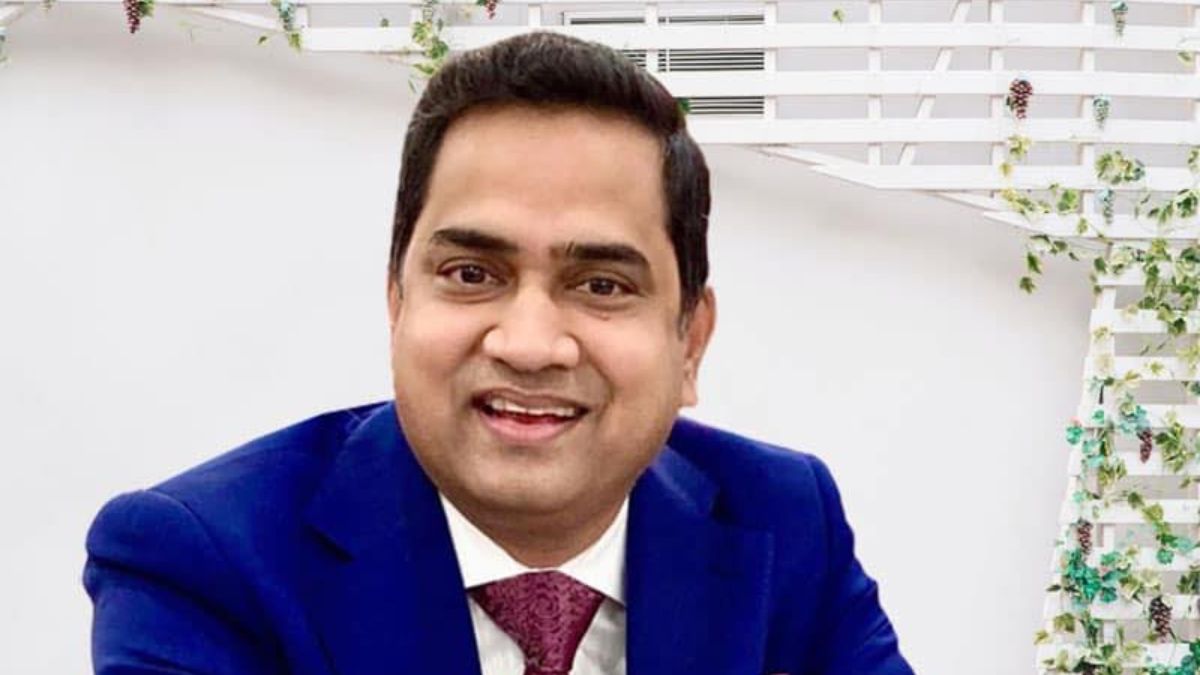
 "Who is Mushfiqul Fazal Ansarey, the 'anti-India' Bangladesh envoy appointed by Muhammad Yunus govt")
Mushfiqul Fazal Ansarey, a journalist and political activist based in the United States, has recently been appointed as an ambassador by Bangladesh’s interim government.
Known for his outspoken criticism of former Prime Minister Sheikh Hasina and his alleged anti-India stance, Ansarey’s appointment has drawn significant attention and raised questions about the motivations behind this move.
Who is Mushfiqul Fazal Ansarey?
After spending nearly a decade in self-imposed exile, Mushfiqul Fazal Ansarey returned to Bangladesh on September 12, 2024. His return followed the ousting of Sheikh Hasina’s government, and soon after, he was appointed to a senior diplomatic position with the rank and privileges of a senior secretary.
His new three-year contract grants him a prominent role in Bangladesh’s foreign diplomatic missions, although the specific country to which he will be posted remains undisclosed as of now.
The Bangladeshi Ministry of Public Administration issued a notification on Ansarey’s appointment, which stated that he must relinquish any other professional or business commitments.
Is Mushfiqul Fazal Ansarey politically connected?
Ansarey’s ties to Bangladesh’s political landscape run deep. From 2001 to 2006, he served as the assistant press secretary to then-Prime Minister Khaleda Zia, a key figure in the Bangladesh Nationalist Party (BNP).
His media career further bolstered his profile, with roles as an anchor for Bangladesh Television (BTV) and as a reporter for The Daily Ittefaq. He also gained visibility through his program ‘Hello Excellency’ on ntv, where he interviewed foreign diplomats.
Ansarey has held various positions in Washington, DC, including as executive editor of the foreign policy magazine South Asia Perspectives and as a White House correspondent for JustNewsBD, an online news platform.
His work in the US frequently involved raising concerns about human rights violations and political corruption in Bangladesh under Sheikh Hasina’s government, often questioning officials at US State Department and United Nations briefings.
Why is Mushfiqul Fazal Ansarey seen as an anti-India figure?
Ansarey has earned a reputation for his provocative questioning during press briefings, especially concerning the Indian government’s involvement in Bangladesh’s internal affairs.
In March 2024, during a press briefing with US State Department spokesperson Matthew Miller, Ansarey raised the issue of Arvind Kejriwal’s arrest and the freezing of the Congress party’s bank accounts, which caused a diplomatic stir.
The Indian Ministry of External Affairs responded by summoning Gloria Berbena, the Deputy Chief of Mission at the US Embassy in India, to lodge a protest over Ansarey’s statements.
Also Watch:
Ansarey also brought attention to allegations of a systematic crackdown on opposition parties in India in the lead-up to the 2024 general elections. He pressed Stéphane Dujarric, the spokesperson for the UN Secretary-General, for a response on this issue, further straining diplomatic relations.
In 2015, Bangladesh’s UN mission objected to him attending events as a journalist, citing his active political affiliations. This led to objections from the mission’s press secretary, who alluded to “active politicians” being given press cards — a veiled reference to Ansarey’s work in both journalism and politics.
In one of his most controversial moments earlier this year, Ansarey falsely attributed a remark to Bangladesh’s Foreign Minister during a press briefing, suggesting Indian interference in the country’s elections. Despite this, he continues to command attention both in the media and within diplomatic circles.
In a post on X (formerly Twitter) on October 9, Ansarey summed up a response from a US State Department spokesperson Matthew Miller, writing: “… Bangladesh issues often come up in meetings with Indian officials, as former dictator Hasina is in India and allegedly trying to destabilise Bangladesh.”
The U.S. will continue working with Bangladesh’s interim government @ChiefAdviserGoB and Bangladesh issues often come up in meetings with Indian officials, as former dictator Hasina is in #India and allegedly trying to destabilize #Bangladesh. #WATCH | This is how the… pic.twitter.com/Gfn4L6awdH
— Amb. Mushfiqul Fazal (Ansarey) (@MushfiqulFazal) October 8, 2024
His critics, particularly from within Bangladesh, have accused him of exaggerating claims to suit a political agenda. Bangladesh’s former foreign minister Hasan Mahmud once alleged that Ansarey was “paid by the BNP,” accusing him of framing his questions to deliberately target the Hasina-led government.
In 2022, Ansarey faced legal challenges in Bangladesh, with charges filed against him and two others under the controversial Digital Security Act for “tarnishing the image of the state.”
Is Ansarey’s appointment a reward for his work?
Many see Ansarey’s appointment as a diplomatic envoy by the Muhammad Yunus-led interim government as a reward for his years of vocal opposition to the Awami League.
Ansarey had been a vocal critic of Sheikh Hasina’s leadership, often using his platform in Washington to challenge the regime on issues of political repression and human rights violations.
Asked about what he expected from a BNP government, Ansarey diplomatically distanced himself, telling reporters at the time, “I cannot speak for the BNP since I do not represent them.”
Also Watch:
Nonetheless, his close association with the BNP leadership, including his previous work for Khaleda Zia, has led many to see him as aligned with their political interests.
Interestingly, Ansarey had previously been part of a government delegation that delivered a letter from Khaleda Zia to Muhammad Yunus in 2006, congratulating him on winning the Nobel Peace Prize.
With inputs from agencies

 "Russian drones over Poland: Trump’s tepid reaction a wake-up call for Nato?")
 "As Russia pushes east, Ukraine faces mounting pressure to defend its heartland")
 "Why Mossad was not on board with Israel’s strike on Hamas in Qatar")
 "Turkey: Erdogan's police arrest opposition mayor Hasan Mutlu, dozens officials in corruption probe")
 "Russian drones over Poland: Trump’s tepid reaction a wake-up call for Nato?")
 "As Russia pushes east, Ukraine faces mounting pressure to defend its heartland")
 "Why Mossad was not on board with Israel’s strike on Hamas in Qatar")
 "Turkey: Erdogan's police arrest opposition mayor Hasan Mutlu, dozens officials in corruption probe")



