

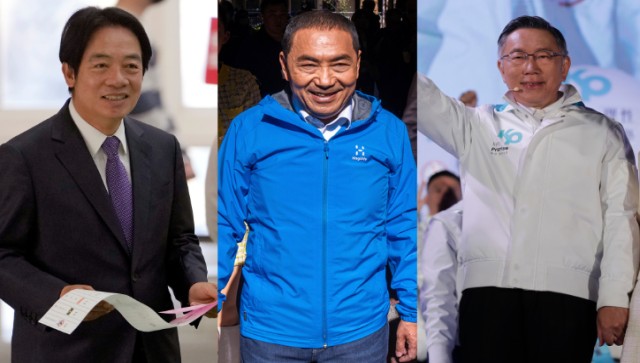
 "Who are the three men in the race to become Taiwan president?")
Today’s presidential election in Taiwan will not only decide the country’s democratic fate but also act as a major flashpoint in the ongoing tensions between China and the United States. Beijing has dubbed the Saturday’s election as a contest between war and peace. Located approximately 160 kilometres (100 miles) off its east coast, the self-governing island is seen by China as a breakaway province. If needed, the Chinese government has threatened to claim the island. All eyes are on the Taiwanese election due to the possibility of escalating military tensions across the Taiwan Strait. In addition to the threat posed by Beijing, voters’ concerns at home are more practical, ranging from the weak economy to high housing costs. Here are the three candidates for the presidential election: Lai Ching-te Lai Ching-te, also known as William, is the vice president of the Democratic Progressive Party of Taiwan. The party opposes China’s claims to sovereignty over the island. Years ago, the 64-year-old defined himself as a “pragmatic worker for Taiwan independence,” attracting criticism from Beijing. Taiwanese leaders’ declarations of independence are met with resistance from China, which also opposes Taipei’s official diplomatic relations with other nations. Talks between Taiwanese President Tsai Ing-wen and Lai have been repeatedly turned down by Beijing. Lai says he is still willing to communicate with China without giving up Taiwan’s independence. [caption id=“attachment_13608432” align=“alignnone” width=“640”] Lai Ching-te, also known as William, is the vice president of the Democratic Progressive Party of Taiwan. AP[/caption] “As long as there is equality and dignity on both sides of the Taiwan Strait, Taiwan’s door will always be open,” he said in December. Lai is a physician who attended Harvard University to study public health. Over the past 25 years, he has served in public office as a legislator and mayor of Tainan, a city in southern Taiwan. Under his and Tsai’s leadership, Taiwan boosted its arms purchases from the US, which is required by its law to give the island the weapons it needs to defend itself. Lai has promised to carry on Tsai’s policy plan and boost the economy and national defence if elected president. Bi-khim Hsiao, a former US diplomat, is his running partner. Hou Yu-ih Hou Yu-ih is the candidate from Taiwan’s main opposition party Kuomintang, or KMT, whose government retreated to the island in 1949 after losing a civil war against the Chinese Communist Party. Though it strongly rejects being pro-Beijing, the KMT is often softer towards China than the DPP. The party has always supported unification with China, but in recent years it has changed its position to reflect the overwhelming need of the population to preserve the status quo. Before entering politics in 2010, Hou was the head of the island’s police force. The 66-year-old took a leave of absence from his role as mayor of New Taipei to pursue a presidential campaign. [caption id=“attachment_13608442” align=“alignnone” width=“640”]
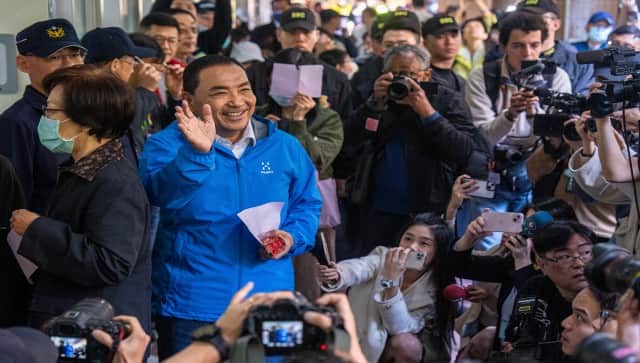 Hou Yu-ih is the candidate from Taiwan’s main opposition party Kuomintang, or KMT, whose government retreated to the island in 1949 after losing a civil war against the Chinese Communist Party. AP[/caption] Hou has described himself as an atypical KMT member and said he would not pursue unification with China if elected. He said that the people of Taiwan must decide on its destiny. As part of his “3D strategy,” which stands for deterrence, dialogue, and de-escalation, Hou has promised to bolster national defence and reopen talks with Beijing, initially through contacts with civil society and culture. He claims that he has a better chance of persuading China to hold negotiations than Lai, who he believes is driving Taiwan into conflict. Jaw Shau-kong, a TV commentator and former legislator, is Hou’s running mate. Ko Wen-je Ko Wen-je, the third presidential contender, is the founder of the tiny Taiwan People’s Party, established in 2019. An outspoken surgeon-turned-politician, Ko advocates for a middle road in relations with Beijing. Though he has stated that he would be open to negotiations with China, his main demand is that Taiwan be allowed to maintain its democracy and civil freedoms. He describes himself as the only candidate who would be acceptable to both the US and China. [caption id=“attachment_13608452” align=“alignnone” width=“640”]
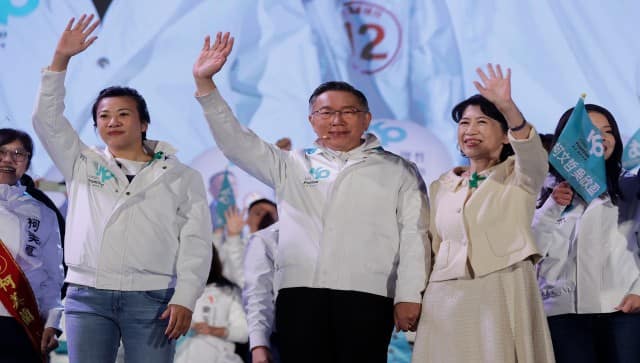 Ko Wen-je, the third presidential contender, is the founder of the tiny Taiwan People’s Party, established in 2019. AP[/caption] Ko claims to be the only contender who could win over both China and the US. The 64-year-old, who previously cooperated with both the DPP and KMT, served as mayor of Taipei from 2014 to 2022. An attempt to contest on Hou’s ticket in Saturday’s election was unsuccessful since the two couldn’t agree on a presidential candidate. Younger people prefer Ko’s straightforward approach and focus on practical issues like housing and education, making him the most popular candidate. Cynthia Wu, a business executive from one of Taiwan’s wealthiest families, is his running mate. With inputs from The Associated Press
Today’s presidential election in Taiwan will not only decide the country’s democratic fate but also act as a major flashpoint in the ongoing tensions between China and the US. Candidates running for the office are DPP’s Lai Ching-te, Hou Yu-ih of KMT, and Ko Wen-je of TPP
Advertisement
End of Article

 "Russian drones over Poland: Trump’s tepid reaction a wake-up call for Nato?")
 "As Russia pushes east, Ukraine faces mounting pressure to defend its heartland")
 "Why Mossad was not on board with Israel’s strike on Hamas in Qatar")
 "Turkey: Erdogan's police arrest opposition mayor Hasan Mutlu, dozens officials in corruption probe")
 "Russian drones over Poland: Trump’s tepid reaction a wake-up call for Nato?")
 "As Russia pushes east, Ukraine faces mounting pressure to defend its heartland")
 "Why Mossad was not on board with Israel’s strike on Hamas in Qatar")
 "Turkey: Erdogan's police arrest opposition mayor Hasan Mutlu, dozens officials in corruption probe")



