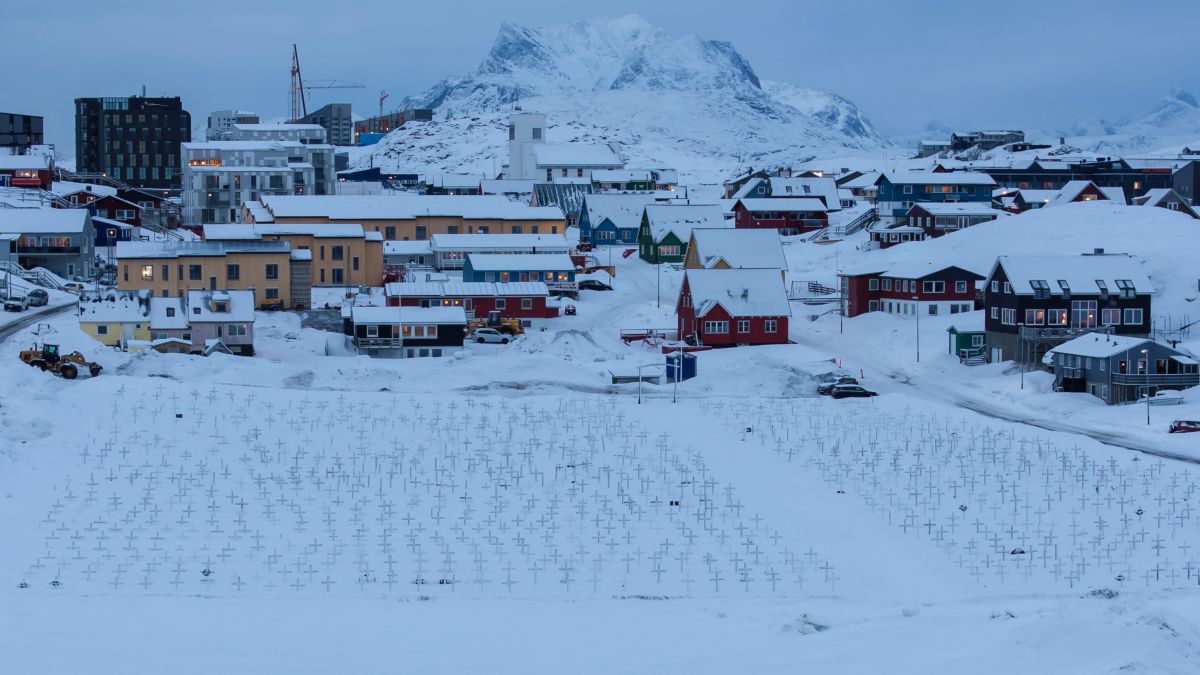
 "When the US tried to buy Greenland in the past and failed")
Many in Europe have been stunned at US President Donald Trump’s insistence on acquiring Greenland. US Secretary of State Marco Rubio has informed Congress that the United States is looking to buy Greenland in the aftermath of the capture of longtime Venezuelan leader Nicolas Maduro.
The White House has said that Trump is open to discussing all options, including using the US military. “Trump sees acquiring Greenland as a US national security priority necessary to deter our adversaries in the Arctic region,” the White House said in a statement. “The president and his team are discussing a range of options to pursue this important foreign policy goal, and of course, utilising the US military is always an option at the commander-in-chief’s disposal,” it added.
Trump first expressed interest in acquiring Greenland during his first term. The semi-autonomous territory is part of the Kingdom of Denmark, a long-term US ally through Nato. European leaders have reacted to Trump’s comments with dismay.
But even a cursory look at history shows this is something they should have anticipated. After all, this isn’t the first time the United States has voiced interest in Greenland.
Let’s take a closer look.
Post-Alaska in 1867
The first time the US attempted to acquire Greenland from Denmark was in 1867.This came in the aftermath of the Civil War and under the Andrew Johnson presidency. At the time, Johnson’s Secretary of State, William H. Seward, had just concluded the purchase of Alaska from Russia for $7.2 million (around Rs 65 crore).
The United States at the time was interested in extending its influence throughout North America and the Arctic. It was Seward, an ardent expansionist, who pushed for the Johnson administration to buy Alaska.
As Ron Doel, a historian at Florida State University, told Yeah“What’s interesting is that so much of US ideology usually involved looking west. But every now and again, it was, ‘Let’s look north.’ And Greenland fits in that along with the purchase of Alaska.”
The United States was eyeing Greenland because of its location and natural resources. Much like he did with Alaska, Seward ordered a detailed survey of the territory.
Robert J. Walker, a former treasury secretary, carried out the study. “The reasons are political and commercial,” Walker wrote. “The shores of Greenland, much more than those of any other country, are indented with deep bays, inlets, estuaries, and fjords, some of them possibly extending from the western to the eastern coast, presenting an immense shoreline, and furnishing most extensive and protected fishing grounds.”
Walker said adding Greenland to its territory would help the US “command the commerce of the world”.
“The rocks and geology of Greenland … besides the valuable coal discovered, indicate vast mineral wealth,” he added.
Seward himself summarised the findings of the report.“Greenland has in vast quantities whale, walrus, seal and shark, cod, salmon, salmon-trout and herring; foxes, wolf, reindeer, bear, a myriad of birds,” Seward wrote. “Good coal is found on the western coast at various points, extending far north, most cheaply mined and close to good harbours.”
However, things fell apart after Seward was roundly mocked for his purchase of Alaska. Newspapers and magazines even referred to the United States’ acquisition of Alaska as “Seward’s Folly”. A divided Congress, still reeling in the aftermath of the Civil War and the death of Abraham Lincoln, also turned on the Johnson administration, making Seward’s dream a non-starter.
After it was discovered that Alaska, the strategically important territory, also contained many valuable resources, including vast oil reserves, history proved the beleaguered Secretary of State right and his critics wrong.
Land swap proposal in 1910
This wasn’t an outright purchase offer as much as a proposal to swap territory.Interestingly, it was the then US ambassador to Denmark, Maurice Francis Egan, who came up with the idea. Egan, in 1910, wrote to the then Assistant Secretary of State with what he described as a “very audacious suggestion”. Egan proposed swapping the US territory of Mindanao in the Philippines to Denmark for Greenland and the Danish West Indies (the US Virgin Islands).
“Greenland is, as you know, a Danish monopoly,” Egan wrote. “It has never been exploited, although the Norwegians are clever enough to see its possibilities, as they already see what might be done with a lesser opportunity in Iceland.”
Again, no headway was made on the proposal. However, the US did later buy the Virgin Islands from Denmark in 1917 for $25 million (Rs 225 crore) in gold. World War I, which was rapidly approaching, also diverted US attention.
Truman makes offer in 1946
In 1946, the United States offered Denmark $100 million (around Rs 900 crore) in gold to buy Greenland. This came in the aftermath of World War II and at the beginning of the Cold War between the United States and the Soviet Union.
Greenland, during the war, had become a strategically important location for Allied planes on the way to Germany, which had invaded neutral Denmark at the outset of the war. “The Pentagon thought of Greenland as the world’s largest stationary aircraft carrier,” Doel said. “Planes weren’t flying all the way across the Atlantic. Having places like Greenland and Iceland became crucial.”
There appeared to be a massive appetite at the top levels of the US government for acquiring the territory.In April 1946, State Department official John Hickerson attended a meeting of the planning and strategy committee of the Joint Chiefs of Staff. Hickerson later wrote that “practically every member” agreed that the US should try to buy Greenland.
“The committee indicated that money is plentiful now, that Greenland is completely worthless to Denmark, and that the control of Greenland is indispensable to the safety of the United States,” Hickerson noted in a memo. However, Hickerson added that the Danes would be unlikely to sell the territory.
It was State Department envoy to Europe William Trimble who floated the proposal. Trimble said the territory offered “valuable bases from which to launch an air counteroffensive over the Arctic area in the event of attack”.
Then Secretary of State James Byrnes made the formal offer to visiting Danish Foreign Minister Gustav Rasmussen in New York on December 14, 1946.
Much like today, the Danes were left completely shocked by the offer. “The Danes were rather horrified that the US thought it could gain a territory by putting that kind of a monetary value on it, and that Denmark would be willing to part with it,” Doel added.
However, not many know that this bid was made completely in secret. It only came to light decades later. Though the Danes turned down the US offer, they allowed Washington to build bases and operate in Greenland.
Trump floats idea in 2019
Trump, during his first term, floated the idea of buying Greenland from Denmark. At the time, the offer was met with disbelief and bemusement by both Washington insiders and the Danish government.
Not many thought Trump was serious about the idea, which the US president publicly called a “strategic move”. Though no formal offer was made and Trump said the United States was “looking at” buying Greenland, Danish Prime Minister Mette Frederiksen rejected the idea out of hand and called it absurd.
Trump reacted badly to being turned down. “I thought the prime minister’s statement … was nasty,” Trump said at the time. “It was not a nice way of doing it. She could have just said ‘no, we’d rather not do it’ … they can’t say ‘how absurd.’”
Trump was also mocked by large sections of the US and Danish media, who likened it more to a fantasy than a serious offer. Trump then cancelled a planned state visit to Denmark. However, the incident was quickly forgotten by both sides.
With inputs from agencies

 "Trump announces 25% tariff on Iran’s trading partners. How India may be affected")
 "India, US to resume BTA talks after 5 months as Gor pushes for trade deal with 'real friends'")
 "ICC sources rubbish Bangladesh sports adviser’s sensational claim of BCB being asked to drop Mustafizur")
 "Jerome Powell: The 'Fed chair with a spine' taking on Trump")
 "Trump announces 25% tariff on Iran’s trading partners. How India may be affected")
 "India, US to resume BTA talks after 5 months as Gor pushes for trade deal with 'real friends'")
 "ICC sources rubbish Bangladesh sports adviser’s sensational claim of BCB being asked to drop Mustafizur")
 "Jerome Powell: The 'Fed chair with a spine' taking on Trump")