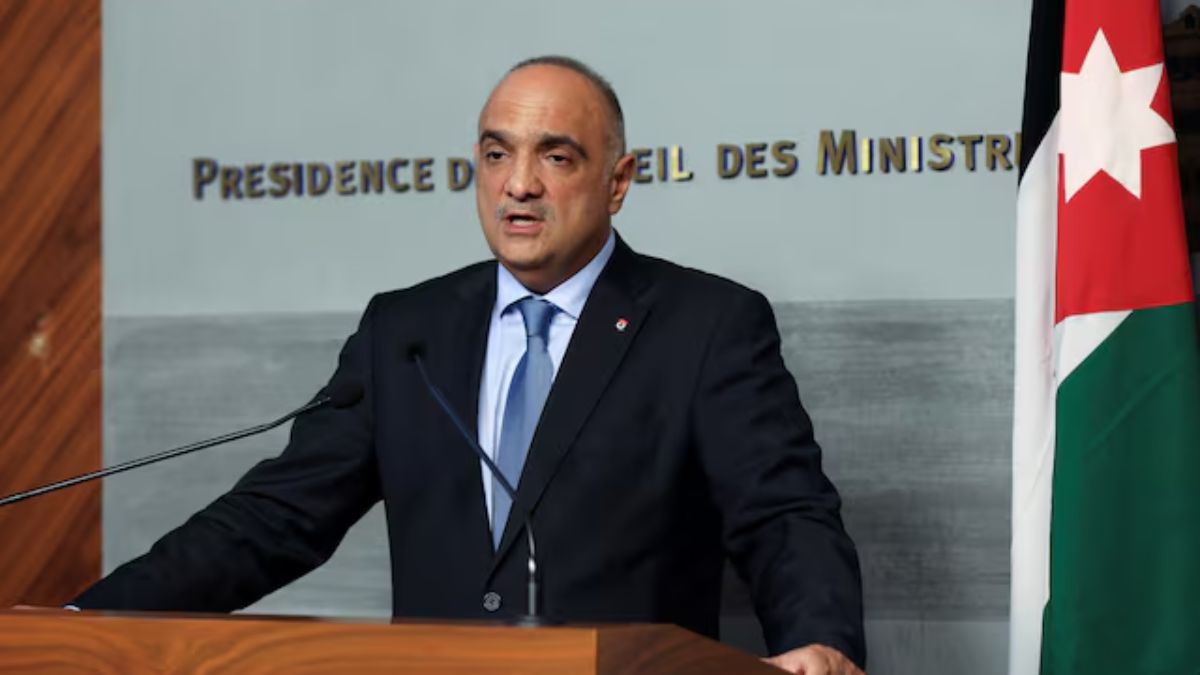
 "Jordan's Prime Minister Bisher al-Khasawneh has resigned. Reuters")
Jordan’s Prime Minister has resigned just days after the country’s elections.
Bisher al-Khasawneh resigned after parliamentary polls which saw Islamist parties gain ground in the US-allied nation.
Jordan’s King Abdullah II has asked Jafar Hassan, the head of his office, to form a new government.
But what is happening in Jordan? Why did al-Khasawneh resign?
Let’s take a closer look:
What’s happening in Jordan?
First, it is important to note the power structure in Jordan.
Jordan is a monarchy where the ruler has absolute control.
It is the king who appoints the prime minister and the cabinet.
The Parliament, which is bicameral, has limited powers.
It comprises the House of Representatives with 138 seats and the Senate with 69 members.
While the former are elected, the latter are appointed by the king.
Khasawneh, 55, had been leading the government since October 2020.
The outgoing prime minister had sought to push reforms pushed by King Abdullah to help reverse a decade of sluggish growth hovering at around two per cent that was worsened by the pandemic and conflict in neighbouring Iraq and Syria.
Turnout in the polls was just 32 per cent.
In Tuesday’s election Jordan’s leading Islamist party, the Islamic Action Front, became the largest in parliament, winning 31 out of the 138 seats.
The IAF is a political offshoot of the Muslim Brotherhood in Jordan, and the result gives the Islamists their largest representation since 1989.
The main issues were voters’ frustration about economic woes and the war in Gaza.
Nearly half of the country’s population is of Palestinian origin.
As per Al Jazeera, these citizens are descendants of those forced out of their homes by the Naqba and the 1967 war.
Jordan in 1994 signed a peace treaty with Israel, becoming only the second Arab state to do so after Egypt, but regular protests have called for the treaty’s dissolution since the war erupted last October.
The Gaza war has hit tourism in Jordan, which relies on the sector for about 14 percent of its gross domestic product.
The kingdom is heavily dependent on foreign aid, especially from the United States and the International Monetary Fund.
In the first quarter of 2024, the unemployment rate was 21 percent.
Why did al-Khasawneh resign?
Under the kingdom’s constitution, the government usually resigns after legislative elections.
“King Abdullah on Sunday tasked Jafar Hassan with forming a new government,” a palace statement said.
In a letter published by the palace, King Abdullah called on Hassan to “mobilise all efforts to support the steadfastness of our Palestinian brothers” in Gaza, the occupied West Bank and “Holy Jerusalem”.
He also called on the premier-designate to “work with all our energy through Arab and international movements to protect the Palestinian people, and stop the attacks and blatant violations of humanitarian principles and international law.”
“Public service is a great honour and responsibility, which we will carry on with all our capability to serve Jordan and Jordanians,” Hassan was quoted as writing on social media by Semafor.
Hassan has a PhD in political science from the University of Geneva and a master’s degree in public administration from Harvard University.
Hassan must now cobble together a new Cabinet to confront a series of challenges, including a struggling economy and widespread public anger over the Israel-Hamas war.
But the new composition of the 138 member parliament retains a pro-government majority, but a more vocal Islamist-led opposition could challenge IMF-led free-market reforms and foreign policy.
With inputs from agencies