

 "What is US Navy's HELIOS laser weapon that destroys drones in seconds?")
The US Navy has been advancing its directed energy weapons technology, and the High Energy Laser with Integrated Optical Dazzler and Surveillance (HELIOS) is at the forefront of these developments.
Developed by Lockheed Martin, HELIOS represents a leap forward in directed-energy weapons, designed to neutralise threats such as drones, fast attack boats, and missiles.
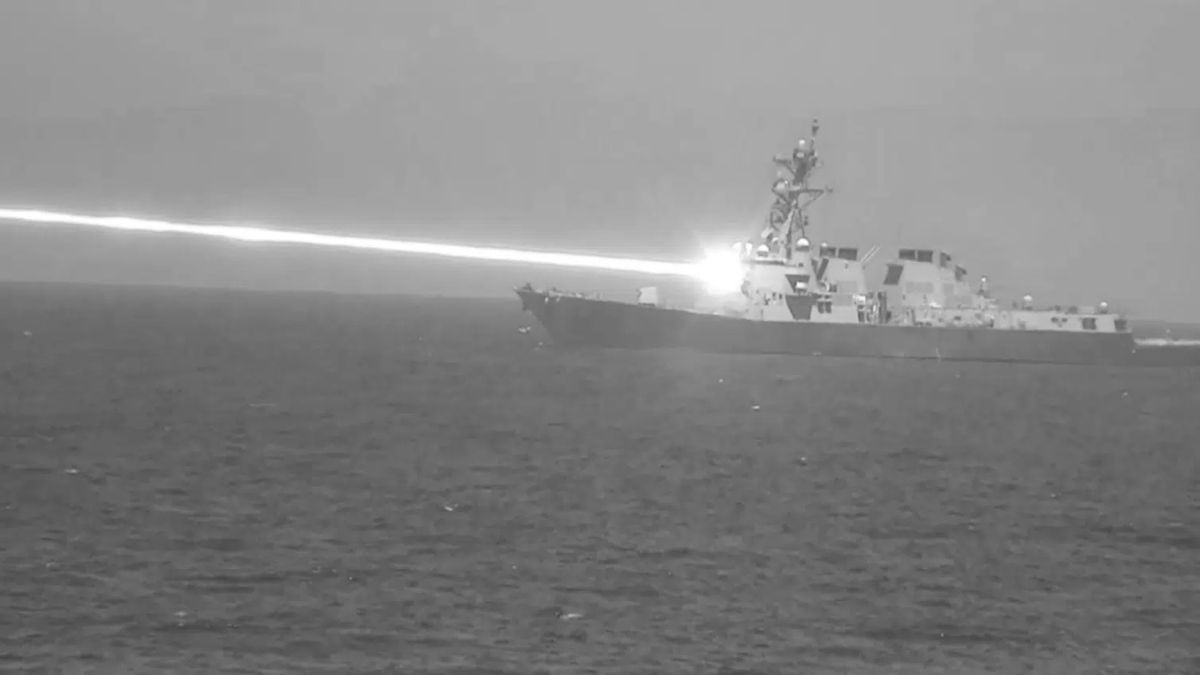
The system was successfully tested aboard the USS Preble (DDG-88) in 2024.
According to the Department of Operational Test and Evaluation (DOT&E) report for 2024, the Center for Countermeasures (CCM) supported the US Navy by collecting imagery and data to validate HELIOS’ functionality and performance.
The report stated: “CCM supported the Navy’s demonstration on USS Preble (DDG 88) to verify and validate the functionality, performance, and capability of the HEL with Integrated Optical Dazzler and Surveillance system against an unmanned aerial vehicle target. CCM collected imagery of the engagements to support the evaluation of system performance.”
The USS Preble was forward-deployed to Yokosuka, Japan, on October 12, 2024, joining the US Seventh Fleet to reinforce maritime security in the Indo-Pacific region. The deployment of HELIOS-equipped Preble highlights the strategic importance of laser weapons in this region, where the Navy faces increasing drone and missile threats.
However, the Navy has not confirmed whether a HELIOS test was conducted specifically in the Indo-Pacific theater.
What is the HELIOS capable of?
HELIOS, developed by Lockheed Martin, is a high-energy laser system designed to neutralize enemy threats through two primary attack modes, Hard Kill which directly destroys a target using high-intensity laser beams, and Soft Kill which disrupts electronic components of enemy systems, effectively blinding or disabling them.
The weapon system operates at over 60 kilowatts, with potential upgrades reaching between 120 and 150 kilowatts. Lockheed Martin describes HELIOS as having a “deep magazine, low cost per kill, speed-of-light delivery, and precision response.”
HELIOS is positioned on top of the Preble’s forward pedestal, which previously housed the Mk 15 Phalanx Close-In Weapons System (CIWS). The laser weapon system focuses energy on a target — whether a drone, a missile, or another aerial threat — causing the material to overheat and combust.
Unlike traditional weapons, HELIOS’ engagement is virtually silent and invisible, with the only visible indication being the destruction of the target.
HELIOS is integrated into the US Navy’s Aegis Combat System, allowing it to function as part of the ship’s overall defence network.
Lockheed Martin executive Jeanine Matthews, in 2022, stated the significance of this integration: “What’s interesting about HELIOS is that it’s not simply a standalone system — [it has] the initial pieces of integration to Aegis, and the next steps would be to make it one of the selections in the weapon system component of Aegis so that you could use [it].”
What will HELIOS defend against?
The recent HELIOS test comes amid a global proliferation of small aerial threats, such as kamikaze drones and loitering munitions. The US Navy has been actively countering such threats, particularly in the Red Sea, where American warships have been engaged in drone defence operations.
Lasers provide a significant advantage against drones due to their ability to heat and weaken structural components rapidly. A direct hit from HELIOS can cause an enemy drone to lose its wings or combust midair. A
dditionally, laser weapons are a cost-efficient alternative to missile interceptors, which can be expensive and time-consuming to produce.
What next for laser weapons?
HELIOS is part of a broader US Navy initiative to develop directed energy weapons, alongside other laser systems such as the Optical Dazzling Interdictor, Navy (ODIN) and the High Energy Laser Counter Anti-Ship Cruise Missile Project (HELCAP).
HELCAP aims to develop a 300+ kilowatt laser weapon to counter advanced anti-ship cruise missile threats.
The Navy’s budget documents outline HELCAP’s objectives: “[HELCAP] will expedite the development, experimentation, integration and demonstration of critical technologies to defeat crossing Anti-Ship Cruise Missiles (ASCM) by addressing remaining technical challenges. HELCAP will assess, develop, experiment, and demonstrate the various laser weapon system technologies and methods of implementation required to defeat ASCMs in a crossing engagement.”
While HELCAP is set to conclude testing in FY2025 at White Sands Missile Range, its findings will inform future decisions regarding the Laser Weapon Testbed (LWT). The Navy is also considering integrating HELIOS with additional ships, including Arleigh Burke-class destroyers DDG 81, 89, 122, 124, and 127.
What challenges does HELIOS face?
Despite the promising capabilities of HELIOS, there are several challenges facing laser weapon development including power supply issues as high-energy lasers require significant onboard energy resources.
Environmental conditions like Fog, wind, and other weather factors can also impact laser effectiveness. System Integration is also a challenge as there needs to be a seamless compatibility with existing shipboard defences.
The US Department of Defense has invested $1 billion annually in high-energy laser research, but progress has been slower than anticipated. The Navy has already deployed eight Optical Dazzling Interdictor, Navy (ODIN) laser dazzlers, designed to disrupt enemy sensors rather than destroy targets outright.
The US is not alone in developing laser-based weaponry. China is reportedly working on equipping its destroyers with high-energy laser weapons, as evidenced by a recent photograph of a Type-071 Amphibious Assault Ship fitted with laser technology.
Analysts speculate that China’s military could deploy these systems on its Type-075 and Type-055 warships in the near future. However, details remain classified.
With inputs from agencies


 "Russian drones over Poland: Trump’s tepid reaction a wake-up call for Nato?")
 "As Russia pushes east, Ukraine faces mounting pressure to defend its heartland")
 "Why Mossad was not on board with Israel’s strike on Hamas in Qatar")
 "Turkey: Erdogan's police arrest opposition mayor Hasan Mutlu, dozens officials in corruption probe")
 "Russian drones over Poland: Trump’s tepid reaction a wake-up call for Nato?")
 "As Russia pushes east, Ukraine faces mounting pressure to defend its heartland")
 "Why Mossad was not on board with Israel’s strike on Hamas in Qatar")
 "Turkey: Erdogan's police arrest opposition mayor Hasan Mutlu, dozens officials in corruption probe")



