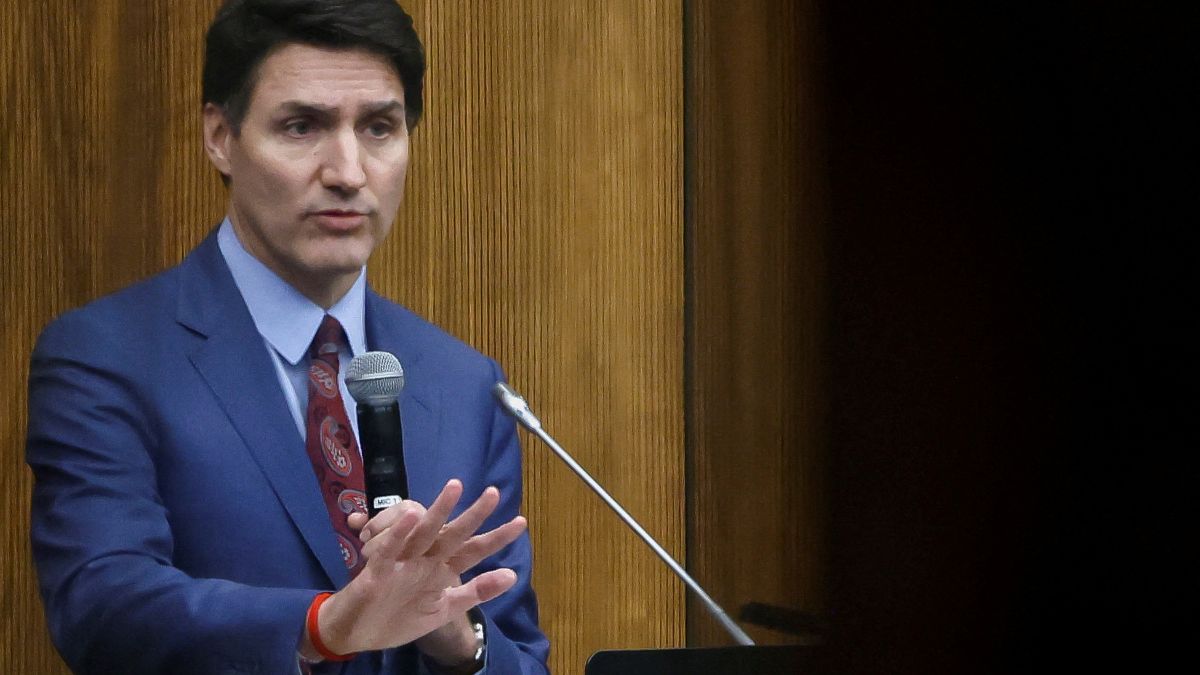
 "Canada's Prime Minister Justin Trudeau stepped down as prime minister of Canada on Monday. Reuters")
On Monday, Justin Trudeau announced that he was stepping down as Canada’s prime minister.
Trudeau, who has been at the helm in Canada for nearly a decade, blamed infighting within his Liberal Party for his resignation.
“I don’t easily back down faced with a fight, especially a very important one for our party and the country. But I do this job because the interests of Canadians and the well-being of democracy” are “something that I hold dear,” Trudeau said.
Trudeau added that he would stay on as prime minister and Liberal leader until a new one was chosen by the party.
But many in India are asking – what does Trudeau’s exit mean for Indian students and workers in Canada?
Let’s take a closer look:
For students
Trudeau stepping down could spell bad news for Indian students.
Canada has been a favoured destination for Indian students for nearly a decade.
The numbers bear this out.
NDTV quoted statistics from the Immigration, Refugees, and Citizenship Canada (IRCC) that showed that around 1.3 million Indian students got study permits between 2015 and 2024.
In 2015, just 31,920 Indian students held study permits – comprising just 14.5 per cent of the total international student population. By 2023, this number had spiked to 278,250 – and comprised 40.7 per cent of the total international student population.
However, a closer look at the government under Trudeau shows that things were already becoming more difficult for Indian students towards the end of his tenure.
Canada’s federal government had already made a number of moves to make study permits harder to obtain including capping the number of international students and making the process more cumbersome.
As a result the number of students who received such permits dipped by four per cent in 2024.
As per Indian Express, till August, just 137,445 Indian students received study permits till August – 36.7 per cent of the total number of students that were given such permits.
The government of Canada has also made life more difficult for students in other ways.
The Trudeau government in November ended its popular Student Direct Stream (SDS) program – a fast-track study permit process that had helped thousands of international students secure visas.
In September, the government imposed a 24-hour work limit per week for foreign students – a move which experts said would likely hurt Indian students.
The Trudeau government had during the pandemic waived the work cap , then at 20 hours per week, for international students.
The Trudeau government had also made changes to Canada’s post-graduation work permit program ( PGWP ) and spousal work permits – which restricted opportunities for students to stay in Canada after graduation.
However, some have defended the recent changes by the Trudeau government.
Tirath Singh, an immigration consultant at Jalandhar-based Pinnacle Immigration, told Indian Express,“The recent changes aim to attract serious students who come to study and work in fields that Canada requires. For those with genuine intentions, these policies provide stability and long-term opportunities.”
“There is no harm in focusing on serious students. It ensures better integration into the job market, facilitates post-graduation work permits (PGWPs), and eases the path to permanent residency (PR). Non-serious students often struggle with these aspects.”
Some say that the Conservative Party, if it were to win the upcoming polls under its leader Pierre Poilievre, could be even worse for students.
A piece in The Times of India noted that the conservatives in Canada have, historically, been more hostile to immigration.
Another piece in the newspaper argued that international students under a Poilievre regime could find it harder to get homes, healthcare and jobs.
“Study permits could become harder to secure, intensifying competition for admission. Revised eligibility for work programmes may limit off-campus employment opportunities, crucial for many students,” the piece argued.
Poilievre in September had vowed to massively pull back the international student programme.
Business Standard had quoted Poilievre as saying, “We’re going to return to the system we had before Justin Trudeau.”
“A modest number of highly promising young people who excelled could come here, study, and if they followed the rules, they could stay.”
Others are more upbeat.
Saurabh Arora, founder and CEO of University Living, told Indian Express, “Justin Trudeau’s resignation marks a significant turning point in Canadian politics, with potential implications for the large community of Indian students in Canada. While the leadership transition introduces an element of uncertainty, it also presents an opportunity for positive change. If the new leadership prioritises education as a bridge for strengthening Canada-India relations, it could open doors for even greater collaboration, ensuring that international students continue to view Canada as a welcoming and supportive environment for their academic and professional aspirations.”
What about workers?
The government under Trudeau has already announced it would be cutting immigration over the next few years.
Canada said it planned to reduce planned permanent residency slots from 500,000 to 365,000 by 2027 – which could impact Indian workers.
As per CBC.CA, Trudeau in September had announced a reduction in temporary foreign workers in Canada.
However, Trudeau had announced an exception for “food security sectors” such as agriculture and food and fish processing as well as construction and health care – all fields that faced acute staffing shortages.
“We need Canadian businesses to invest in training and technology, not increasing their reliance on low-cost foreign labour,” Trudeau said.
“It’s not fair to Canadians struggling to find a good job, and it’s not fair to those temporary foreign workers, some of whom are being mistreated and exploited.”
Experts had said that the reduction in work permits under Canada’s Temporary Foreign Worker Program (TFWP) could impact Indian workers in sectors such as IT and hospitality – fields where Canada relies heavily on foreign talent to bridge labour shortages.
Poilievre might go even further than Trudeau.
As per NDTV, Poilievre had accused Trudeau of destroying the TFW programme.
He announced that he would “block temporary foreign workers where they are taking jobs from Canadians” – though he said he would keep the programme for the agricultural sector.
Experts say here too, things could get more difficult under Poilievre.
Adarsh Khandelwal, cofounder of Collegify, told The Times of India, “If the Conservatives win and form a government, one possible area of change could be immigration policy. The Conservatives may place more restrictions on immigration or prioritise a different set of criteria for granting visas or work permits.”
Whatever happens next, parents and students in India will be keeping a close eye on Canada.
With inputs from agencies