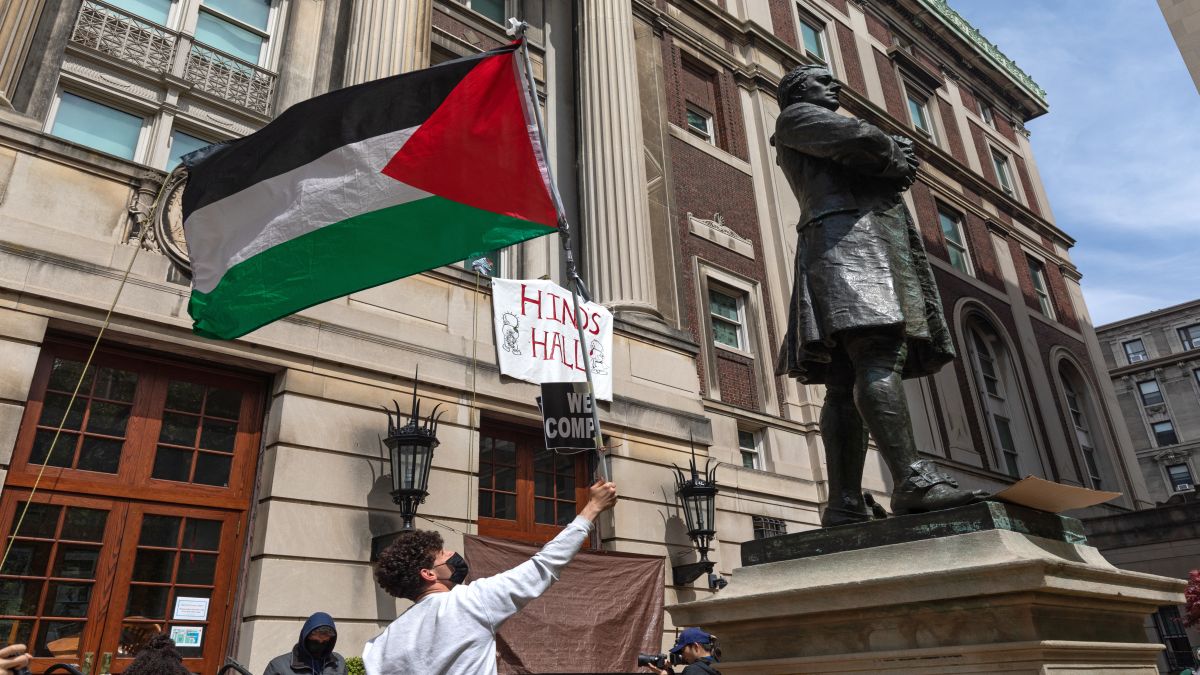
 "Pro-Palestinian student protesters wave a Palestinian flag as they gather on the front steps of Hamilton Hall at Columbia University in New York City. Students here have been among the first to embrace the pro-Palestinian campus encampment movement, which has spread to a number of universities across the United States. AFP")
It’s been over two weeks of protests at United States’ universities. Thousands of students across various colleges have been protesting Israel’s war in Gaza, and calling on the administration to divest from the Jewish nation.
At the forefront of these protests across America has been Columbia University , located in New York City. Hundreds of demonstrators have set up a pro-Palestine encampment, demanding for their voices to be heard. In fact, late Tuesday night (30 April), dozens of protestors sieged Hamilton Hall, and unfurled a banner to reveal the building’s new name by protestors: “ Hind’s Hall — in honour of the six-year-old Hind Rajab, who was killed by Israeli troops in Gaza.
This led to New York Police Department (NYPD) officials storming the university and arresting more than 100 people for trespassing, criminal mischief, and burglary.
While the visuals of the NYPD officials in riot gear and carrying zip ties were dramatic, it’s not the first time that the esteemed Ivy League university has had a brush with protests. For many, its drawing out memories of 1968 when police were called to clear protesting students from the campus.
As Columbia University continues its churn of discontent, dissatisfaction and dissent, we go back in time to when it was the epicentre of other agitations.
Columbia’s 1968 anti-Vietnam protests
Prior to 2024’s protests, perhaps, the biggest and most famous protest at Columbia came in 1968. The student rumblings of 1968 started in February, when two black South Carolina State University students, protesting a segregated bowling alley, were shot and killed by state troopers in Orangeburg.
However, it was Columbia’s protest in April that captured the attention of the nation because of its stature as an Ivy League college situated in the media capital of the world.
Impact Shorts
More ShortsOn 23 April 1968, Columbia students took over Hamilton Hall — a building which had opened in 1907 — to protest America’s role in the Vietnam War and “university policies they considered racist” — the administration’s plan to build a gymnasium in nearby Morningside Park.
Students barricaded themselves inside, preventing the acting dean, Henry S Coleman, from leaving his office for one night. By the next morning, Black students renamed the hall as ‘Malcolm X Liberation College’ and even asked White students to leave so that their grievances could be heard.
Acceding to their demands, the White students moved their demonstrations to other buildings on the campus. While the Black students demanded that the administration drop its plans for the gymnasium, the others demanded an end to the university’s “affiliation” with a think tank involved in Pentagon weapons research.
A week later, on 30 April, the police — on the behest of Columbia’s president — entered the building through underground tunnels and cleared the students. Police officers trampled protesters, hit them with nightsticks and dragged some down concrete steps.
Student publication Barnard Magazine had then reported that students were “punched with brass knuckles, kicked, dragged down concrete steps, thrown to the ground and then stomped upon by the police”. More than 700 students were arrested by the NYPD over the course of seven days in April 1968 —but a judge dropped criminal trespassing charges for at least 368 of them in October.
Juan Gonzalez, a former columnist for the New York Daily News who was one of the Columbia protesters involved in the 1968 demonstrations, told NBCNews: “We fought pitched battles with the cops. It was much more violent than what we’ve seen so far at the demonstrations now.”
But at the end of it all, the protesting students emerged victorious: Columbia disaffiliated from the weapons think tank, the Institute for Defense Analyses, and scrapped the plans for the gym.
Incidentally, the police action against the Columbia demonstrators in 1968 was on the same day — 30 April — when NYPD police stormed the university to remove the pro-Palestine demonstrators from Hamilton Hall.
The ’85 anti-apartheid protests
Following the ’68 demonstrations, came the 1985 protests. In April of that year, around 100-200 students chained up Hamilton Hall, demanding that the university divest from companies that were doing business in South Africa. At the time, civil rights activist Jesse Jackson had said on the steps of Hamilton: “America is not always right, but we have the right to protest for the right. When the nation of democracy becomes South Africa’s number one trading partner, we’re wrong, this is wrong.”
Aniko Bodroghkozy, a media studies professor at the University of Virginia, who participated in the protest, told TIME: “I think students could get in and out but that encampment went on for many, many weeks.”
After three long weeks, students led by the multiracial organisation Coalition for a Free South Africa ended their protest with a march into Harlem.
And on 7 October of the same year, Columbia became the first major US university to fully divest from South Africa. Eventually, as VOX reports, 155 universities divested, and in 1986, the US government also bowed to pressure from protesters and enacted a divestment policy.
1996 — protests over ethnic studies department
After witnessing a one-day blockade in 1992 to halt Columbia’s plan to demolish the Audubon Theatre and Ballroom, where Malcolm X was assassinated, the Ivy League university witnessed another demonstration in 1996.
This time, students were demanding the creation of an ethnic studies department. When their pleas went unheard, they went on hunger strike and over 100 protesters occupied Hamilton Hall for four days.
The administration finally relented to their demands and provided space for the Asian and Hispanic studies programmes. Three years later, it also inaugurated the Centre for the Study of Ethnicity and Race.
Columbia’s Mattress protest of 2014
In September 2014, a then 21-year-old Emma Sulkowicz, a Columbia University student, carried her dormitory room mattress everywhere. The reason: two years ago, in 2012, she claimed that she had been raped by a fellow student, Paul Nungesser.
When she went to the police to report her crime, it was reported that the officer she approached was dismissive, stating to Emma and her friend that “of all the cases, 90 per cent are bullshit, so I don’t believe your friend for a second.”
Realising that she was not going to get justice, she began to carry a mattress with her everywhere she went on campus until Nungesser left or was expelled from Columbia. She even decided to take it a step further by bringing the mattress to her graduation, despite the university telling students not to bring any large items across the stage.
Her form of protest led to tremendous media coverage and replications of her demonstration at other campuses; students would hold a mattress, pillow or something else representing defiance of sexual assault at their institution.
As Mark Naison, professor of history and African & African American Studies at Fordham University and himself a participant in the 1968 demonstrations, tells the AP: “When you’re going to Columbia, you know you’re going to an institution which has an honoured place in the history of American protest. Whenever there is a movement, you know Columbia is going to be right there.”
With inputs from agencies