

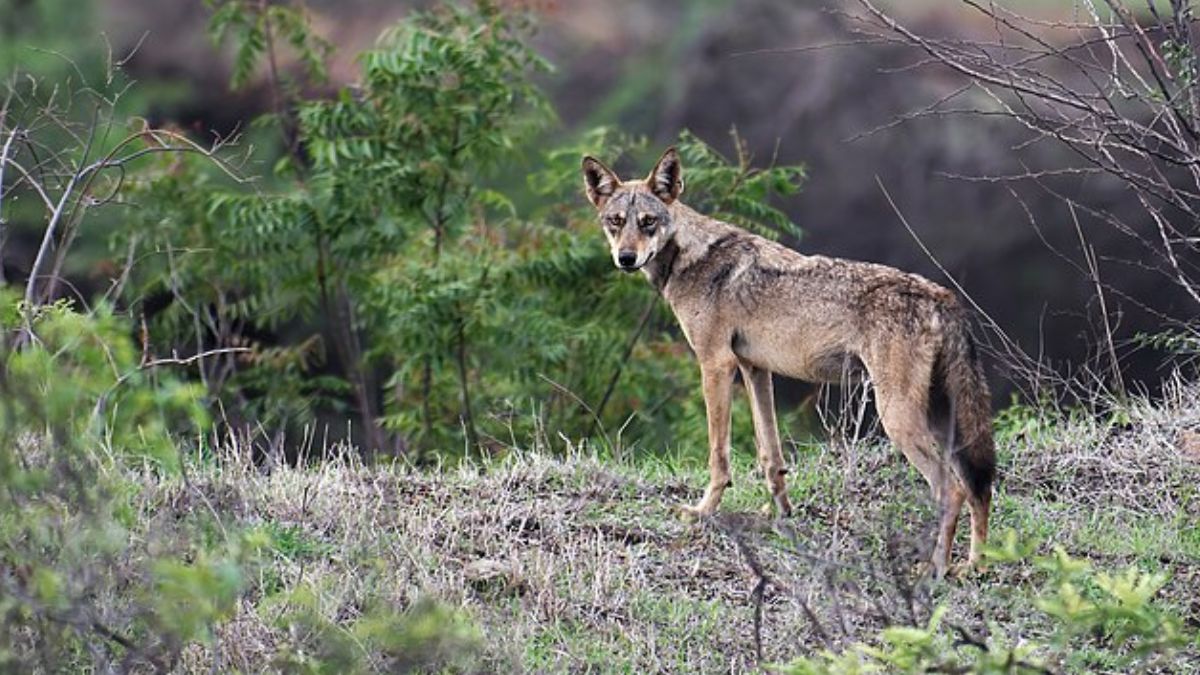
 "Why have wolves in UP’s Bahraich turned ‘man-eaters’?")
A series of wolf attacks have terrorised villagers in Uttar Pradesh’s Bahraich district. The wild animals have been blamed for killing nine people, including eight children and one woman, in the past two months.
The UP administration has launched ‘Operation Bhediya’ to capture the wolves on the prowl. So far, four of these predators have been caught while two remain at large. Panicked residents are carrying out night patrols and letting off firecrackers in hopes of warding off the wild animals.
#WATCH | Bahraich, Uttar Pradesh: In the wake of wolf attacks, the forest department team is conducting a door-to-door awareness campaign.
— ANI UP/Uttarakhand (@ANINewsUP) September 4, 2024
So far 4 wolves have been caught. pic.twitter.com/zRH2KLXlxI
While these predators live close to human settlements, they generally do not attack people. Then when do wolves turn into man-eaters? Let’s understand.
Wolf attacks on humans
Wolves usually stay away from people. The global study conducted by the Norwegian Institute for Nature Research between 2002-2020 says the risk of such attacks by the wild animal is “above zero, but far too low to calculate”. During this period, 26 deadly wolf attacks were reported on humans across the world, with four taking place in India.
Impact Shorts
More Shorts“Wolf attacks on humans are known and RS Dharmakumarsinh’s book Reminscences of Indian Wildlife (1970) actually talks about how wolves hunt and stalk pregnant women. This is an animal living in proximity to humans. Normally, they don’t attack humans. People are not their normal prey. They hunt goats and sheep. Why they have hunted humans in this particular case (Bahraich) has to be studied,” wildlife historian Mahesh Rangarajan told Down To Earth (DTE).
Veteran wildlife scientist YV Jhala believes a single wolf is responsible for the recent fatal attacks in the UP district, reported DTE.
Why wolves attack humans
Wolves, like all predators, can potentially attack humans. Experts say a loss of habitat and lack of prey could push wolves to target humans.
When humans and predators compete for natural resources — by cutting forests, turning wild habitats into farmland, and hunting wild herbivores for bushmeat, it could lead to the wild animals attacking people, as per an Indian Express report.
The newspaper piece mentioned that sometimes wild predators get accustomed to human flesh after an accidental kill.
Speaking to News18, Divisional Forest Officer (DFO) Ajeet Pratap Singh, who is leading Operation Bhediya, said, “Wolves are not typically known for attacking humans, even though they have coexisted with us in the same territories for centuries. However, these attacks may occur when a wolf accidentally preys upon a child. Once a wolf tastes human flesh, particularly that of a child, it may develop a preference for it. The soft flesh of children and their vulnerability makes them easier prey compared to other animals, which could lead a wolf to become a man-eater.”
According to the International Wolf Centre (IWC), wolves who turn into man-eaters usually prey on children as they are easy targets. “Wolves normally do not attack people. Wherever there is a high density of wolves in India, there has been no record of them killing people or children. It is only in areas where there is extreme poverty where children are not looked after properly, there is no prey and livestock is guarded more than children, that wolves attack children. Even dogs will. Any predator would, as they have to survive,” Jhala was quoted as saying by DTE.
Some experts also believe the cross-breeding of dogs and wolves could have made the wild animals comfortable in human spaces. The abandoned wolf-dog hybrids may turn into “man-eaters” as they would have lost the fear of people as pets, as per Indian Express.
According to wildlife officials, torrential rains that trigger heavy flooding have driven out wolves from their usual territory into more populated farmland.
“When their natural prey is no longer available, wolves are left with fewer options,” DFO Singh told the Times of India. “The floods have created a scarcity that has pushed them to take risks they wouldn’t normally consider.”
The theory of revenge is also being floated amid the Bahraich attacks. Sanjay Pathak, senior forester and former director of Dudhwa National Park, recalled two significant wolf attacks in Uttar Pradesh — in the mid-1990s and 2003. In both instances, wolves preyed on children after coming under attack by farmers – a litter of wolf cubs were killed once and the second time their habitat was destroyed.
He said to News18 that “wolves are one of the most intelligent animals and what makes them different and even more terrorising than other carnivores is their tendency to take revenge. It may sound a little weird but it’s true.”
ALSO READ: How UP’s Bahraich is trying to hunt down man-eating wolves
When wolves attacked humans in India
The number of human fatalities caused by wolf and tiger attacks was similar in the second half of the 19th Century. In 1875, wolves killed 1,018 people and tigers 828 in north India, Indian Express reported citing Surgeon General Joseph Fayrer.
Under British rule, these wild animals were slain for bounties and an estimated one lakh wolves were hunted mainly in the North-West Provinces and Awadh (later United Provinces) between 1871 and 1916.
However, the Indian wolf survived the slaughter.
Historically, wolf attacks have mostly been seen in northern India including UP, Madhya Pradesh, Bihar and West Bengal.
A pack of four adult wolves killed 17 children in MP’s Astha in the winter of 1985-86. All four animals were eventually hunted.
Five wolf packs were blamed for killing 60 children in the Hazaribagh West, Koderma, and Latehar forest divisions of undivided Bihar between 1993 and 1995, as per the Indian Express report.
In 1996, as many as 76 children in Pratapgarh, Sultanpur, and Jaunpur in eastern UP became a targets of wolves.
Ten children died in wolf attacks in the Balrampur district adjoining Bahraich in UP in 2003.
With inputs from agencies


 "Russian drones over Poland: Trump’s tepid reaction a wake-up call for Nato?")
 "As Russia pushes east, Ukraine faces mounting pressure to defend its heartland")
 "Why Mossad was not on board with Israel’s strike on Hamas in Qatar")
 "Turkey: Erdogan's police arrest opposition mayor Hasan Mutlu, dozens officials in corruption probe")
 "Russian drones over Poland: Trump’s tepid reaction a wake-up call for Nato?")
 "As Russia pushes east, Ukraine faces mounting pressure to defend its heartland")
 "Why Mossad was not on board with Israel’s strike on Hamas in Qatar")
 "Turkey: Erdogan's police arrest opposition mayor Hasan Mutlu, dozens officials in corruption probe")



