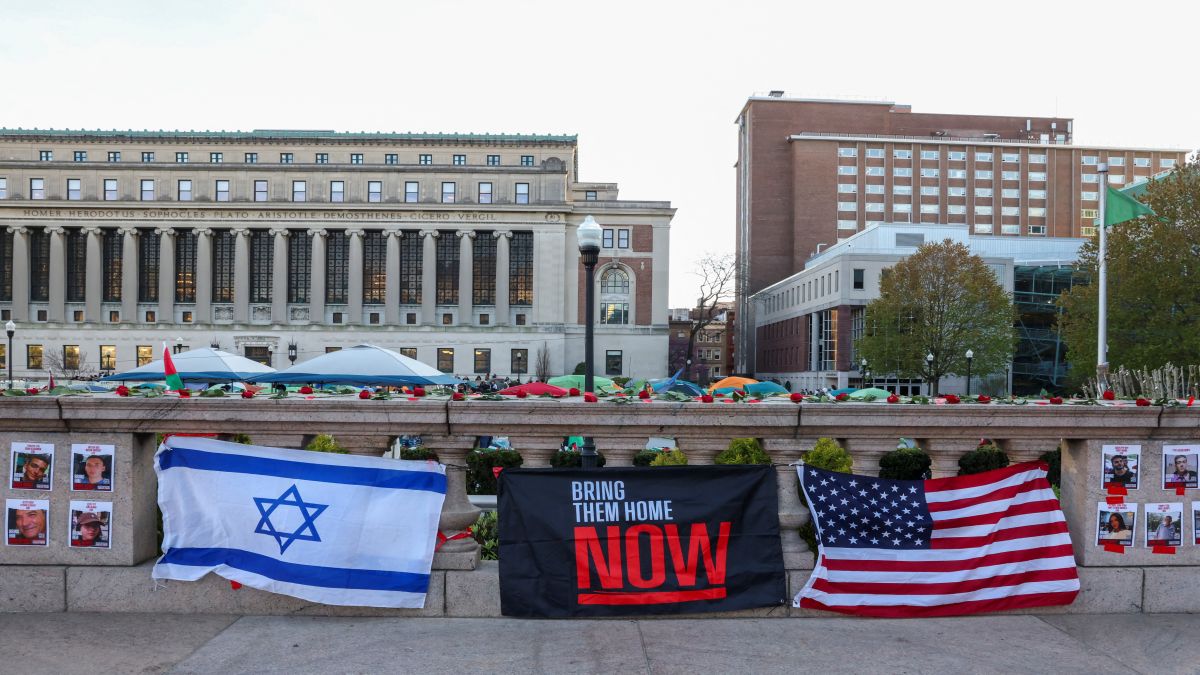
 "Signs in support of Israel are posted on campus near the encampment where students are protesting in support of Palestinians at Columbia University, during the ongoing conflict between Israel and the Palestinian Islamist group Hamas, in New York City, US. Reuters")
Tensions have escalated on several US campuses amid ongoing pro-Palestinian protests. These demonstrations, marked by mass arrests and disruptions to classes, have roiled some of America’s most esteemed universities in recent weeks.
Top American university administrators are finding it difficult to control the aftermath of the Gaza War on the country’s campuses as pro-Palestinian, pro-Israeli, campus administration, and police clash.
Columbia University in New York has emerged as a focal point for these protests, with organisers demanding divestment from companies profiting from “Israeli apartheid, genocide, and occupation in Palestine.”
Here’s how anger is rising in US universities.
Protests rock Columbia University, calls for divestment
Some of America’s most prestigious universities have been rocked by protests in recent weeks as students and other agitators take over quads and disrupt campus activities, furious over the Israel-Hamas war and ensuing humanitarian crisis in Gaza.
At Columbia University in New York, the core of the spreading protests, organisers are calling for the university to divest from companies “that profit from Israeli apartheid, genocide and occupation in Palestine.”
Also Read: After Columbia, it is now Harvard, Yale, MIT: How top US colleges are unable to contain Gaza protestsPro-Israel supporters and others worried about campus safety have pointed to anti-Semitic incidents and argue that campuses are encouraging intimidation and hate speech.
“Students have the right to protest, but they are not allowed to disrupt campus life or harass and intimidate,” Columbia’s vice president of public affairs Ben Chang told reporters Monday.
Impact Shorts
More Shorts“We are acting on concerns we are hearing from our Jewish students,” he said, adding that university officials were meeting “in good faith” with the demonstrators.
Protesters meanwhile — including a number of Jewish students in the “Gaza Solidarity Encampment” — say they’ve disavowed instances of anti-Semitism and are there to support Palestinians.
“My college administration, my representatives in Congress and my own president have continually acted as spokespeople for the Jewish community, equating anti-Zionism with anti-Semitism,” Jewish student Sarah Borus, from Columbia’s Barnard College, said at a news conference held by Jewish and Palestinian students.
“They silence us, suspend us,” she added.
Protesting students also said they had been called slurs by a pro-Israel professor and that anti-Muslim incidents on campus were being ignored.
But another Jewish student at Columbia, Nick Baum, told CNN he has felt “downright unsafe” on campus in recent days, saying anti-Semitism there has “reached a boiling point.”
Professors have pushed back since Columbia President Minouche Shafik called in police last week to arrest students , with some announcing they would not enforce student suspensions.
While there is a long history of campus activism around Israel and the Palestinian cause, flaring tensions amid the war have attracted major media and political scrutiny.
“Jewish students at Columbia University don’t feel safe. It’s become so dangerous that students were forced out of the classroom,” Republican Speaker of the House Mike Johnson said Tuesday.
“Let’s be clear: these are not peaceful protests, these are anti-Semitic mobs.”
NYU arrests
Further downtown, 133 people were arrested at New York University (NYU) and released after being issued with court summons, the New York Police Department told AFP, as protests also intensify at other colleges.
An NYU spokesman said the decision to call police to the campus came after additional demonstrators, many of whom were not thought to be affiliated with the university, breached the barriers erected around the protest encampment.
This “dramatically changed” the situation, the spokesman said in a statement on the school’s website Monday, citing “disorderly, disruptive and antagonising behaviour” along with “intimidated chants and several anti-Semitic incidents.”
On the West Coast, California State Polytechnic University announced it would be closed until at least Wednesday after pro-Palestinian demonstrators occupied an administrative building.
The protests have also drawn the attention of President Joe Biden and his administration.
“Anti-Semitic hate on college campuses is unacceptable,” US Secretary of Education Miguel Cardona posted on X on Tuesday, expressing concern about the unrest.
That afternoon, hundreds of NYU students and faculty staged a walkout.
There have also been demonstrations at MIT, the University of Michigan, UC Berkeley and Yale, where at least 47 people were arrested Monday after refusing requests to disperse.
With inputs from AFP