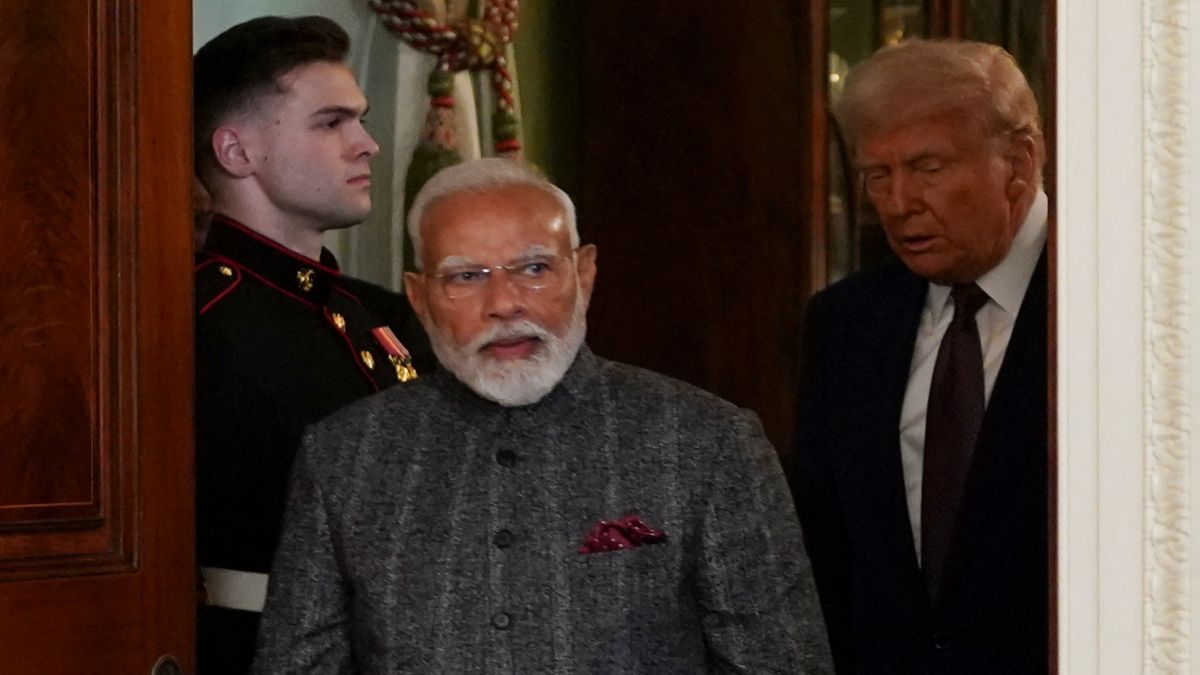
 "How India could be affected after Trump’s Section 301 probe into ‘unfair trade practices’")
After his sweeping tariff policy was set aside by the US supreme court, Donald Trump has renewed his tariff war by initiating trade investigations against India and 15 other nations, including China and the European Union.
The probes, which will likely expand to more nations, will be conducted under Section 301 of the Trade Act of 1974, US Trade Representative Jamieson Greer told reporters during a call. That law permits the US to impose tariffs on imported goods from other nations found to have engaged in unfair trade practices.
Greer said that the Section 301 probes “will cover acts, policies, and practices of certain economies relating to structural excess capacity and production in manufacturing sectors.”
“We expect that this investigation will uncover a variety of unfair trading practices related to excess capacity and production in manufacturing,” he said. “Our view is that key trading partners have still production capacity that is really untethered from the market incentives of domestic and global demand.”
What is a Section 301 probe?
Before we delve into what this probe means for India, let’s understand what exactly a Section 301 investigation is.
Section 301 of the US Trade Act of 1974 is a powerful trade enforcement tool that enables the United States to take action against foreign policies it deems detrimental to American commerce.
This law allows the Office of the United States Trade Representative (USTR) to examine policies, regulations, and barriers that could hurt American businesses, restrict market access, or put US exports at a disadvantage
When an investigation is launched, the USTR gathers evidence through different means, including public comments and the concerned country. These investigations, which typically take months to complete, are required for the US president to unilaterally place duties on imports from specific countries deemed to employ unfair trading practices.
The probe will follow three stages:
>> Public comments accepted until April 15
>> Public hearing expected around May 5
>> Findings and potential remedies before July
If found guilty, the US, by law, could then either impose tariffs or import restrictions. The law also allows Washington to enforce other retaliatory trade measures if a country is found to have violated trade practices.
Which countries are being probed now?
On Wednesday (March 11), US Trade Representative Jamieson Greer announced that America would be launching a 301 probe against several countries.
These are: China, the European Union, India, South Korea, and Mexico. Besides these countries, Japan, Taiwan, Vietnam, Singapore, Switzerland, Norway, Indonesia, Malaysia, Cambodia, Bangladesh, and Thailand will also be investigated.
Notably, Canada, the second-largest US trading partner, was not listed among the targets.
Weighing in on the same, Greer said: “So these investigations will focus on economies that we have evidence appear to exhibit structural excess capacity and production in various manufacturing sectors, such as through larger persistent trade surpluses or underutilised or unused capacity.”
The US official pointed at the automotive sector in China and Japan, saying a growing number of companies were unprofitable or unable to meet interest payments from operations.
He said that despite China’s electric vehicle capacity outstripping national demand, the country’s top EV maker, BYD, was “aggressively expanding” its overseas manufacturing footprint, with factories in Uzbekistan, Thailand, Brazil, Hungary, and Turkey, and was expected to expand capacity in Europe, where existing automotive plants are operating at only 55 per cent of capacity.
He also cited large US trade surpluses in Germany and Ireland as evidence of EU excess capacity. Singapore had excess global capacity in semiconductors despite a trade deficit with the US, and Norway had excess capacity by evidence of large fuels and seafood exports.
Why has the US launched this Section 301 probe now?
Following the announcement, many wondered why the Trump administration had decided to launch such a probe. And the answer is the setback the American president received at the US supreme court.
The country’s top court recently struck down the US president’s “reciprocal tariff” policy, noting that the administration had exceeded its authority when it imposed sweeping tariffs under emergency economic powers.
However, in order to maintain its leverage over other nations, the Trump administration imposed a temporary 10 per cent tariff on imports from all countries for 150 days under a different law, until July.
By announcing this probe, the US is creating an alternative route to target countries and examine their trade practices in detail. As Reuters reported, the 301 probe offers the Donald Trump administration an avenue to rebuild a credible tariff threat against trading partners to keep them negotiating and implement trade deals that were cut to reduce his higher tariff rates under the International Emergency Economic Powers Act.
There’s also the China angle. US President Donald Trump will be soon travelling to China to meet Xi Jinping. It seems that the Trump administration could be using the 301 probe to acquire better trade terms with Beijing.
Why is India on the list of countries to be investigated?
India is among the 16 nations being investigated. This reflects old concerns that Washington has had about India’s trade policies. In the past, Washington has complained about relatively high tariffs, rules on local sourcing, and price controls in the pharmaceutical sector.
Many experts have stated that including India in the list of countries is significant because just a month ago, New Delhi and Washington unveiled a framework for an interim bilateral trade agreement.
Under this framework, India has agreed to reduce or eliminate tariffs on several US industrial and agricultural products. Moreover, both sides have pledged to remove non-tariff barriers and expand market access. India would also purchase $500 billion worth of US goods over five years, as mentioned in the framework
What could be the impact of this probe on India?
As of now, India will feel no impact from this investigation. But it does shine a light on the country’s trade practices. The investigation also adds a layer of uncertainty on trade with the US, which is India’s largest export market.
If the investigations reveal violations, several of India’s exports could be exposed to huge tariffs. For instance, pharmaceuticals, a major export to the US, could face higher costs or stricter regulations. IT hardware and electronics could become less competitive if new duties are imposed. Textiles and garments could also be affected, while auto components and engineering goods could see supply chain disruptions or higher costs.
For now, the Section 301 probe remains a warning and a leveraging tool for Washington. For India, it’s left to be seen if the probe fructifies into anything concrete. For now, India will engage with the US to defend its trade and protect its exports.
FAQs
1. What is a Section 301 probe?
Section 301 allows the US government to investigate whether a foreign country’s trade practices are “unreasonable, discriminatory, or burden US commerce”.
2. Has the US ever carried out such an investigation before?
Section 301 has been used repeatedly by Washington to challenge foreign trade practices. In Trump’s first term, the US used Section 301 more aggressively. The most notable instance was in 2018, when the USTR imposed tariffs of up to 25 per cent on about $370 billion of Chinese imports after a probe into Beijing’s policies on technology transfer, intellectual property, and innovation.
3. What happens if violations are found?
If the USTR finds that a country has violated trade terms, it could impose a number of punishments. These include:
>> Imposing tariffs or import restrictions
>> Suspending trade concessions granted under agreements
>> Negotiating binding agreements requiring policy changes or compensation
4. When will this 301 probe be completed?
While public opinion will be sought until April 15, the findings should come by July.
5. What could be the impact on India?
For India, the immediate economic impact is uncertain, but the investigation introduces a layer of trade risk. The US is India’s largest export market, and several key sectors could be exposed if tariffs are eventually imposed.
With inputs from agencies

 "US-Israel Iran War Live Updates: Two Indian tankers granted safe passage through Strait of Hormuz")
 "After Jaishankar-Araghchi talks, Iran allows Indian tankers through Strait of Hormuz: Report")
 "Why are ships becoming key targets in the Iran war?")
 "Vessel carrying Saudi crude reaches India; first tanker to arrive from Strait of Hormuz since Iran war")
 "US-Israel Iran War Live Updates: Two Indian tankers granted safe passage through Strait of Hormuz")
 "After Jaishankar-Araghchi talks, Iran allows Indian tankers through Strait of Hormuz: Report")
 "Why are ships becoming key targets in the Iran war?")
 "Vessel carrying Saudi crude reaches India; first tanker to arrive from Strait of Hormuz since Iran war")