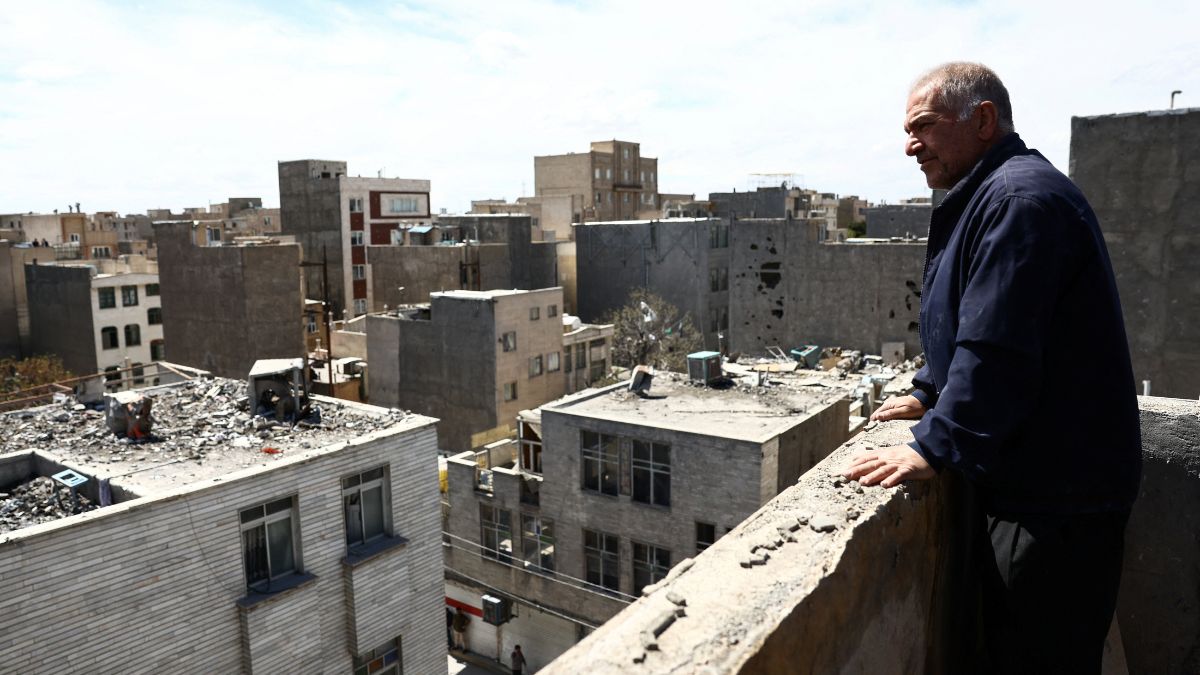
 "A man looks at a residential building damaged by a strike, amid the US-Israeli conflict with Iran, in Tehran, Iran, March 27, 2026. File Image/WANA via Reuters")
The conflict in West Asia is escalating into its fifth week and discussions within Washington have increasingly turned toward the possibility of deploying ground forces inside Iranian territory.
While no formal approval has been granted by United States President Donald Trump, senior officials and multiple reports indicate that a range of military scenarios — including limited incursions and targeted strikes — are under active consideration.
What kind of ground ops is the Pentagon preparing for?
According to US officials cited in multiple reports, the Pentagon has been working on operational plans that envision a sustained but limited ground campaign within Iran. These plans are not structured as a full-scale invasion but rather as a series of focused missions aimed at achieving specific strategic objectives.
The Washington Post reported that preparations are underway for operations that could extend over several weeks. These would likely include coordinated raids conducted by both special operations units and conventional infantry forces.
The scope of such missions could involve entering Iranian territory to neutralise threats linked to maritime security and energy infrastructure.
Among the potential targets under discussion are Kharg Island — a crucial hub for Iran’s oil exports — and other coastal regions located near the Strait of Hormuz.
Officials have also considered actions to identify and dismantle weapons systems capable of targeting commercial shipping and military vessels operating in the Gulf.
The planning process has included detailed assessments of operational timelines. One official indicated that the missions being evaluated would probably take “weeks, not months” to execute, while another suggested a duration of “a couple of months.”
These scenarios carry significant risks for US personnel. Troops involved in such operations could face a wide spectrum of threats, including drone attacks, missile strikes, ground-based fire, and improvised explosive devices.
Despite the advanced planning, the final decision remains pending. Addressing the reports, White House press secretary Karoline Leavitt pointed out that preparing options does not equate to imminent action.
“It’s the job of the Pentagon to make preparations in order to give the Commander in Chief maximum optionality. It does not mean the president has made a decision,” she said.
Could key Iranian islands and energy routes become targets?
Among the scenarios being evaluated is the possibility of taking control of Kharg Island, which serves as the backbone of Iran’s oil export network.
Axios reported that another option involves Larak Island, a strategically positioned location that contributes to Iran’s oversight of the Strait of Hormuz. This island is known to host defensive installations, including bunkers, radar systems, and fast-attack vessels capable of targeting passing ships.
A third option includes Abu Musa and two smaller nearby islands situated near the western entrance of the strait. While these territories are administered by Iran, they are also claimed by the United Arab Emirates.
In addition to territorial objectives, discussions have included measures aimed at disrupting Iranian oil exports more broadly. This could involve intercepting or seizing vessels transporting Iranian crude through the eastern side of the Strait of Hormuz.
Another focal point of the planning involves Iran’s nuclear programme. Officials have explored the possibility of deploying ground forces to secure highly enriched uranium stored within fortified facilities deep inside the country.
However, such an operation is widely regarded as complex and high-risk.
As an alternative, large-scale aerial bombardment of these facilities has been considered as a means of preventing access to nuclear materials without requiring ground incursions.
How is the US strengthening its military presence in the region?
Parallel to the planning of potential operations, the United States has been steadily increasing its military footprint across West Asia.
Thousands of Marines have already been dispatched to the region, with the first contingent arriving aboard an amphibious assault ship. The US Central Command confirmed that approximately 3,500 additional personnel reached the theatre as part of the 31st Marine Expeditionary Unit, transported on the USS Tripoli.
This deployment included not only troops but also a range of supporting assets, such as transport aircraft, strike fighters, and amphibious assault capabilities designed to support both offensive and defensive operations.
Further reinforcements are expected in the coming weeks. Plans are in place to deploy additional Marine units, along with thousands of soldiers from the US Army’s 82nd Airborne Division.
The division’s command element and an infantry brigade have been directed to prepare for deployment, signalling a readiness to scale up operations if required.
At the same time, the administration has issued strong warnings to Tehran. Leavitt conveyed the administration’s stance in unequivocal terms, stating, “The President doesn’t bluff and he is ready to unleash hell. Iran shouldn’t miscalculate again… any violence beyond this point will be because the Iranian regime… refuses to come to a deal.”
How has Iran responded to the possibility of US ground troops?
Iranian Parliament speaker Mohammad Bagher Ghalibaf issued a strongly worded warning, suggesting that any US incursion would be met with force.
“Unaware that our men are waiting for the arrival of American soldiers on the ground to set fire to them and punish their regional partners forever. Our firing continues. Our missiles are in place.”
“Our determination and faith have increased. We are aware of the enemy’s weaknesses, and we clearly see the effects of fear and terror in the enemy’s army.”
Ghalibaf also indicated that Iran is closely monitoring developments and would respond not only to direct military action but also to any regional support provided to US operations.
He also warned that intelligence assessments suggest preparations by adversaries to seize Iranian territory, possibly with backing from a regional country. In response, he stated that any such move would trigger attacks on “vital infrastructure” belonging to the assisting nation.
Iran’s military leadership has echoed this assertive posture. Navy chief Shahram Irani warned of direct action against US naval forces operating in the region.
“As soon as the USS Abraham Lincoln carrier strike group comes within firing range, we will avenge the blood of the martyrs of the Dena warship by launching various types of sea-to-sea missiles,”
Could the conflict expand beyond Iran?
The possibility of the conflict spreading beyond Iranian territory has also been raised by officials and sources linked to Iran’s military establishment.
One scenario under discussion involves the Bab al-Mandeb Strait, a critical maritime chokepoint connecting the Red Sea to the Gulf of Aden. Iranian-linked sources have suggested that Tehran could open a new front in this area if military action is taken against Iranian territory.
According to these sources, Iran has the capability to pose a “credible threat” to shipping routes in the region, potentially disrupting global trade flows.
Further complicating the situation is the potential involvement of allied groups. Reports indicate that Yemen’s Houthi rebels, who are backed by Iran, could play a role in controlling or contesting access to the Bab al-Mandeb Strait if the conflict escalates.
How are diplomatic efforts faring?
Even as military preparations intensify, diplomatic initiatives continue in parallel. Pakistan has positioned itself as a mediator, preparing to host discussions aimed at resolving the conflict.
These talks are expected to involve foreign ministers from Saudi Arabia, Turkey, and Egypt.
The United States has previously put forward a 15-point ceasefire proposal, which includes provisions for reopening the Strait of Hormuz and placing restrictions on Iran’s nuclear programme. However, Tehran has rejected this framework, offering alternative proposals instead.
Despite the lack of agreement, channels for dialogue remain open. Sources indicate that Iran has not completely ruled out negotiations, although deep mistrust persists between the two sides.
This mistrust is particularly evident within Iran’s military leadership, including the Islamic Revolutionary Guard Corps, which views US diplomatic overtures with suspicion.
How many people have been killed so far?
In Iran, casualty figures vary depending on the source. A US-based rights group has reported that 3,461 people have been killed since the outbreak of hostilities, including 1,551 civilians and at least 236 children.
Meanwhile, the International Federation of Red Cross and Red Crescent Societies has cited a lower estimate of at least 1,900 deaths and approximately 20,000 injuries resulting from US and Israeli strikes.
Elsewhere in the region, Lebanon has recorded 1,238 deaths due to Israeli strikes, including at least 124 children. Iraq has reported around 100 fatalities linked to the broader conflict.
In Israel, missile attacks launched from Iran and Lebanon have resulted in 19 deaths. Additionally, an Israeli farmer was killed in a separate incident involving misfired Israeli forces near the Lebanese border.
The United States has also sustained losses, with 13 service members confirmed dead. These include six personnel killed in a refuelling aircraft crash over Iraq and seven others who died during operations against Iran.
Casualties have also been reported in several Gulf countries. The United Arab Emirates has recorded 10 deaths, including military personnel, while Qatar reported seven fatalities following a helicopter crash during routine operations.
Kuwait has confirmed six deaths, and Bahrain has reported two fatalities resulting from separate Iranian attacks. Oman has recorded multiple deaths linked to drone strikes and maritime incidents, while Saudi Arabia has reported two casualties following a projectile strike.
In the West Bank, four Palestinian women were killed in a missile attack, and in Syria, four people died when a projectile struck a building in Sweida. France has also reported the death of one soldier and injuries to six others in a drone attack in northern Iraq.
Also Watch:
With inputs from agencies