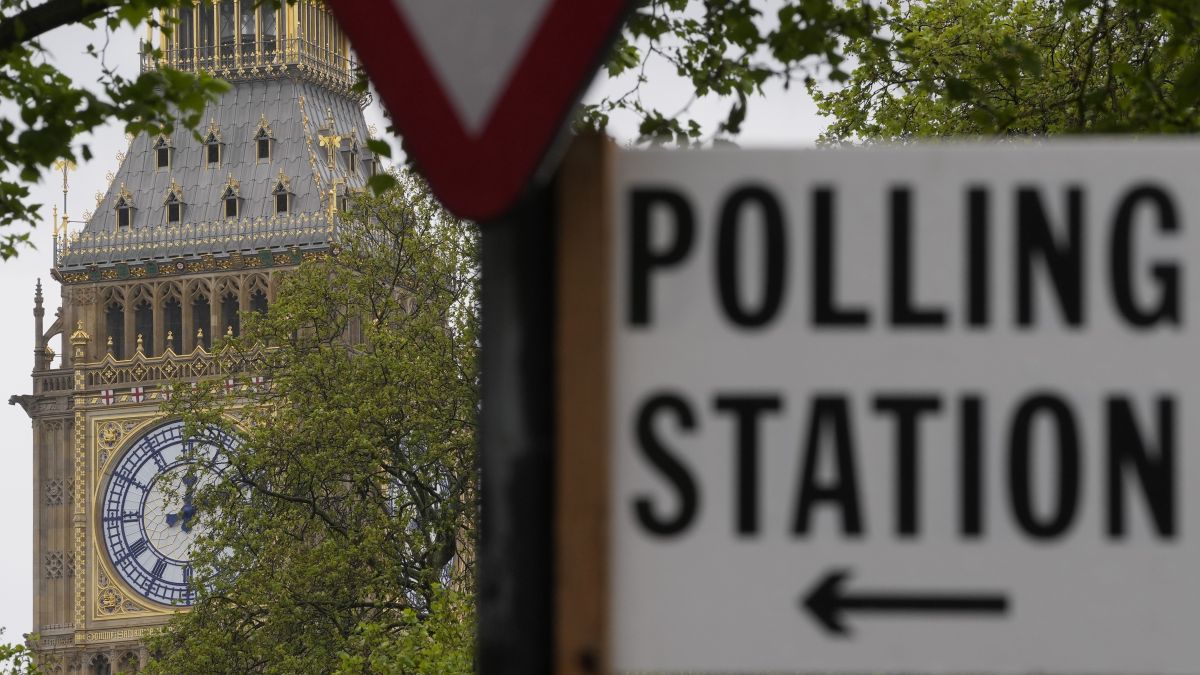
 "A sign points to where residents can cast their votes in London. File Image/AP")
2024 is the year of elections. Now it is time for the United Kingdom to vote. The country is on the cusp of a change. Poll after poll suggests that the Conservative Party is expected to face a big defeat and Labour will form a government.
It has been six weeks since Prime Minister Rishi Sunak announced on Downing Street the date of the polls, as rain poured down. It is an early election . July 4 was picked. It came as no surprise that it was a Thursday.
Elections in the UK have for years been held on the fourth day of the week. Here’s why.
Rishi Sunak’s announcement
The UK PM had until January 2025 to hold the elections. Yet on May 22 he announced that the country would go to polls on July 4 .
Speaking in the rain outside No 10, the PM said he spoke with the King to ask for the dissolution of Parliament. “The King has granted this request and we will have a general election on the 4th of July.”
If you are familiar with the ways of the British, there are no prizes for guessing that the poll falls on Thursday.
A Thursday election for 89 years
No law in the UK mandates that elections should be held on a Thursday. However, it has become a tradition that has been followed for over eight decades.
Impact Shorts
More ShortsVoting in general elections, by-elections for individual seats, and local elections are all held on a Thursday.
It was in 1935 that a general election was held on Thursday and it has been that way since, according to a report in _Independent.
_
The Fixed-term Parliaments Acts 2011 states that general elections must be usually held on the first Thursday in May once every five years. However, this is not set in stone. This year, the big day will be held in July and the last election took place on December 12, 2019.
The 2017 general election was held on June 8. The last election to be held in May was in 2015; the polling day was 7 May. All the polls were held on a Thursday.
Why Thursdays?
There is no one particular reason. It’s just become a custom now. However, many theories continue to do the rounds.
According to some, Fridays were considered unsuitable to hold the polls because it was traditionally payday. It is the day people spend winding down and socialising or visiting pubs, reports the BBC. Sunday is the day a large part of the population goes to Church and there was concern that their choices would be influenced by what they heard there.
A weekday for elections kept voters away from the pub or the Church. Back in the day, Thursday was considered a traditional market day in many towns and villages. It was a viable option, as people would be able to drop in at the polling station and cast their ballots on the way to the market.
Many see Thursday as an efficient day for polling, as results are typically announced by Friday morning. This allows for a smooth transition of power over the weekend with the prime minister having enough time to pick his Cabinet. Over the two days, a newly elected leader can settle down on Downing Street and be ready to brief civil servants by Monday morning, according to a report in the Independent.
With this routine, there is little disruption to governance.
Call for a change in the practice
In many countries, elections are held over the weekend. There has been a growing call that the UK should also follow this.
According to Professor Ailsa Henderson from the University of Edinburgh, a weekend vote would appeal to a lot of people. “Allowing it on more than one day – where one is a weekday and one is on the weekend – you’ll probably maximise your turnout,” she was quoted as saying by the BBC.
However, there has been criticism in the past that weekend voting would involve a high cost of overtime for election staff.
The exception
For 89 years, elections in the UK have been held on Thursdays. However, there was an exception in 1978.
The Scottish town of Hamilton held a by-election on a Wednesday in that year so that it would not interfere with the start of the 1978 football World Cup in Argentina the next day, reports the BBC.
That’s Britain and its love for the beautiful game.
The last general election that wasn’t held on a Thursday in the country took place on a Tuesday in October 1931.
With inputs from agencies