

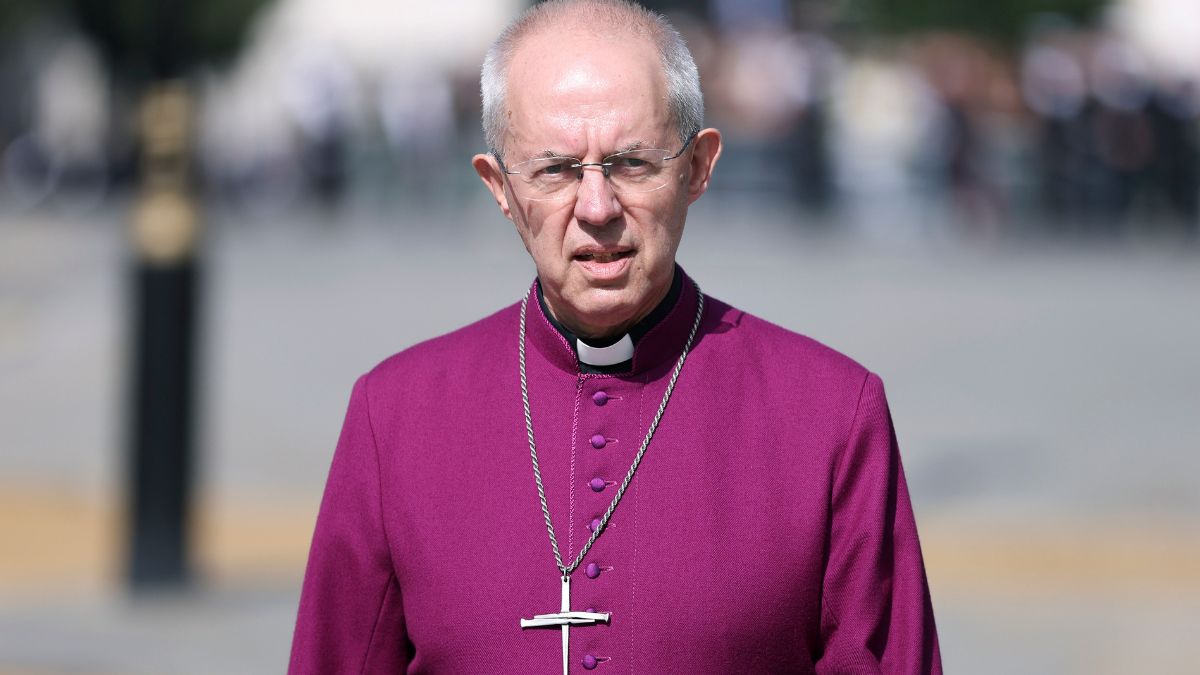
 "What’s the UK abuse scandal that led to the head of Church of England's resignation?")
The Church of England is under scrutiny over the cover-up of one of its worst abuse scandals. Amid intense pressure, the Archbishop of Canterbury Justin Welby has resigned after a damning report published last week found that he failed to act after discovering the abuse of boys and young men decades ago.
Welby, who refused to step down earlier, announced his resignation on Tuesday (November 12). He said in his resignation letter, “Having sought the gracious permission of His Majesty The King, I have decided to resign.”
Welby, the spiritual leader of 85 million (8.5 crore) Anglicans globally, said his decision was “in the best interests of the Church of England, which I dearly love and which I have been honoured to serve”.
“The Makin review has exposed the long-maintained conspiracy of silence about the heinous abuses of John Smyth. When I was informed in 2013 and told that police had been notified, I believed wrongly that an appropriate resolution would follow.
“It is very clear that I must take personal and institutional responsibility for the long and retraumatising period between 2013 and 2024.”
He said he stepped down in “sorrow with all victims and survivors of abuse.”
Statement from the Archbishop of Canterbury.https://t.co/aNnuLBMapo pic.twitter.com/pIIR1911QU
— Archbishop of Canterbury (@OfficeofABC) November 12, 2024
Impact Shorts
More ShortsLet’s take a closer look.
UK church abuse scandal
John Smyth, a senior British lawyer, abused over 100 boys and young men in the United Kingdom and Africa at Christian summer camps in the 1970s and 1980s, according to an independent review led by Keith Makin, a former social services director.
The report found that Smyth, over four decades, became “arguably, the most prolific serial abuser to be associated with the Church of England”. His victims involved 130 boys and young men across three countries – the UK, Zimbabwe and possibly South Africa.
Smyth subjected private schoolboys who attended evangelical Christian holiday camps to traumatic physical, sexual, psychological and spiritual attacks, reported The Guardian.
The physical abuse of boys and young men came to light in an investigation by Britain’s Channel 4 News in February 2017. It revealed how Smyth groomed his victims at Christian summer camps, universities and Winchester College, before viciously beating them.
As per New York Times (NYT), the Makin report said that Smyth convinced his victims “that the way to Christ was through suffering”.
“The impact of that abuse is impossible to overstate and has permanently marked the lives of his victims,” the report added.
It further said that it had found “clear evidence that the abuse perpetrated by John Smyth in the UK” was “‘covered up’, minimised and held as ‘secret’ from at least 1982 (and possibly earlier.)”
According to the Makin report, the Church of England knew “at the highest level” about the abuse since July 2013. Welby gained knowledge about the allegations against Smyth around August 2013, after he became the Archbishop of Canterbury.
The review concluded that Smyth could have been brought to justice had Welby formally reported it to police after taking over as the archbishop 11 years ago.
Welby volunteered at the holiday camps in the 1970s. As per the Makin report, he met Smyth at several such Christian summer camps run by the Iwerne Trust, between 1975 and August 1979.
“We have explored with Justin Welby his relationship at that time with John Smyth. He knew John Smyth from the Iwerne camps and was in John Smyth’s dormitory for two camps,” the report said, as per BBC.
“He has described being ‘impressed’ by John Smyth and reacting to his apparent power of intellect and charismatic [in the lay sense] personality. He says that they were never close, however.”
Smyth has rejected that he knew about Smyth’s physical abuse . The report says this is “unlikely”. “[Welby] may not have known of the extreme seriousness of the abuse, but it is most probable that he would have had at least a level of knowledge that John Smyth was of some concern … It is not possible to establish whether Welby knew of the severity of the abuses in the UK prior to 2013,” The Guardian cited the review as saying.
Reacting to the Makin report, Welby said in a statement that he had “no idea or suspicion of this abuse before 2013,” but admitted that he “personally failed” to ensure the abuse claims were investigated properly.
The report also found that Smyth’s “appalling” actions were identified in the 1980s, but he was not exposed by the church and allowed to leave the UK, which led him to continue his abuse abroad.
The powerful lawyer died in 2018 in South Africa’s Cape Town while he was under investigation by the UK’s Hampshire Police, reported Sky News.
Archbishop of Canterbury resigns
The independent review released last week created a storm, with calls rising for Archbishop of Canterbury Welby , the head of the Church of England, to resign.
Welby said last week he had considered resigning over his “shameful” decision not to act on reports of abuse by Smyth back in 2013.
However, Lambeth Palace said Monday (November 11) that Welby had “apologised profoundly both for his own failures and omissions, and for the wickedness, concealment and abuse by the church more widely”, adding that he did not intend to step down.
About 1,500 members of the church, including some from the General Synod – the church’s parliament, signed a petition calling for the archbishop to quit.
As pressure intensified, the Archbishop of Canterbury announced his retirement. This came hours after the UK Prime Minister Keir Starmer declined to back him publicly.
On Monday, the Bishop of Newcastle, Helen Ann Harlety, became the most senior member of the clergy to demand Welby’s resignation.
However, some point out that Welby stepping down is a side issue.
James, a survivor of Smyth’s abuse, told The Guardian, “There were plenty of other senior clerics who were aware of Smyth’s abuse, from early too. Replacing the Archbishop of Canterbury without a real change in culture is not enough as far as I’m concerned.”
Speaking to BBC, Andrew Graystone, an author who profiled Smyth’s abuse, condemned the culture of “cover-up and secrecy” within the church, adding that the Archbishop of Canterbury’s resignation is not enough to bring a change.
What happens next?
It could take months before a new Archbishop of Canterbury is installed.
Under the Church of England’s rules, Welby’s successor will be picked by a committee known as the Crown Nominations Commission. It will submit two names for nomination to the PM, in an order of preference.
The prime minister, in turn, will advise the monarch on the appointment.
With inputs from agencies


 "Russian drones over Poland: Trump’s tepid reaction a wake-up call for Nato?")
 "As Russia pushes east, Ukraine faces mounting pressure to defend its heartland")
 "Why Mossad was not on board with Israel’s strike on Hamas in Qatar")
 "Turkey: Erdogan's police arrest opposition mayor Hasan Mutlu, dozens officials in corruption probe")
 "Russian drones over Poland: Trump’s tepid reaction a wake-up call for Nato?")
 "As Russia pushes east, Ukraine faces mounting pressure to defend its heartland")
 "Why Mossad was not on board with Israel’s strike on Hamas in Qatar")
 "Turkey: Erdogan's police arrest opposition mayor Hasan Mutlu, dozens officials in corruption probe")



