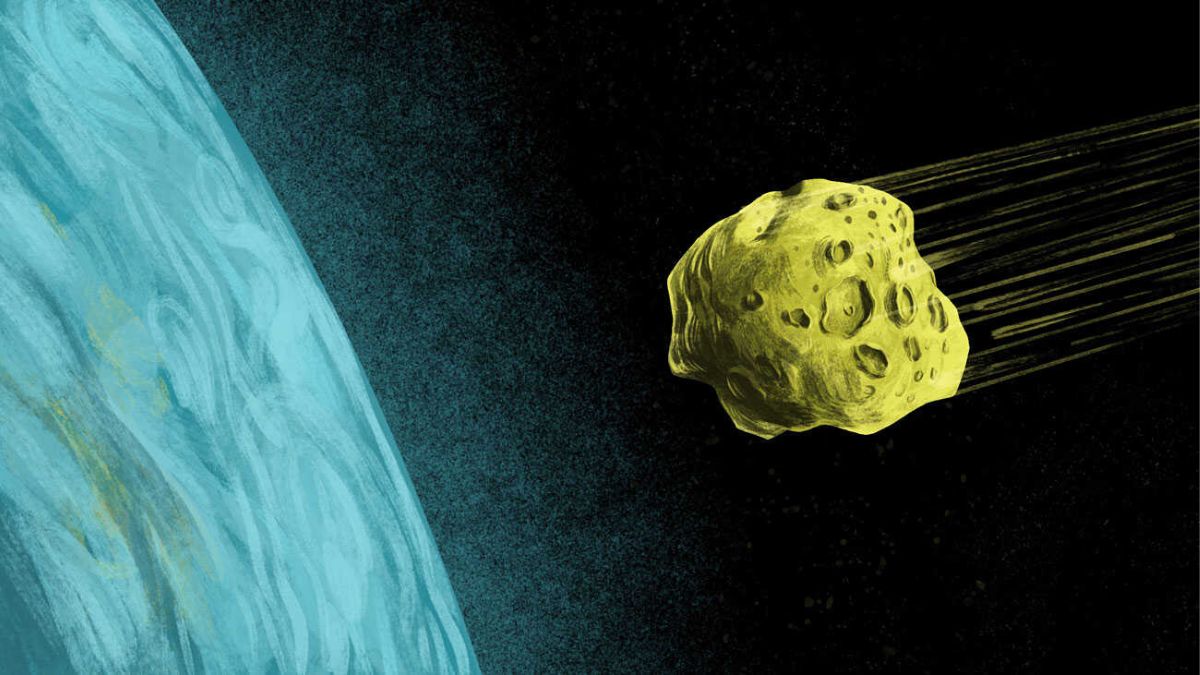
 "One asteroid of approximately 76 metres in size will
make a close approach towards Earth. Representative image. Reuters")
In the vast expanse of our solar system, another celestial close encounter is underway as two massive asteroids are making their way toward our planet, NASA said.
The premier US space agency raised a warning that asteroids, one nearly as big as a building, are approaching the Earth and will most likely pass by Earth by today (13 May). While asteroids passing by is not unusual, the fiery speed with which these two are travelling has become a concern.
But how dangerous are these asteroids and can they strike us? Here’s what we know
1. The two celestial visitors are named 2024 JB2 and 2020 JP10, and they measure between 60-130 metres and 52-120 metres wide, respectively. The asteroid 2024 JB2 is a part of the Apollo group of near-earth asteroids that have orbits intersecting with Earth’s orbit.
2. Asteroid 2024 JB2 is making its way to Earth at an astounding speed of 63,683 kilometres per hour, NASA’s Center for Near-Earth Object Studies (CNEOS) data revealed. Whereas, the other space rock is even faster and is heading towards Earth at a staggering 90,000 km per hour.
3. Data from NASA says that during their time of passing Earth, Asteroid 2024 JB2 will be 44.3 lakh km away from Earth whereas the other asteroid will be 72 lakh km from Earth.
4. The space agency constantly monitors known near-Earth objects using data from observatories worldwide, including NASA-funded ones like Pan-STARRS and Catalina Sky Survey. Planetary radar projects like the Goldstone Solar System Radar Group are also employed to track these objects, providing crucial information on their size, speed, and trajectory to evaluate potential impact risks for our planet.
Impact Shorts
More Shorts5. While the focus remains on the two sizable asteroids heading towards Earth, there’s another celestial visitor set to make a close approach. Named 2024 JQ12, this diminutive asteroid measures between 5 to 12 metres in width. According to projections, it will pass within 800,000 kilometres of Earth during its flyby, hurtling through space at a speed of around 11,000 kilometres per hour.
6. As per NASA, while most asteroids steer clear of Earth, a small subset falls under the classification of ‘Potentially Hazardous Asteroids’. These asteroids, larger than 140 metres, have orbits that bring them within 75 lakh km of Earth’s orbit around the Sun. In February a “stadium-size” asteroid sized between 210 metres and 480 metres — similar in size to New York City’s Empire State Building — was classified as a Potentially Hazardous Asteroid.
7. NASA explains that asteroids are nothing but remnants from the birth of our solar system approximately 4.6 billion years ago when vast clouds of gas and dust collapsed. Around 994,383 asteroids are known to exist in the solar system, with no two of them alike.
8. The asteroids capable of causing a ‘global disaster’ if they hit the Earth are extremely rare, NASA says. They probably would need to be about a kilometre or more in diameter. Such bodies impact the Earth only once every 100,000 years on average. The last such devastating hit was recorded 11 years ago in Russia, when an asteroid named Chelyabinsk slammed into Earth’s atmosphere emitting energy equivalent to the detonation of about half a million metric tonnes of TNT.
9. Five years, on April 13, 2029, the near-Earth asteroid ‘Apophis’, nicknamed ‘God of Destruction’, will make an incredibly close approach to Earth, passing within approximately 48,280 kilometres, NASA says. This historic event which can be visible to the naked eye, will allow the agency’s OSIRIS-REx spacecraft to study this 1,000-feet-wide celestial visitor up close.
With inputs from agencies