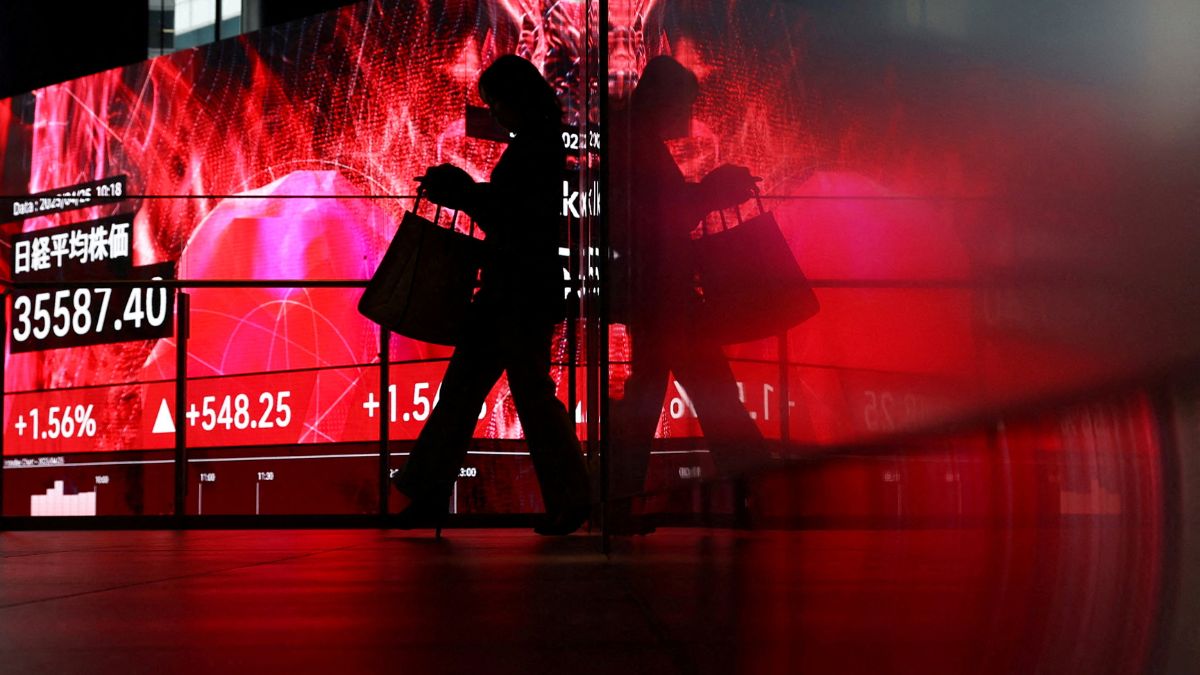
 "Trump’s trade war by numbers: Who benefited, who bled and what comes next?")
United States President Donald Trump’s sweeping tariffs on major global economies have resulted in a mixed bag of economic outcomes across continents.
From the US and Europe to China and Taiwan, the repercussions of his aggressive trade policies are visible in everything from factory output to GDP forecasts.
Touted by Trump as a means to restore balance to America’s trade relationships and shield US industries, the reality — when measured in economic data — reveals a far more uneven picture across continents.
US economy: A mixed bag
The US economy contracted at a 0.3 per cent annual pace in the first quarter of 2025, marking the first economic shrinkage in three years.
The contraction was largely driven by businesses front-loading imports to avoid the higher costs associated with Trump’s escalating tariffs. Despite the dip, Trump remained defiant in tone.
“This is Biden’s Stock Market, not Trump’s,” said Trump, attributing the downturn to his predecessor. “Our Country will boom, but we have to get rid of the Biden ‘Overhang.’”
He continued: “This will take a while, has NOTHING TO DO WITH TARIFFS, only that he left us with bad numbers, but when the boom begins, it will be like no other. BE PATIENT!!!”
However, the fallout from the tariffs became immediately apparent in the markets and in corporate America. The trade policy introduced uncertainty that clouded earnings seasons, with multiple firms pulling or reducing their forward guidance.
Wall Street reflected the nervousness: the Dow Jones Industrial Average dropped 466.73 points (1.15 per cent) to 40,061.02; the S&P 500 fell 1.5 per cent to 5,477.54; and the Nasdaq Composite declined 1.97 per cent to 17,117.58.
Meanwhile, key indicators showed contradictory signals. While the Personal Consumption Expenditures (PCE) price index remained unchanged and consumer spending showed resilience, the dollar strengthened and bond yields saw marginal movement.
The yield on 10-year Treasury notes dropped slightly to 4.164 per cent, and the two-year note yield fell to 3.613 per cent, signalling cautious sentiment regarding future Federal Reserve rate moves.
Trump, addressing concerns about everyday consumer impact, remarked, “US kids may get ‘2 dolls instead of 30’ but China will suffer more in trade war.”
Factories stumble in China
China’s economy has been one of the primary targets of Trump’s tariff regime, and the effects are now clearly visible in its industrial output data.
The purchasing managers’ index (PMI) in China fell to 49.0 in April — the lowest reading since December 2023 — indicating contraction and marking a steep decline from March’s 50.5.
The National Bureau of Statistics (NBS) reported that this was below the forecast of 49.8 in a Reuters poll. The non-manufacturing PMI, while still above the growth threshold, also fell from 50.8 to 50.4, underscoring wider economic drag.
Much of the initial boost China experienced in exports — over 12 per cent in March — was due to front-loading by businesses before US tariffs as high as 145 per cent took effect in April.
Beijing responded with reciprocal tariffs of up to 125 per cent on American imports. However, as those shipments slowed in April, so too did factory activity.
While Chinese officials expressed confidence in the nation’s ability to weather the US trade shock, the latest data suggests that domestic demand remains weak, and export-dependent manufacturing is under pressure.
The International Monetary Fund, Goldman Sachs and UBS have all revised their forecasts for China’s economic growth downward, anticipating that the country will miss its official targets for 2025 and beyond.
A short-lived growth spurt in Europe
In contrast to the US and China, the Eurozone reported relatively robust economic growth of 0.4 per cent in the first quarter of 2025. This growth was driven, in part, by a surge in exports to the United States before new tariffs came into effect. However, optimism was short-lived.
On April 2, just two days after the first quarter ended, Trump imposed a new 20 per cent tariff on goods imported from the European Union.
That blow, coupled with ongoing levies on steel, aluminium and automobiles, led to widespread downgrading of the Eurozone’s economic forecasts.
The European Central Bank responded by continuing its monetary easing, cutting its benchmark interest rate for the seventh time in its current cycle, most recently on April 17. Inflation has eased to 2.2 per cent, creating room for further rate reductions.
Germany, the region’s largest economy and heavily reliant on exports to the US, has been particularly affected.
The German parliament recently approved a €500 billion ($570 billion) investment fund to stimulate infrastructure growth, but the federal government has already lowered this year’s GDP growth projection to zero, following two years of economic contraction.
Taiwan and India: Riding the tariff wave differently
Some economies have seen unexpected benefits in the short term due to the reordering of global supply chains. Taiwan’s economy grew 5.4 per cent in the first quarter of 2025, its fastest pace since early 2024.
This was largely attributed to a rush in technology exports ahead of anticipated US import tariffs. Taiwan’s Directorate General of Budget, Accounting and Statistics subsequently raised its full-year growth forecast to 3.6 per cent from a previous 3.14 per cent.
Major companies like TSMC, Apple and Nvidia played key roles in driving this surge. TSMC, the world’s largest contract chipmaker, posted a 60 per cent year-on-year jump in first-quarter net profit, signalling strong global demand — particularly for AI-related applications.
India, meanwhile, continues to walk a tightrope. Deloitte estimates GDP growth for the fiscal year at between 6.5 per cent and 6.7 per cent, with a slightly lower range of 6.3 per cent to 6.5 per cent forecast for FY25.
The Indian government’s Rs 1 lakh crore ($12 billion) tax incentive package announced in the 2025 Union Budget is aimed at spurring domestic demand. However, uncertainties in global trade — particularly the ripple effects of Trump’s tariffs — could pose risks.
“Growth this fiscal will be contingent on two opposing forces,” noted Deloitte. The firm highlighted the tension between domestic policy support and global trade disruptions.
Deloitte also indicated that a proposed bilateral trade agreement with the US, expected by fall, could help mitigate tariff risks and create new export opportunities.
How market response has looked like
Global financial markets have reflected the turmoil sparked by the trade war. European stocks, which had rallied early in the quarter, erased gains following the release of US GDP data.
The pan-European STOXX 600 slipped 0.12 per cent, and the FTSEurofirst 300 declined by 0.18 per cent.
In Asia, sentiment has been relatively upbeat. MSCI’s index of Asia-Pacific shares outside Japan rose 0.78 per cent, and Japan’s Nikkei climbed 0.57 per cent to 36,045.38. Emerging market stocks also edged higher, reflecting optimism in select regions less directly exposed to the tariff duels.
Currency markets responded to the diverging economic signals. The dollar index rose 0.26 per cent to 99.42. The euro weakened to $1.1363, while the yen fell to 142.75 per dollar. Sterling declined to $1.3339, and the Mexican peso dropped 0.35 per cent. Conversely, the Canadian dollar strengthened slightly by 0.08 per cent.
Oil markets took a sharp hit. US crude dropped 1.89 per cent to $59.30 per barrel, while Brent fell 1.6 per cent to $63.22 per barrel — marking their steepest decline in three and a half years as fears of reduced global demand mounted.
Gold also retreated, with spot gold down 0.39 per cent to $3,302.72 per ounce and US futures sliding 0.66 per cent to $3,297.00.
The global economic data paints a clear picture: Trump’s tariffs have reshaped trade dynamics with measurable consequences. Some countries, like Taiwan and India, have experienced short-term boosts, while others — most notably the US, China and Germany — have absorbed significant setbacks in key economic indicators.
With inputs from agencies

 "Pentagon no longer views China as top threat, offers 'more limited' support to US allies")
 "'Governor Carney sorely mistaken': Trump threatens 100% tariff on Canada over its potential China trade deal")
 "Bangladesh out of 2026 T20 World Cup, announces ICC; Scotland named replacement team")
 "Monster winter storm cancels nearly 10,000 US flights, leaves millions bracing for ice and outages")
 "Pentagon no longer views China as top threat, offers 'more limited' support to US allies")
 "'Governor Carney sorely mistaken': Trump threatens 100% tariff on Canada over its potential China trade deal")
 "Bangladesh out of 2026 T20 World Cup, announces ICC; Scotland named replacement team")
 "Monster winter storm cancels nearly 10,000 US flights, leaves millions bracing for ice and outages")