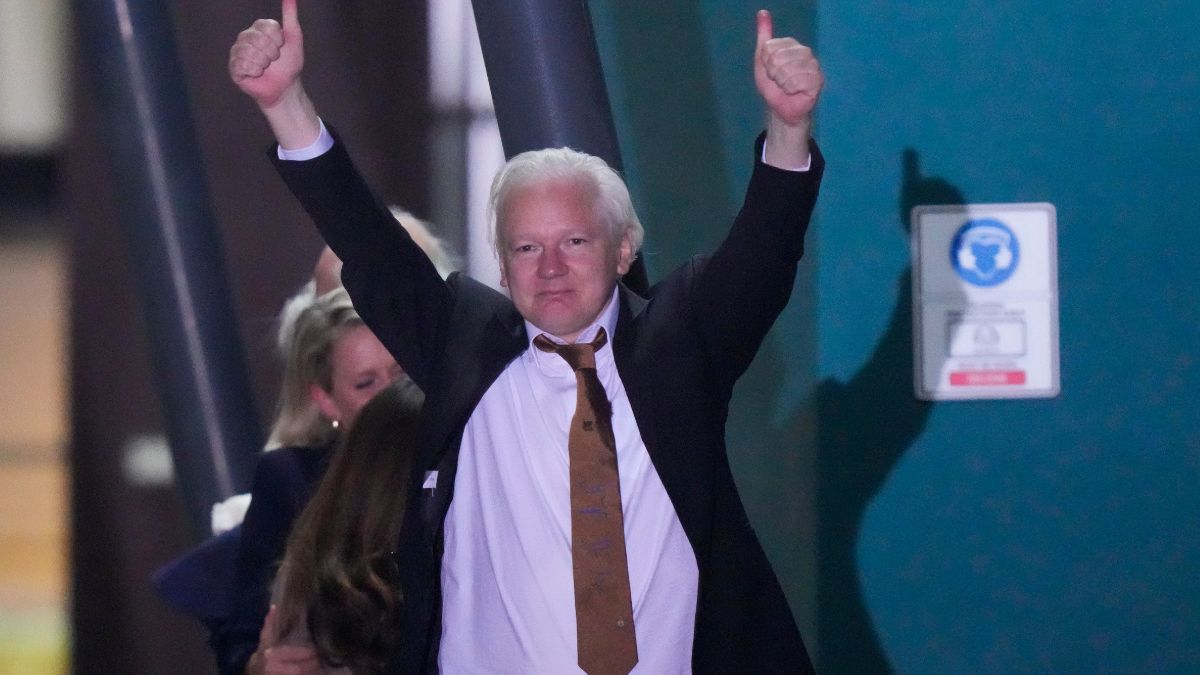
 "WikiLeaks founder Julian Assange is a free man now. File Photo/AP")
What a week it was to end June!
WikiLeaks founder Julian Assange finally gained his freedom.
The United States saw its first presidential debate between Joe Biden and Donald Trump. From the economy to abortion, every topic was on the table. But it is not each contender’s reply that has made headlines.
In Kenya, protesters forced the government to withdraw a finance bill containing controversial tax hikes.
Tajikistan, which has over 90 per cent Muslim population, has banned the hijab.
Here’s all this and more in our weekly roundup of explainers from around the world.
1. WikiLeaks founder Julian Assange’s years-long legal woes came to an end this week. The 52-year-old, who published hundreds of thousands of leaked government documents online, reached a plea deal with US prosecutors.
Assange flew from London to Saipan, a US commonwealth north of Guam, to get his freedom. The plea deal ended attempts by the US Justice Department to extradite him to America.
Assange is now in his homeland of Australia. His wife told reporters, “Julian plans to swim in the ocean every day. He plans to sleep in a real bed. He plans to taste real food, and he plans to enjoy his freedom.”
But why did he travel to the island of Saipan? We explain this in our report .
2. US President Joe Biden faced off with his Republican rival Donald Trump in a widely watched debate hosted by CNN in Atlanta. Both traded barbs and accused each other of being history’s worst presidents.
Impact Shorts
More ShortsBiden, a Democrat, did not shy away from bringing up Trump’s status as a convicted felon or his “having sex with a porn star on the night, while your wife was pregnant?”
“You have the morals of an alley cat,” the US president declared.
Trump, 78, who sounded more confident (even while diverting facts) than his rival, took potshots at Biden over his lack of cohesion. “I really don’t know what he said at the end of that sentence. I don’t think he knows what he said either.”
So, who was the winner of this nearly two-hour debate? Read our story to find out.
3. Kenya witnessed deadly protests this week, with demonstrators setting a part of Parliament on fire. Scores of people died in the protests against the country’s finance bill. The bill aimed to increase taxes or fees on several daily items and services including internet data, fuel, bank transfers and diapers.
As anger against the controversial tax hikes grew, Kenyans took to the streets to express their dissent. It was TikTok that spurred these protests. But how? Here’s our story delving into the role of young content creators in Kenya’s protests.
4. It was not supposed to be spotted. Manta Ray, a sophisticated unmanned underwater vehicle (UUV) of the US, was seen on Google Maps, garnering attention. The top-secret submarine prototype was found by Google Maps docked at the Port Hueneme naval base in California.
The incident sparked speculations about its capabilities and purpose. Read our story on this submarine drone and how it is used by the US military.
5. Tajikistan has banned the hijab, terming it as “alien” to its culture. The Parliament of the Muslim-majority nation passed a bill to amend the existing law ‘On Regulation of Holidays and Ceremonies’ and forbid the “import, sale, promotion and wearing of clothing deemed foreign to the national culture”.
The move has angered several citizens and Muslim advocacy groups, who argue that people should have the freedom to choose what they want to wear. We explain in our report why Tajikistan has taken this step.
6. While the world is mulling adopting a four-day work week, Greece is moving backward. The European nation is implementing a six-day work week from July.
Although officially the 40-hour work week remains, employers in Greece can now ask staff to work up to an extra two hours per day or work for eight hours on the sixth day. Why is the country doing this? Where do other countries in Europe stand? Read our story to find out.
You are all caught up for the week. If you like the way we explain, you can bookmark this page .