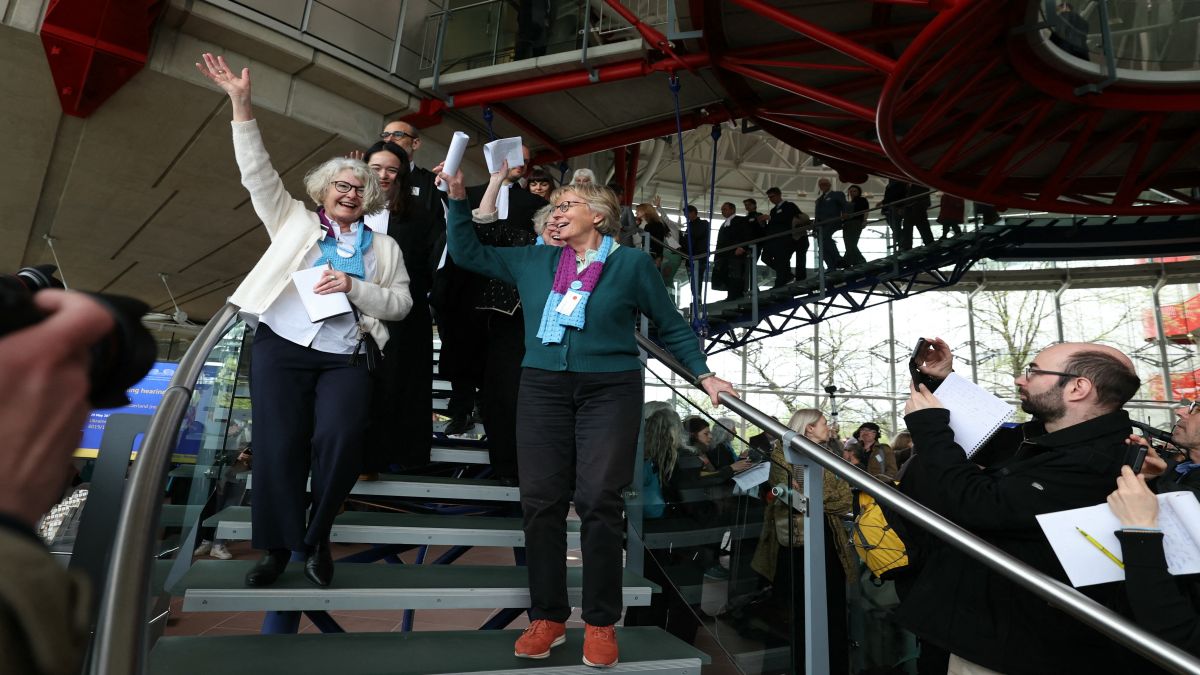
 "Members of Swiss association Senior Women for Climate Protection celebrate after the European Court of Human Rights (ECHR) said Switzerland was not doing enough to tackle climate change, in the first such ruling on the responsibility of states in curbing global warming. AFP")
Governments be warned: You must protect your citizens from climate change — it’s their human right.
On Tuesday (9 April), a group of elderly Swiss women , called KlimaSeniorinnen or Senior Women for Climate Protection, won the first ever climate case victory in the European Court of Human Rights. Europe’s top court ruled that Switzerland’s efforts to meet its emission reduction targets had been woefully inadequate.
But this isn’t the only such climate litigation case around the world. There are several such instances, with the United Nations stating that the total number of such cases has more than doubled since 2017 and is growing worldwide.
We take a closer look at the rise of climate action cases and why experts state that these will only increase in the years to come.
The Swiss climate case
On Tuesday (9 April), the ‘Climate Grannies’ as they are called won a significant ruling on holding governments accountable for addressing climate change. The European Court of Human Rights (ECHR) found that Switzerland failed to implement sufficient climate policies — violating the women’s human rights.
The case finds its origins in 2016 when the elderly women complained about the “failings of the Swiss authorities” in terms of climate protection that could “seriously harm” their health. And after eight years of litigation, the women emerged victorious.
The ECHR ruled by 16 judges to 1 that the women were subject to a violation of Article 8 as well as (unanimously) Article 6 — the right to a fair trial in their country.
Impact Shorts
More ShortsFollowing the landmark verdict, Rosmarie Wydler-Wälti, a leader of KlimaSeniorinnen Schweiz, told Reuters, “We keep asking our lawyers, ‘Is that right?’
“And they tell us, ‘It’s the most you could have had. The biggest victory possible.’”
Popular Swedish climate campaigner Greta Thunberg joined the women at the court in Strasbourg and hailed the decision. “This is only the beginning of climate litigation. This means that we have to fight even more, since this is only the beginning. Because in a climate emergency, everything is at stake.”
Switzerland will now be obligated to update its climate change policies; it would have to take greater action on reducing emissions, including revising its 2030 emissions reduction targets to get in line with the Paris Agreement goal of limiting warming to 1.5 degrees Celsius.
As per experts, this ruling could have a ripple effect in Europe and beyond; it could set precedent for how courts could deal with climate litigation cases argued on the basis of human rights infringements.
Rising tide of climate litigation
But this isn’t the only climate change lawsuit that has been filed. In 2020, six young people from Portugal filed a case against 32 European countries, including Britain, Switzerland, Norway, Russia and Turkey, seeking action against these nations.
The youth, aged between 12 and 14, argued that climate change threatens their rights to life, privacy, mental health and other matters. They had filed the case, they said, following the horrific wildfires of 2017. However, the ECHR had ruled out their case owing to geographic stretch. The court found that there were no grounds in the Convention for the “extraterritorial jurisdiction” sought by the applicants.
Former mayor of the French town of Grande-Synthe, Damien Careme, had also brought a case in 2019, complaining about the “deficiencies” of the government putting his town at risk from rising sea levels. That case was rejected by the ECHR as Careme didn’t live in France — having moved to Brussels to take a post as a member of the European Parliament.
In 2020, 16 children — between the ages of 5 and 22 — took the American state of Montana to court for, they said, violating their right to a clean environment, which is enshrined in the state’s constitution. In 2023, after a protracted court fight, they won with the court stating that Montana must consider the effects of climate change when deciding whether to begin or renew fossil-fuel projects.
And as recently as 21 March, India’s Supreme Court recognised a right to be free from the adverse effects of climate change as a distinct right, emphasising that India must prioritise clean energy initiatives such as solar power. The judgment stemmed from a petition filed by wildlife activist MK Ranjitsinh and others to protect the Great Indian Bustard (GIB), a critically endangered bird found only in Rajasthan and Gujarat.
According to the UN Environment Programme (UNEP), there is a rise in climate litigation and many are viewing it as a tool to secure climate action and justice. As per the UNEP, the number of climate action cases has increased from 884 in 2017 to 2,180 in 2022. And while most cases have been brought in the US, it is taking root across the globe with about 17 per cent of cases now being reported in developing countries, including Small Island Developing States.
Cause for rise in climate litigation
But why is there a rise in such cases? Dr Joana Setzer, an Assistant Professorial Research Fellow at the Grantham Research Institute on Climate Change and the Environment, has a theory on the increasing number of cases pertaining to climate change.
She said: “We have seen a big increase in climate cases in the last 10 years or so and there are several interconnected reasons behind why this could be the case. Firstly, there has been an increase in awareness of the climate problem – the causes, the consequences and the urgency of acting. The science on this is very robust and we have a better understanding of the problems as a society. This helps provide the evidence needed for litigation.”
“There is also a growing sense of frustration that the law and passing legislation are not enough. Seeing heads of state go to international conferences and shake hands over new agreements is promising but not good enough. Often these promises don’t translate into action,” she further explained.
And this is echoed by Richard Wiles, president of the Center for Climate Integrity, a non-profit that tracks and supports climate complaints. In a report published by The Guardian, he said, “We might look back and say 2024 is the year that climate lawsuits really took off.”
Experts also note that through this kind of litigation, people more vulnerable to climate change, including young people, women, and Indigenous people, are given a voice when they are otherwise left out of public policymaking. “It’s an equalizer in a way, because it provides different communities with this opportunity to challenge ambition in climate change action, in ways that at the regular governance level is not possible,” said Maria Antonia Tigre of the UNEP.
Impact of climate litigation
Climate activists note that climate litigation has become a truly global movement; Dr Setzer was quoted as saying that it “has grown to have a life of its own.”
Moreover, it can safeguard a country’s climate policy from changing governments. For instance, the victory of the far-right in the Netherlands’ general election raised concerns that the country’s climate policy could be watered down. But a court decision set a minimum threshold for what the government must achieve.
In some cases, a climate change case can see impact beyond its original jurisdiction. Experts in Pennsylvania found that the Montata ruling gave fuel to adding green provisions into state constitutions.
It also gives impetus to climate awareness. More people are made aware of the hazards of climate change and may facilitate a change in people’s attitudes.
Climate litigation also helps to change the narrative and hold people and corporations accountable. An example of this would be French bank BNP Paribas announcing in May 2023 that it would stop funding new gas projects. The move came a few months after campaigners sued the bank for financing fossil fuels.
The year 2024 could also see new climate cases; litigants are attempting to hold corporations such as Delta Airlines, Nike and Etsy accountable for greenwashing. There’s also the new cases against plastic producers.
Only time will tell how climate litigation grows, but one’s thing is for certain: it’s not going anywhere.
With inputs from agencies