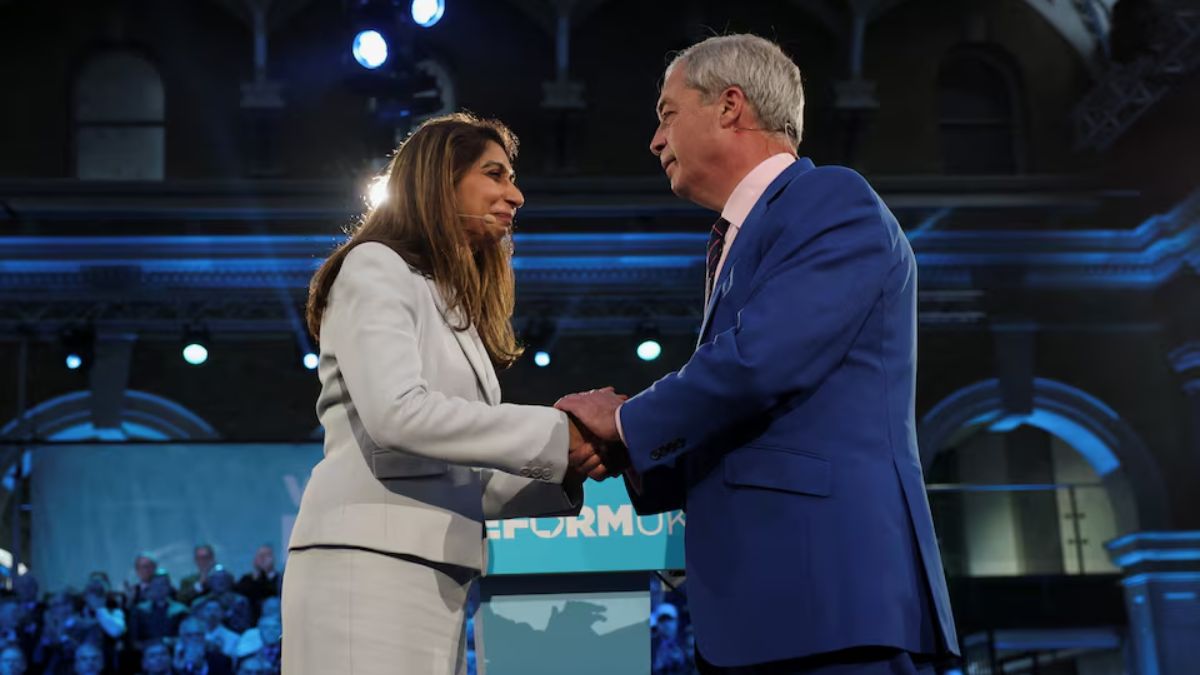
 "Former British Home Secretary Suella Braverman, who today announced she has defected from the Conservative Party to Reform UK, looks at Britain's Reform UK leader Nigel Farage as they attend the Veterans for Reform press launch, in London, Britain, January 26, 2026. Reuters")
Suella Braverman’s decision to defect to Reform UK is not just another blow to Kemi Badenoch’s attempt to stabilise the Conservatives after their 2024 defeat. It also changes what Reform is being judged on.
Earlier this month, Badenoch sacked Robert Jenrick from the shadow cabinet for plotting to defect to Reform. Hours later, he did just that. Braverman’s move takes Reform’s number of MPs to eight. Party leader Nigel Farage has said Reform had been in talks with her for a year .
At this point, though, Reform is at risk of absorbing so many former Tories that it starts to look like the establishment it denounces. This recruitment spree rewrites the insurgent brand.
Reform’s leadership will understandably celebrate Braverman’s arrival as a serious coup. She is a former home secretary and a national media figure. Her departure is an unmistakable signal that the Conservative right is fragmenting. The Times reports she told supporters it felt like she had “come home”, but there is a basic strategic tension here.
Reform has thrived by arguing that British politics is run by a closed circle of insiders who repeatedly fail and are then reshuffled into new jobs. A rapid intake of ex-ministers risks making Reform look less like a clean break and more like a migration route for political careers.
Quick Reads
View AllThat attack line is already being deployed. After former chancellor Nadhim Zahawi’s switch earlier this month, the Liberal Democrats described Reform as “ a retirement home for disgraced former Conservative ministers ”. The same basic charge has followed Braverman’s move: critics argue that people who helped shape the recent Conservative record are now trying to rebrand themselves within Reform rather than account for it.
For Reform, then, the immediate gain in publicity comes with a reputational cost: the party becomes easier to frame as a collection of defectors rather than a coherent alternative.
The May deadline: Reform knows the danger
If Reform were confident that any defection is good news, it would have no need for a cut-off date. But Farage has set the local elections date of May 7 as the latest date he will take Conservative switchers. After that, he believes his party would start to look like “a rescue charity for every panicky Tory MP”.
That is revealing. It implies Reform is trying to capture the benefits of defections (experience, profile, the aura of inevitability) while limiting the downside (brand dilution, factional chaos, accusations of being “Tories in new colours”). A deadline is, in effect, an admission that there is such a thing as too many ex-Tories… or at least too many arriving too quickly.
The deeper issue is organisational. Recruiting MPs is not the same as building a party machine. Defectors bring personal followings, constituency operations, donor networks and ideological baggage. They can add reach, but they can also add volatility, especially if Reform’s appeal relies on projecting discipline and clarity.
And internal tensions are not theoretical. Braverman and Jenrick are not merely Conservatives who happen to have drifted rightwards. They were also senior figures in a government that Reform has attacked as incompetent and deceitful.
That is why a July 2025 post on X by Zia Yusuf (widely circulated as Braverman joined) lands so sharply. In the post, the head of policy at Reform UK referred to the Conservative government’s handling of an Afghan data leak and secret resettlement, asking, “Who was in government?” and then named Braverman as home secretary and Jenrick as immigration minister.
The point isn’t whether Yusuf’s earlier argument was fair or unfair. It’s that it feeds an “own goal” narrative. Reform’s senior figures have recently depicted these people as emblematic of the failures of the Conservative state, and now the party is inviting them into the tent.
That forces Reform into a delicate position. If it embraces defectors uncritically, it weakens its anti-establishment brand. If it keeps attacking them, it destabilises its own recruitment strategy.
Braverman’s seat: Opportunity and risk
Braverman’s own constituency, Fareham and Waterlooville, illustrates why Reform wants converts of her stature and why the strategy can backfire.
On official local results for the 2024 general election , Braverman won with 35 per cent of the vote; Reform placed fourth on 18 per cent, behind Labour (23 per cent) and the Liberal Democrats (19 per cent).
That is the kind of compressed result Reform dreams about: a sizeable right-populist base already present, plus a Conservative vote that if transferred could turn a marginal into a secure Reform seat. From this perspective, defections are not just PR. They are an attempt to solve Reform’s hardest electoral problem: converting diffuse national support into winnable constituency coalitions.
But the same numbers show the danger. If Braverman fails to bring a large share of Conservative voters with her, the most likely short-term effect is to make the seat more competitive for her opponents through vote fragmentation and tactical voting. Defections can therefore produce a paradox: they make Reform look bigger nationally while making individual contests messier locally.
And at the national level, the risk is huge. Reform’s central claim – that it is the “alternative” to a failed political class – is now colliding with the reality of who it is recruiting from that class.
If Reform wants to remain a pure insurgency, it must keep its distance from establishment figures and prioritise new candidates. If it wants to look like a credible government-in-waiting, it will keep collecting experienced politicians, but it must then accept the costs – intensified scrutiny, more ammunition for opponents, and the constant suspicion that it is simply rebranding Conservatism rather than replacing it.
Thomas Lockwood , PhD Researcher in Politics, York St John University
This article is republished from The Conversation under a Creative Commons license. Read the original article .