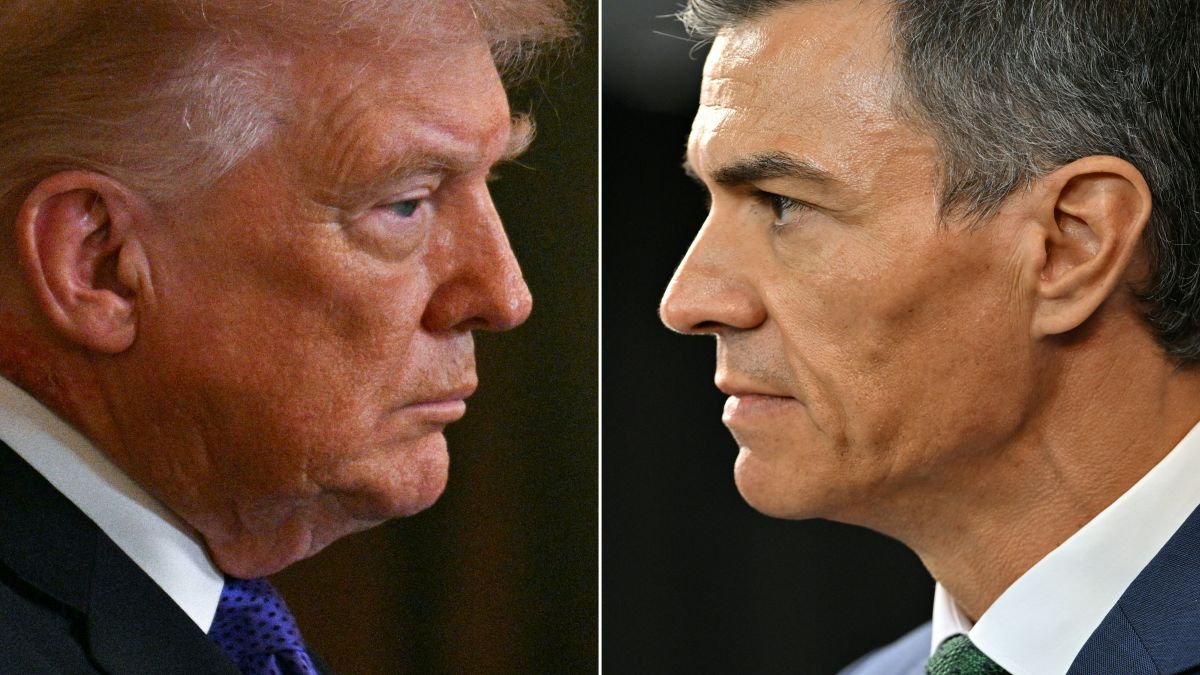
 "Spain's decision to restrict its airspace and military bases to the US for any operations linked to the ongoing war in Iran is the latest in a series of disagreements between US President Donald Trump and Spain's PM Pedro Sanchez. File image/AFP")
In the early days of the Iran war, Spain’s Prime Minister Pedro Sanchez deemed the US strikes on the Islamic Republic as a violation of international law, becoming the only European head of government to publicly reject the war on principle.
Now, days later, as the war in West Asia escalates and widens, Spain has closed its airspace to planes of the United States involved in the US-Israel war on Iran.
This marks the latest disagreement between the two countries and their leaders in recent months.
- Catch the latest developments from the Iran war here
But what’s behind Pedro Sanchez’s motivations to go up against the US? What complications arise with the imposition of the airspace ban?
Spain closes airspace to US planes
On Monday (March 30), Spain’s Defence Minister Margarita Robles announced that the country has closed its airspace to US planes involved in attacks on Iran. “We will not authorise the use of Morón and Rota [military bases] for any acts related to the war in Iran,” she said, adding that Spain had “made this clear to the American government from the beginning”.
US military aircraft can continue to use the bases within the terms of a bilateral agreement, such as providing logistics support to the 80,000 US forces based in Europe.
This latest move comes after the Spanish PM told Congress last Wednesday, “We have denied the United States the use of the Rota and Morón bases for this illegal war. All flight plans involving operations in Iran have been rejected. All of them, including those for refuelling aircraft.”
In simple terms, flyovers by bombers or tanker aircraft participating in Operation Epic Fury are not being approved. The Spanish ban has a single exception: in emergency situations, the aircraft in question will be authorised to transit or land.
Consequences of Spain’s refusal to use its airspace
Spain’s closing its airspace to the US for the purpose of strikes on Iran has complicated efforts for Washington. Following its decision, some fifteen KC-135 aircraft departed Spain for France or Germany. These tanker aircraft constitute a fundamental pillar of air power.
Moreover, the US has had to seek an alternative location in Europe for its B-52 bombers and B-1s. Now, these aircraft are housed at Fairford Air Base in Gloucestershire, southeastern England. While the B-52s and B-1s have enough range to strike Iran and return to England without refuelling, for practical reasons, the amount of bombs they can carry is inversely proportional to the amount of fuel. The less kerosene they carry at take-off, the more munitions they can load.
Quick Reads
View AllDefence experts note that bombers taking off from Fairford in England must cross France from north to south and refuel once they reach the Mediterranean, which comes with great risk. As El País stated in one report, in some cases where the bombers have not flown over France — either because Paris has not authorised it due to the payload or for operational reasons — they have had to circle the Iberian Peninsula to enter through the Strait of Gibraltar; since, as explained, Spain does not authorise them to enter its airspace.
US reaction to Spain’s move
Sanchez’s decision to cut off its airspace to the US hasn’t gone down well with the Trump administration. US Secretary of State Marco Rubio said that Spain’s leaders are “bragging" about cutting off its airspace, even as Washington has pledged to defend the Nato member. He said that the trans-Atlantic military alliance is useful for the US, because it “allows us to station troops and aircraft and weapons in parts of the world that we wouldn’t normally have bases, and that includes in much of Europe.”
“But if NATO is just about us defending Europe if they’re attacked, but then denying us basing rights when we need them, that’s not a very good arrangement,” Rubio told Al Jazeera. “That’s a hard one to stay engaged in and say this is good for the United States. So all of that is going to have to be reexamined.”
Additionally, US President Donald Trump had earlier warned Spain of cutting trade if the European nation denied them the use of Rota and Morón military bases in southern Spain.
Growing differences between Spain and US
Spain’s closing its airspace to the US is yet another disagreement between the two countries in recent times.
Earlier, after the US and Israel launched airstrikes on Iran on February 28, Spain’s Prime Minister Pedro Sanchez had said that Madrid opposed this mission. At the time, he condemned US and Israeli strikes on Iran, calling them “an unjustified and dangerous military intervention that is outside of international law”.
Days later, in a televised address, the 54-year-old Spanish leader once again reiterated his stance on the Iran war, saying: “The position of the government of Spain can be summed up in four words: no to war.”
“We will not be complicit in something that is harmful to the world and contrary to our values and interests, simply out of fear of retaliation,” he added. “We oppose this disaster,” Sanchez said, arguing that his stance is shared by “many other governments” and “millions of citizens across Europe, North America and West Asia who do not want more war or uncertainty tomorrow”.
Following this, US President Donald Trump threatened to impose a full trade embargo on Spain over its opposition to the Iran war. “Spain has been terrible,” Trump told reporters at the White House during a meeting with German Chancellor Friedrich Merz, adding that he told Treasury Secretary Scott Bessent to “cut off all dealings” with Madrid.
Earlier too, Trump and Sanchez had their differences when the Spanish leader said that his government wouldn’t increase its defence spending in accordance with a deal agreed to by other Nato members following Trump’s pressure. At the time, Sanchez’s government said that Spain could meet its military commitments by spending 2.1 per cent of gross domestic product on defence, instead of the five per cent the rest of the 32-nation military alliance agreed upon.
Sánchez also has been among the most vocal critics of Israel’s actions during the war in Gaza , which has invited criticism from the Jewish nation’s government on several occasions. Last October, Spain’s parliament approved the enshrinement in law of a total arms embargo on Israel, permanently banning the sale of weapons, dual-use technology, and military equipment.
Motivations behind Sanchez’s position on the war
But what is driving Sanchez’s adversarial position? Is it ethics or politics? Many suggest that it’s driven by the politics of his government. Sanchez runs a fragile coalition government with the support of smaller left-wing parties and regional allies, including Catalan separatists. Many of the smaller allies in his coalition oppose US military intervention. Hence, backing Washington or even facilitating the war through US bases could risk his government.
But there’s more. Sanchez has earned a reputation for repeatedly surviving political crises. Despite declining poll numbers and ongoing scandals within his party and inner circle, he appears to be betting that Trump’s deep unpopularity in Spain will ultimately work to his advantage, particularly among his left-leaning base.
And recent elections may suggest that he’s betting right. The results show that there’s a strong-anti war stance, making him more appealing to voters across party lines.
There’s also the fact that he’s hoping that by standing up to Trump, he distracts the public from the corruption allegations against his wife — allegations he claims were cooked up by right-wing operatives to harass him.
Only time will tell if Sanchez’s stance pays off politically. Either way, it will shape the course of Europe; if the strategy proves successful, it could encourage other European leaders to push back against Washington. If it backfires, Europe’s cautious response will become even more prominent.
With inputs from agencies