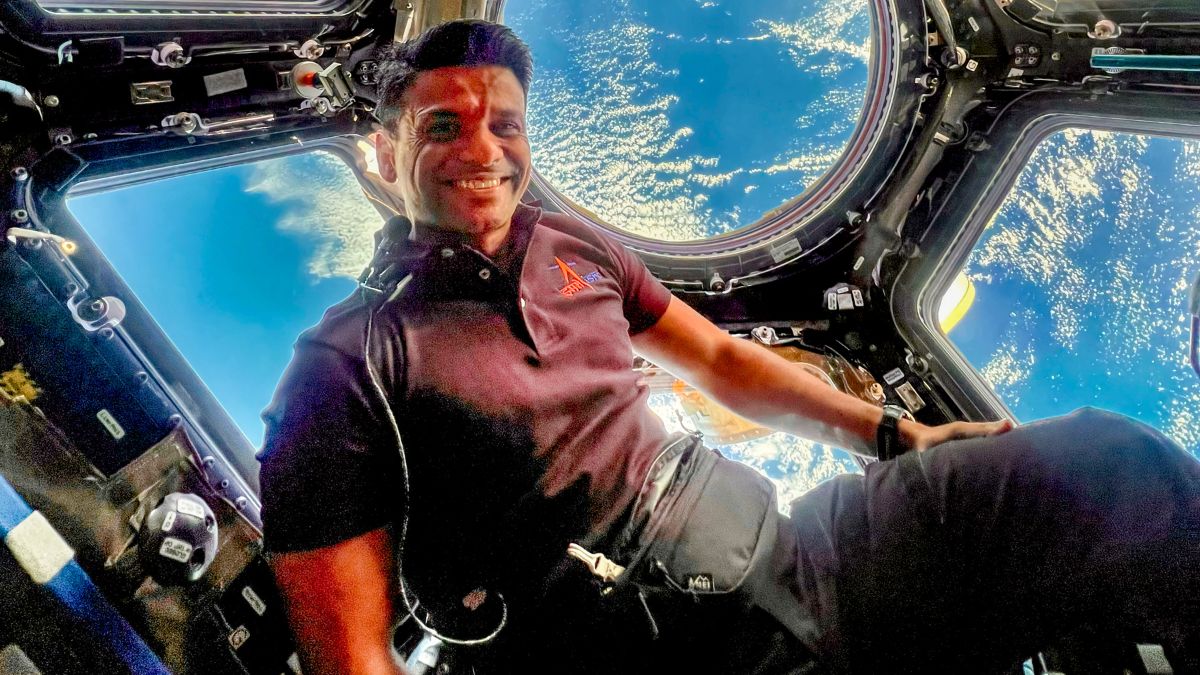
 "The Axiom-4 mission took off from Nasa’s Kennedy Space Center in Florida on June 25. Axiom Space/PTI")
Indian astronaut Shubhanshu Shukla, along with three others from the Axiom-4 mission, is set to come back to Earth from the International Space Station on July 14.
The Dragon spacecraft will undock from the Space Station with all four astronauts at 4.30 pm (IST) and follow a planned path to re-enter Earth’s atmosphere. The splashdown is expected off the California coast on July 15 at around 3:00 pm IS. It will take 22.5 hours after the undocking for the spacecraft to land in the Pacific Ocean.
Notably, Shukla is on a 14-day mission to the International Space Station. He became the first Indian to visit the ISS and the second Indian astronaut in space, after Wing Commander Rakesh Sharma, who travelled to space in 1984.
But how will he make the journey back? What exactly happens during the return process?
Let’s take a look:
How will Shubhanshu Shukla’s return from space unfold?
The Axiom-4 mission took off from Nasa’s Kennedy Space Center in Florida on June 25. After a journey lasting 28 hours, the Dragon spacecraft successfully docked with the International Space Station on June 26.
Returning to the spacecraft, which is attached to the ISS’s space-facing Harmony module, is a step-by-step process. It involves many checks and careful execution of standard procedures.
To start, the crew, led by US astronaut Peggy Whitson, will carry out detailed inspections of the Dragon spacecraft.
Before undocking begins, tasks such as loading cargo, preparing the crew, closing the hatch, and pressurising the spacecraft will be completed. The team will check key systems, including life support, propulsion, and communication, to confirm everything is working properly before the return to Earth. They will also make sure there are no air leaks between the Dragon and the ISS docking point. This is to ensure a tight seal before the hatch is closed, according to The Tribune.
Impact Shorts
More ShortsInside the spacecraft, the crew will secure all items, including experiments and personal belongings, so they do not float around in microgravity. After conducting more than 60 science experiments, they will carefully store all research materials for the trip back to Earth.
Once the hatch is shut and sealed, which helps maintain the cabin environment during departure and flight, everything inside the spacecraft will be secured again. This hatch is usually closed a few hours ahead of undocking.
Next, the crew will set up Dragon’s systems, such as navigation and propulsion. The actual undocking is automated and handled by the spacecraft’s onboard system, but the astronauts will monitor the steps closely and are ready to take control if needed.
A final decision to proceed, either “go” or “no-go”, will be taken together with mission control, the report said. The return journey is expected to last about 22 hours, ending with a splashdown in the Pacific Ocean.
Once ready, the power and data cables, known as umbilicals, will disconnect, and 12 latches will release, putting the capsule into what’s called a soft-capture state.
Then, using 12 Draco thrusters, the Dragon will carry out what’s called “Burn Zero”, a short firing to help it gently move away from the ISS and avoid any sticking at the docking point.
Shortly after, the Dragon will carry out “Departure Burn One”, which helps increase its speed and distance from the ISS, The Weekly Spaceman reported.
**
Shubhanshu Shukla’s farewell address from ISS**
During the farewell ceremony of the Axiom-4, Shukla said that the journey was incredible and credited those involved in the mission. “It has been an incredible journey. It has been made amazing and incredible because of the people who are involved,” he said.
He also spoke about India’s journey ahead in space exploration. Talking about Rakesh Sharma, the first Indian astronaut who went to space, Shukla said, “Forty-one years ago, an Indian came to space and he told us how India looks from up above. Today’s India looks ambitious from space, today’s India looks fearless, today’s India looks confident, today’s India looks full of pride… today’s India still looks ‘saare jahan se acha.”
“Our journey ahead into space exploration may be long and arduous but it has begun,” he said, on the eve of the crew’s return journey to Earth.
Speaking in Hindi and English, he said, “Aapki or meri yatra abhi bhot lambi hai (Our journey is still very long)… I assure you, if we make a firm resolve, even the stars are attainable.”
He thanked the Indian Space Research Organisation (ISRO) and Nasa for the opportunity. “I would like to take his opportunity to thank my country and all its citizens for supporting this mission and me with all their hearts. I would like to thanks ISRO for making this happen, all the colleagues at ISRO who have worked tirelessly in developing all the protocols and the outreach activities,” he said.
“I would also like to thank NASA and its international partners Axiom Space, SpaceX for ensuring we were trained adequately well and providing all the support round the clock,” he added.
Shubhanshu Shukla time in space
The Axiom Mission 4 crew carried out a wide range of research activities focused on advancing scientific understanding, testing new technology, and supporting global outreach in space exploration.
With more than 60 experiments across fields like biomedical science, advanced materials, neuroscience, agriculture, and space technology, Ax-4 marks the highest number of studies conducted on any Axiom Space private astronaut mission so far.
These experiments may lead to important developments for space travel and life on Earth, including progress in diabetes care, cancer treatment options, and improved ways to monitor human health and performance.
During the final part of his mission, Shubhanshu Shukla clicked photos of ‘moong’ and ‘methi’ seeds sprouting in petri dishes and placed them in a storage freezer on the ISS. This was part of a study looking at how microgravity affects the early stages of plant growth.
The mission is headed by former Nasa astronaut Peggy Whitson, now with Axiom Space, who serves as commander. The team also includes Slawosz Uznanski from Poland, representing the European Space Agency, and Tibor Kapu from Hungary, both acting as mission specialists.
Group Captain Shukla is the mission’s pilot.