

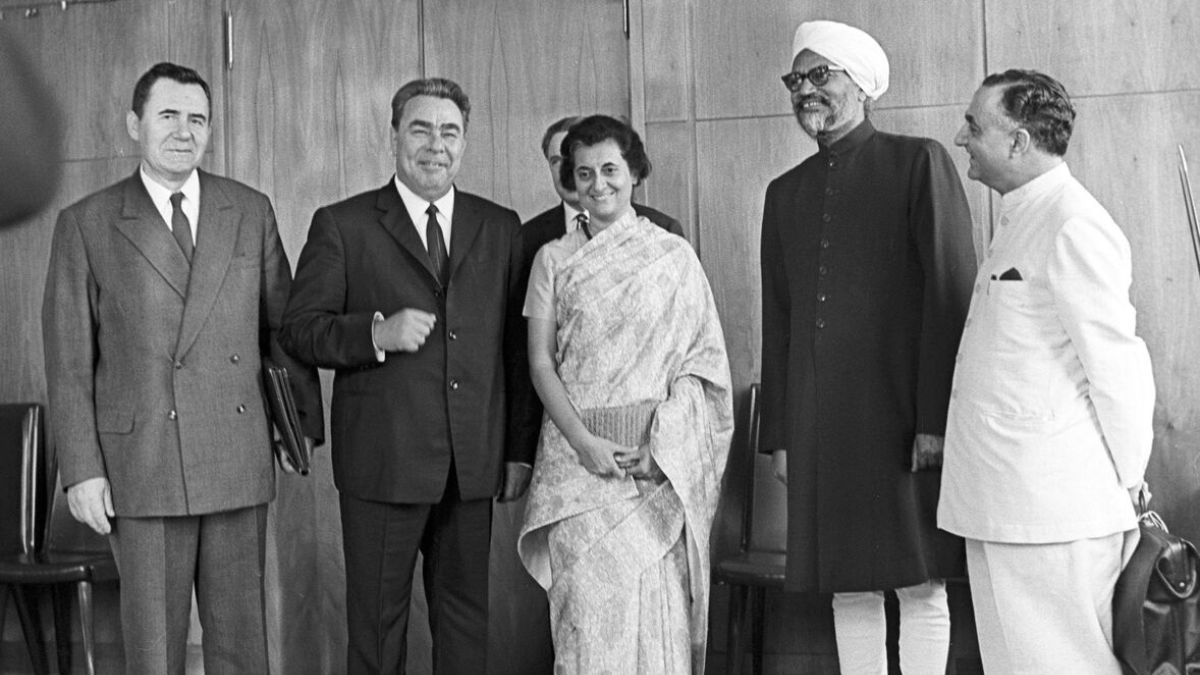
 "When Russia helped India in the war against Pakistan in 1971")
Russian President Vladimir Putin’s upcoming State visit to India has put the spotlight on the deep historical roots of Indo-Russian cooperation — roots that reach back decades with one moment being the 1971 war between India and Pakistan.
The Kremlin has already indicated the scale of importance it attaches to the upcoming summit. Yuri Ushakov, a top foreign policy aide in Moscow, explained to Russian State TV that both governments have been working meticulously to prepare for the visit.
“We and the Indian side are actively preparing for the visit and hope it will be fruitful in every sense. It will be an extremely grand (visit) because it’s even called a state visit,” he noted during an interview.
The dates for the summit are to be announced simultaneously in both capitals, following the groundwork laid during External Affairs Minister S Jaishankar’s meeting with Putin in Moscow last week.
For decades, the relationship has been defined by high-level dialogue — but perhaps no episode cemented the partnership more deeply than the 1971 war, during which the Soviet Union’s involvement decisively shaped the outcome.
How the landscape was before the 1971 war
The Indo-Pakistani War of 1971 was not an isolated military confrontation; it emerged from a humanitarian and political catastrophe in erstwhile East Pakistan (now Bangladesh).
Following the Pakistan Army’s brutal crackdown on Bengali civilians, a wave of atrocities — including mass killings, rapes, and arson — triggered a historic refugee crisis.
India, led by Prime Minister Indira Gandhi, faced an overwhelming influx of civilians fleeing the violence. This exodus placed immense pressure on India’s economy, social infrastructure, and national security calculations.
Meanwhile, Pakistan’s military ruler, General Yahya Khan, was determined to suppress Bengali aspirations for autonomy, plunging the region into deeper turmoil. India concluded that the situation was untenable and could destabilise the entire region.
Any intervention, however, would have to consider the broader strategic environment. In 1971, Pakistan enjoyed the backing of the United States, UK, and China — three major powers whose support could materially influence the conflict.
Faced with this alignment, India recognised the need for a powerful counterweight. This led to one of the most consequential diplomatic moves in independent Indian history: the signing of the Treaty of Peace, Friendship, and Co-operation with the Soviet Union on August 9, 1971.
This treaty was not merely symbolic; it provided India with explicit political assurances and set the stage for direct military aid if required.
Signed in New Delhi by Sardar Swaran Singh and Soviet Foreign Minister Andrei Gromyko, it constituted a major strategic shift away from the idealistic framework of nonalignment.
The agreement ensured that Soviet power would stand behind India during the crisis — a factor that would prove decisive in the weeks ahead.
As one assessment notes, the treaty effectively “ensured that India checkmated possible Anglo-American and Chinese help to Pakistan.”
How the Soviet Union committed itself to India
The USSR’s role in the 1971 war extended far beyond political rhetoric or diplomatic support. Its military assistance — both implicit and explicit — was instrumental in creating conditions that allowed India to prosecute the war effectively.
The critical northern front
One of India’s biggest concerns in 1971 was the possibility of China joining the conflict on Pakistan’s side. Pakistan expected that any confrontation with India would be reinforced by Chinese military intervention across the Himalayan frontier.
Indeed, contemporary Pakistani communications frequently referenced expectations of support from “our friends from the North.”
China’s intervention was not an abstract threat; only two years earlier, in 1969, the Soviet Union and China had clashed violently along the Ussuri River, particularly around Damansky Island.
Tensions had escalated steadily since 1968, culminating in a series of deadly engagements that lasted over seven months.
The Soviet military response eventually involved heavy artillery bombardments, including the use of BM-21 Grad rockets, which inflicted severe damage on Chinese positions. This deep mistrust shaped Soviet strategic thinking in 1971.
When India prepared for war, the Soviet Union seized an opportunity to counter Beijing’s influence by supporting New Delhi. Moscow deployed an extraordinary concentration of forces — 44 motorised divisions — along the Sino-Soviet frontier.
This unprecedented military build-up created a direct land threat to China, discouraging Beijing from opening a second front against India. This redeployment has been documented by the International Institute for Strategic Studies in London.
The effect was immediate and decisive: China held back from intervening.
With the northern front stabilised, India was able to relocate large contingents of troops from its border with China to the western battleground with Pakistan — an operational advantage that significantly contributed to India’s success.
When US and UK warships approached India
As the conflict increased, the United States and the United Kingdom moved to influence the outcome in Pakistan’s favour.
This effort unfolded dramatically in early December 1971, when the US Navy’s Seventh Fleet, including the nuclear-powered aircraft carrier USS Enterprise, entered the Bay of Bengal.
The Nixon administration’s intent was clear: to send a signal of support to Pakistan and apply severe pressure on India.
The British government, acting in parallel, dispatched the aircraft carrier HMS Eagle to the Arabian Sea. The combined deployment of two major Western carrier battle groups represented a significant threat.
The plan, according to analyses of US strategy, involved a three-front encirclement of India: pressure in the east from the US fleet, pressure from the west via British naval forces, and Pakistani units engaged on land.
American pressure did not stop at naval movement. Declassified tapes and documents reveal that then-US President Richard Nixon encouraged China to initiate military action against India.
According to the records, Henry Kissinger — then US National Security Advisor — was tasked with urging Beijing to mobilise troops towards the Indian border. Some commentaries note that Nixon even claimed India needed a “mass famine,” illustrating the depth of hostility within the administration.
The convergence of the US and UK fleets created what appeared to be a dangerous standoff.
As Bangladesh’s independence movement gained momentum and India made rapid battlefield advances, this Western show of force was designed to complicate India’s military campaign and deter any further gains.
How Moscow responded
The turning point in the maritime confrontation came when India sent an urgent request for Soviet intervention. Moscow responded with exceptional swiftness.
From Vladivostok, the Soviet Pacific Fleet — including nuclear-armed vessels — began moving at high speed towards the Indian Ocean.
Commanded by Admiral Vladimir Kruglyakov, the Soviet flotilla consisted of two major task groups.
These included nuclear-armed ships, atomic submarines, cruisers, and destroyers with the capability to confront US and UK naval forces directly. The Soviets also assembled Task Force 40, a group of cruisers and destroyers intended to reinforce the naval deployment.
In a calculated show of force, Soviet nuclear submarines surfaced intentionally to ensure they were detected by American surveillance satellites.
This deliberate move was meant to demonstrate the seriousness of Soviet resolve and to deter US military action. American and British task forces quickly recognised the risks of further escalation.
Faced with the prospect of a direct naval standoff with the USSR — and with no political appetite in Washington or London for a confrontation with Moscow in South Asia — both fleets altered their course.
They did not enter Indian waters, avoiding an engagement that could have dramatically reshaped the conflict.
For India, the Soviet intervention removed the last potential external obstacle to its military objectives. With the Western fleets diverted, India’s armed forces continued their operations without the threat of imminent interference.
How an unbreakable India-Russia partnership was founded
The momentum on the battlefield accelerated dramatically once the Soviet deterrent came into effect. Within days of the Western naval retreat, Indian forces achieved a decisive victory in East Pakistan.
On December 16, 1971, the Pakistan Eastern Command surrendered — a capitulation involving 93,000 troops, one of the largest mass surrenders since World War II.
This turning point reshaped South Asian history. Bangladesh emerged as an independent nation, altering the geopolitical map of the region.
The 1971 war remains one of the clearest demonstrations of Soviet commitment to India’s security. Soviet assistance allowed India to counter multidimensional threats from the United States, the United Kingdom, Pakistan, and potentially China.
The conflict also highlighted the limits of nonalignment during moments of existential crisis.
Although, some analysts later criticised the romanticism surrounding nonalignment in New Delhi’s elite circles, noting that the doctrine effectively collapsed when India signed the 1971 treaty with the USSR.
The Soviet role in 1971, along with earlier episodes of diplomatic warmth — such as the Soviet Union’s symbolic gift of a high-yield dairy cow to Prime Minister Jawaharlal Nehru during his 1960 visit — contributed to a long-term relationship that has endured through dramatic changes in global politics.
Nehru’s engagement with the USSR in the early years of independence, particularly in areas such as agriculture and development, laid the groundwork for deeper cooperation that would later extend to defence, energy, and space technology.
Even today, the 1971 conflict serves as a powerful reminder of how India navigated threats by aligning with a strategic partner at the right moment.
With inputs from agencies

 "Russia approves Relos agreement with India. How this defence pact is a win-win for both countries")
 "Putin signals stronger India-Russia ties ahead of visit, pushes for more Indian exports")
 "Hegseth says he 'did not see any survivors' before second strike on Venezuelan drug boat")
 "Trump administration halts immigration from 19 nations over security concerns")
 "Russia approves Relos agreement with India. How this defence pact is a win-win for both countries")
 "Putin signals stronger India-Russia ties ahead of visit, pushes for more Indian exports")
 "Hegseth says he 'did not see any survivors' before second strike on Venezuelan drug boat")
 "Trump administration halts immigration from 19 nations over security concerns")



