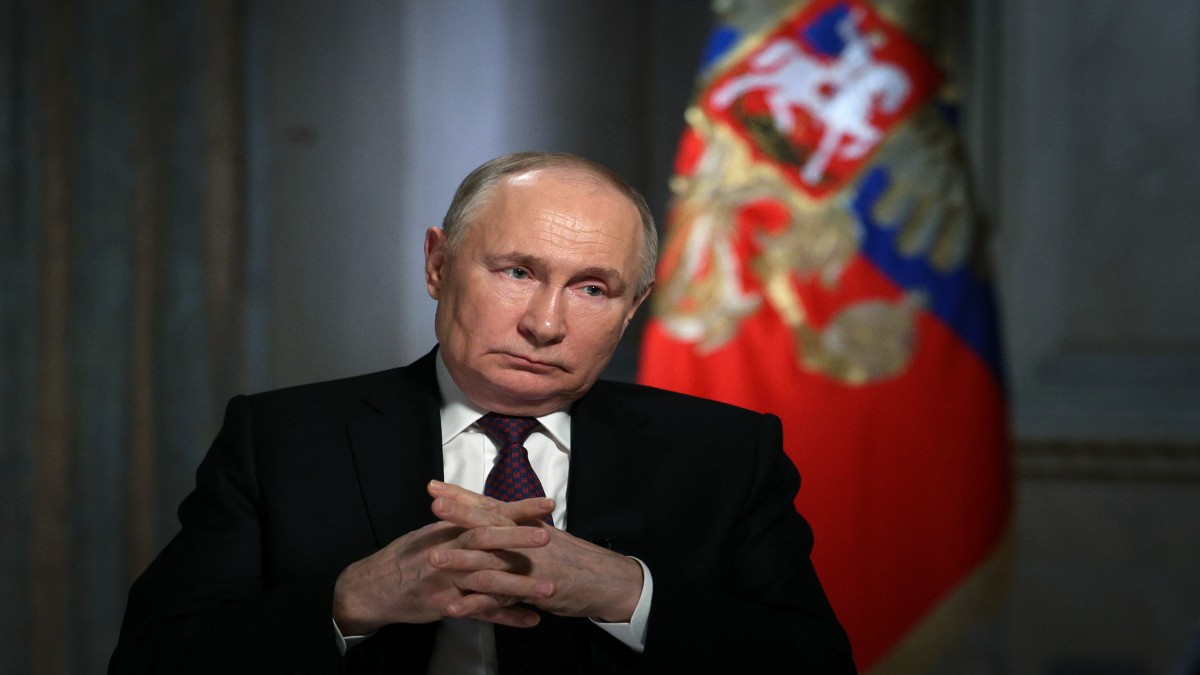
 "Russian President Vladimir Putin gestures while speaking during an interview with a Russian state-owned media organization in Moscow, Russia. AP")
There is hardly much political drama in the battle for Vladimir Putin’s re-election to a second six-year term as president of Russia.
The 71-year-old will almost certainly be able to hold office until 2030 as a result of the voting that ends on Sunday, giving him a complete three decades to lead Russia as either the prime minister or president.
However, it’s what he does after he crosses the finish line that grabs attention and causes anxiety in a lot of onlookers.
Let’s take a closer look.
Putin’s firm grip on authority
Putin has a solid hand thanks to his lengthy-term and the widespread silence of powerful domestic opposition voices.
The unexpected endurance of the Russian economy in the face of extensive Western sanctions imposed after the invasion of Ukraine supports that position.
This stance is further cemented by Moscow’s steady advances on the battlefield in recent months, the US’ and other countries’ support for military assistance to Kyiv, and the growing scepticism of some Western countries regarding increasingly progressive social attitudes that echo Putin’s advocacy for “traditional values.”
Putin, in short, would head into a new term with few obvious restraints, and that could manifest itself quickly in major new actions.
“Russia’s presidential election is not so important as what will come after. Putin has often postponed unpopular moves until after elections," Bryn Rosenfeld, a Cornell University professor who studies post-Communist politics, said in a commentary.
Impact Shorts
More ShortsA chance for a second military mobilisation
In Russia, some people think it might happen.
Ordering a second military mobilisation to fight in Ukraine would likely be the most unpopular thing at home but it might the families of the troops who were drafted 18 months prior.
Notably, the first one, in September 2022, generated protests and caused a large number of Russians to flee their country to avoid being called up.
“Russian leaders are now talking of ‘consolidating the whole of Russian society around its defense needs,’" Brian Michael Jenkins, a senior adviser at the RAND Corporation think tank told The Associated Press.
“The precise meaning of this phrase is not entirely clear, but it suggests that Russia’s leadership understands that the war Putin describes will go on for a long time, and therefore resources must be mobilized,” he added. “In other words, Russian society must be organized for perpetual warfare.”
But Tatiana Stanovaya, a senior fellow at the Carnegie Russia Eurasia Center, says Putin doesn’t need a mobilisation partly because many Russians from poorer regions have signed up to fight in order to get higher pay than what they can earn in their limited opportunities at home.
In addition, Putin’s apparent confidence that the war is turning in Russia’s favour is likely to make him continue to insist that the only way to end the conflict is for Ukraine to sit down at the negotiating table, she said. “Which, in fact, means capitulation.”
Testing NATO’s resolve
Although there is still a lack of support for Ukraine in Washington, recent statements from Polish foreign minister Radek Sikorski and French president Emmanuel Macron indicate that sending soldiers to defend Kyiv is at least an ideal option.
Considering those remarks, Putin would be inclined to challenge NATO’s determination.
Alexandra Vacroux, executive director of the Davis Center for Russian and Eurasian Studies at Harvard University, posits that Russia within several years will make an attempt to assess NATO’s commitment to Article 5, the alliance’s common defense guarantee under which an attack on one member is considered an attack on all.
“I don’t think that Putin thinks that he needs to be physically, militarily stronger than all of the other countries. He just needs them to be weaker and more fractured. And so the question for him is like … instead of worrying so much about making myself stronger, how can I make everyone else weaker?” she said.
“So in order to do that, it’s like you have to find a situation where you could test Article 5,” and if the response is mild or uncertain “then you’ve shown that, like NATO is just a paper tiger,” Vacroux said.
Russia could run such a test without overt military action, she said, adding, “You could imagine, like, one of the big questions is what kind of cyberattack constitutes a threat to attack?”
Fears of Moldova
Neighbouring Moldova, although not being a member of NATO, is growing more and more concerned about being targeted by Russia. Moldova has been dealing with issues since the invasion, which has caused residents of Chisinau, the country’s capital, to worry that their nation is also under Kremlin attack.
Due to reported mounting pressure from Moldova, the congress in the separatist Transnistria area of Moldova, where Russia maintains a base with 1,500 soldiers serving as nominal peacekeepers, has asked Moscow for diplomatic “protection.”
That appeal potentially leaves “a lot of room for escalation,” said Cristain Cantir, a Moldovan international relations professor at Oakland University. “I think it’s useful to see the congress and the resolution as a warning to Moldova that Russia may get more involved in Transnistria if Chisinau does not make concessions.”
Potential events at home
Even though independent media and allies of the opposition are already intimidated or silenced, additional repressive measures may be implemented on the domestic front in Russia under the new Putin administration.
Stanovaya suggested that rather than initiating repressive measures personally, Putin authorises them when they are created by others with the understanding that the head of the Kremlin will accept.
“Many players are trying to survive and to adapt, and they compete against each other and often they have contradictory interests," she said. “And they are trying all together in parallel to secure their own priorities and the stability of the regime.”
Russia last year banned the notional LGBTQ+ “movement” by declaring it to be extremist in what officials said was a fight for traditional values like those espoused by the Russian Orthodox Church in the face of Western influence. Courts also banned gender transitioning.
Ben Noble, an associate professor of Russian politics at University College London, said he believes the LGBTQ+ community could face further repression in a new Putin term.
In the Kremlin’s eye, they “can be held up as an import from the decadent West,” he said.
With inputs from The Associated Press