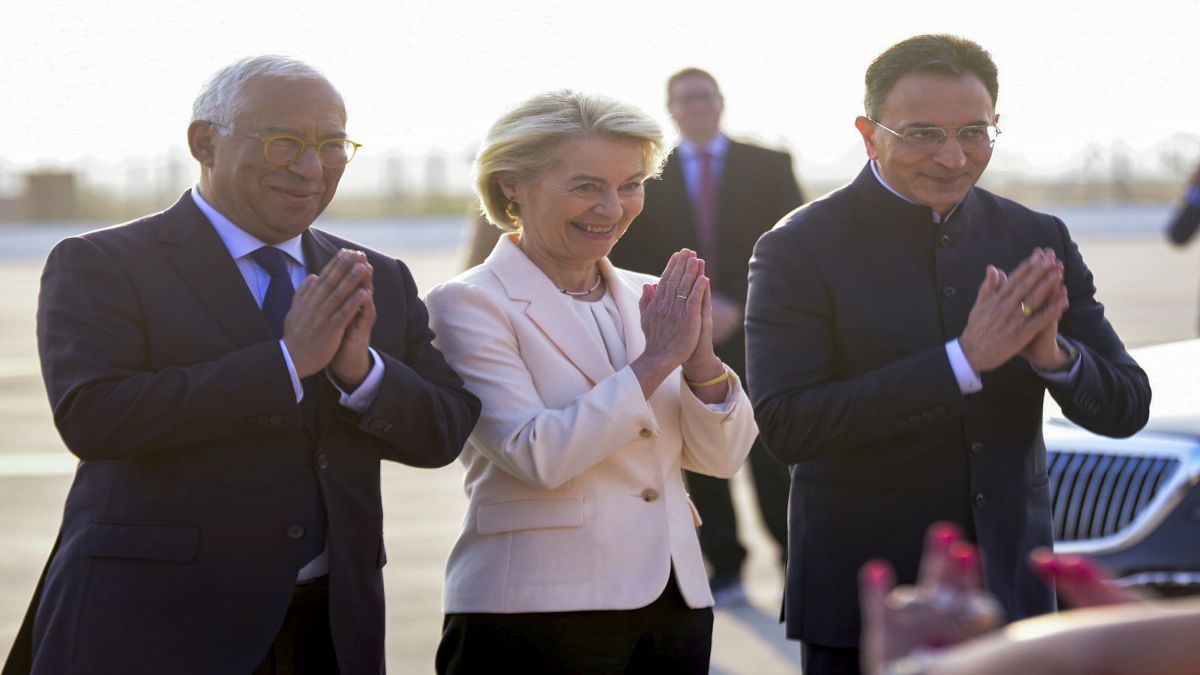
 "Who are Ursula von der Leyen and Antonio Costa, top EU officials and Republic Day chief guests?")
In a short while, India’s Republic Day Parade 2026 will witness the gathering of around 10,000 special guests at Kartavya Path in Delhi on Monday (January 26). This year, European Commission President Ursula von der Leyen and Antonio Costa, president of the European Council, will grace the event as the chief guests.
The European Commission president’s visit to New Delhi from January 25 to January 27 is expected to result in the signing of a trade deal between India and the European Union (EU), which von der Leyen has described as the “ mother of all deals”.
We take a look at who they are.
Who is Ursula von der Leyen?
Ursula von der Leyen, a German gynaecologist and politician, has several achievements to her name. She is the first female president of the European Commission.
Born in October 1958, von der Leyen spent her first 13 years in Brussels. Her father was a European Commissioner at the time when the EU was the European Economic Community, according to Time magazine.
She has also lived in Belgium, the United Kingdom and the United States, and is fluent in French and English.
Von der Leyen studied economics at two German universities and at the London School of Economics (LSE), but did not graduate.
“I lived much more than I studied,” she told the weekly Zeit about her time at LSE. “No details, please. Only this: in 1978, I immersed myself for one year in this seething, international, colourful city. For me, coming from the rather monotonous, white Germany, that was fascinating.
“For me, London was the epitome of modernity: freedom, the joy of life, trying everything. This gave me an inner freedom that I have kept until today. And another thing I have kept: the realisation that different cultures can get on together very well.”
Quick Reads
View AllVon der Leyen later switched to study medicine in Hanover and graduated as a doctor of medicine in 1991.
She lived in California for a few years while her husband, a professor of medicine, served on the faculty at Stanford University.
Von der Leyen, a mother to seven children, began her political innings in her early 40s. In 1990, she joined former German Chancellor Angela Merkel’s Christian Democratic Union party (CDU).
After rising through the ranks in the regional government of Lower Saxony, von der Leyen was appointed as minister for Family, Seniors, Women and Youth in Merkel’s first government in 2005.
During that time, von der Leyen improved maternity and paternity pay rights. Under her watch, Germany introduced a law mandating that every child over a year old will get a place at a daycare facility. The government also brought a paid parental leave scheme that included at least two months of paid leave for fathers.
In 2009, van der Leyen moved to the Labour Ministry in Merkel’s government. She went on to become the first female defence minister of Germany in December 2013.
In Germany, she was referred to with nasty nicknames, including Krippen-Ursel (“crèche Ursel”), meaning a conservative closet feminist set on increasing nursery places, as per The Guardian.
Van der Leyen became the 13th president of the European Commission in 2019. She was appointed to the post again after her five-year tenure ended. The 67-year-old will head the Commission until 2029.
ALSO READ: The story of India’s Republic Day and the military parade tradition
What does the European Commission do?
The European Commission is the main executive body of the EU. Its main roles include proposing new laws and policies, monitoring their implementation and managing the EU budget.
As per its website, the Commission also “ensures that EU policies and laws are correctly applied across Member States, negotiates international agreements on behalf of the EU, and allocates funding.”
As the president, von der Leyen is responsible for the organisation of the Commission and allocating portfolios to individual Commissioners. She also decides the Commission’s policy agenda, along with representing the body at European Council meetings, G7 and G20 summits, summits with non-EU countries and major debates in the European Parliament and the Council.
Who is Antonio Costa?
Antonio Costa, the 64-year-old president of the European Council, has an Indian connection. His paternal grandfather was from Goa, while his paternal grandmother was French-Mozambican.
In December 2024, Costa, the former Portuguese prime minister, became the first person from an ethnic minority to lead one of the EU’s most important institutions.
In an interview with Politico two years back, he boasted that Prime Minister Narendra Modi had personally given him an overseas citizen card, saying that his “cultural closeness, knowledge and sometimes even linguistic skills … obviously help, and I hope to use them in the service of the EU.”
He said at the time that he was keen to use his Indian heritage to redefine Europe’s often unequal relationship with Asia, Africa and South America.
Costa formed close ties with overseas leaders, especially those from the African, Asian and South American countries during his eight years as Portuguese PM between November 2015 and April 2024.
The Socialist leader, who is a skilled negotiator, secured unlikely political alliances in Lisbon. He also developed strong relations with colleagues in other European Union capitals, including with Hungary’s nationalist PM Viktor Orban.
Unlike his predecessor, Belgian Charles Michel, Costa shares a close working relationship with Commission President von der Leyen.
What is the European Council?
The European Council is among the EU’s seven institutions. It comprises 27 EU member states, the President of the European Council and the President of the European Commission.
The Council is the EU’s supreme political authority, which sets the Union’s policy agenda. It provides leadership to the EU and, under the Lisbon Treaty, “the necessary impetus for its development”. It frames the EU’s general political direction and sets its priorities.
The European Council, however, does not enjoy any formal legislative powers and cannot make laws.
With inputs from agencies


 "Republic Day 2026 Live Updates: PM Modi wishes nation; Parade to kick off at 10:30 am")
 "From Suryastra to Shaktiban, Republic Day parade to see many firsts on Kartavya Path")
 "Canada energy minister heads to India 'to protect and empower Canadian economy' amid tiff with Trump")
 "Trump blames Democrats for ‘chaos’, calls for immigration enforcement amid Minneapolis shooting uproar")
 "Republic Day 2026 Live Updates: PM Modi wishes nation; Parade to kick off at 10:30 am")
 "From Suryastra to Shaktiban, Republic Day parade to see many firsts on Kartavya Path")
 "Canada energy minister heads to India 'to protect and empower Canadian economy' amid tiff with Trump")
 "Trump blames Democrats for ‘chaos’, calls for immigration enforcement amid Minneapolis shooting uproar")