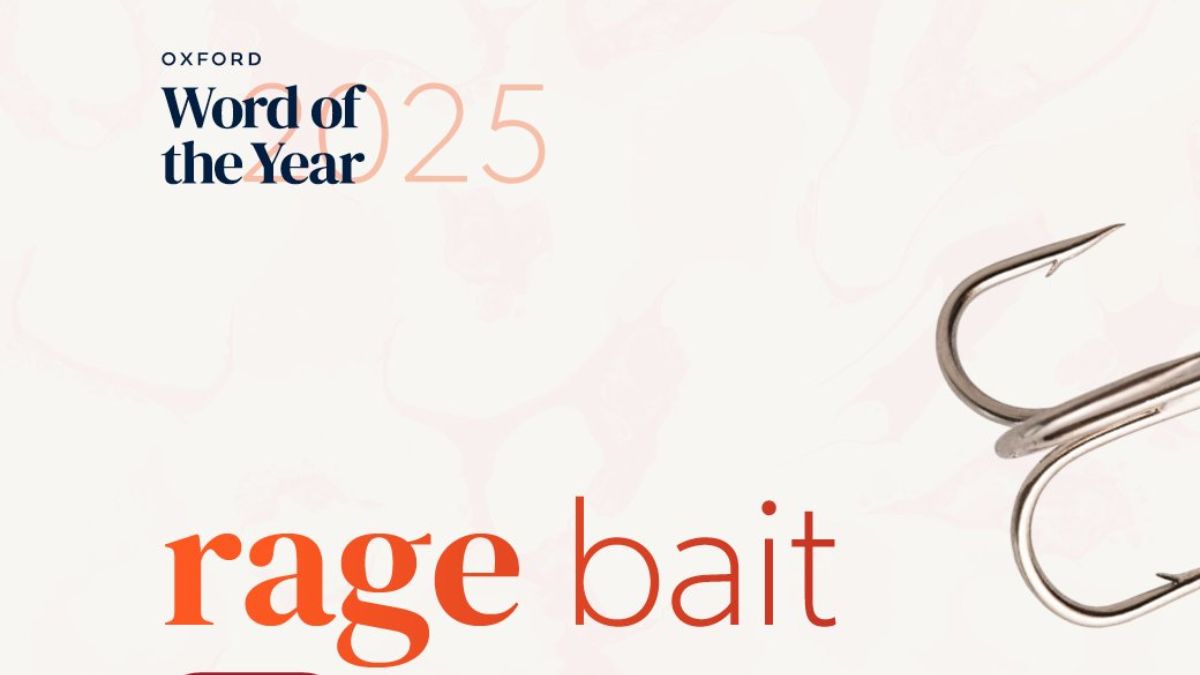
 "Oxford University Press has named ‘rage bait’ as the Oxford Word of the Year 2025. Image courtesy: X/@UniofOxford")
How often do you read something online and are fuming? You may have fallen victim to rage bait.
But what does it mean? It is a term used to define “online content deliberately designed to elicit anger or outrage by being frustrating, provocative or offensive”. And it is the Oxford 2025 World of the Year.
Rage bait was picked by Oxford University Press after a public vote in which more than 30,000 people had their say. Over the past year, according to Oxford’s data, the frequency of use of the word spiked by a factor of three. And from actress Jeniffer Lawrence to right-wing influencers, all have confessed to rage-baiting.
What is rage bait?
Rage bait is defined as online content designed to provoke outrage and stir up controversy to increase traffic or engagement of a particular web page or social media account. It’s a compound of the words rage, which means “a violent outburst of anger”, and bait, “an attractive morsel of food”. Both these terms are established in English and date back to Middle English times.
Rage bait has existed since 2002, but its usage has tripled in the last 12 months, according to Oxford University Press, which publishes the Oxford English Dictionary.
“Our experts noticed that the use of rage bait this year has evolved to signal a deeper shift in how we talk about attention—both how it is given and how it is sought after—engagement, and ethics online,” Oxford University Press noted.
It draws a close parallel to the etymologically related clickbait, where the purpose is to use a headline to lure a reader into viewing an article or video by giving it a one-click. However, rage bait has a specific focus on evoking anger and polarisation. Its simple goal is to produce memes, write and post something that makes other users viscerally angry.
How did the word rage bait come into existence?
It was first used online in a posting on Usenet, a network of discussion groups, in 2002. It was used as a way to designate a particular type of driver reaction to being flashed at by another driver requesting to pass them, introducing the idea of deliberate agitation, as per Oxford University Press.
The word then evolved into internet slang, which goes beyond simply annoying people, and it has become shorthand for content designed to elicit anger by being offensive and frustrating. It’s also a staple term in global journalism and is widely used in online creators’ vocabulary.
Quick Reads
View AllAs social media algorithms started to reward more provocative content, resulting in the development of practices such as rage-farming, a constant effort to cultivate anger by seeding rage-bait material, often wrapped in misinformation and conspiracy theory-based material, gathered steam.
What words did rage bait beat this year?
The other two words that could not beat rage bait were: Aura farming and Biohack.
Aura farming : The word that refers to cultivating an impressive, charismatic persona and public image to convey an air of confidence and coolness. It became popular after Rayyan Arkan Dikha, an 11-year-old from Indonesia, went viral while dancing during a traditional canoe race, triggering the trend.
Biohack: The word refers to an attempt to improve one’s physical or mental performance, health, and longevity through lifestyle changes, supplements or technology.
Language experts chose rage bait over the other two after considering votes and analysing lexical data.
“The fact that the word rage bait exists and has seen such a dramatic surge in usage means we’re increasingly aware of the manipulation tactics we can be drawn into online,” said Casper Grathwohl, the president of Oxford Languages.
“Before, the internet was focused on grabbing our attention by sparking curiosity in exchange for clicks, but now we’ve seen a dramatic shift to it hijacking and influencing our emotions, and how we respond. It feels like the natural progression in an ongoing conversation about what it means to be human in a tech-driven world—and the extremes of online culture,” he added.
What are other words of 2025?
This year, Cambridge Dictionary declared ‘parasocial’ its word of 2025. It is defined as a relationship felt by someone between themselves and a famous person they do not know, according to the BBC.
‘Vibe coding’, a software development that turns natural language into computer code using AI, has been named Collins Dictionary’s Word of the Year 2025.
Dictionary.com announced “6-7” as the 2025 Word of the Year. While the origin of the term is unclear, teachers and parents heard teenagers and other children screaming it in classrooms.
AI slop is Macquarie Dictionary’s Word of the Year. The dictionary defines the word as “low-quality content created by generative AI [artificial intelligence], often containing errors, and not requested by the user”.
Merriam-Webster has yet to announce the Word of the Year.
With inputs from agencies