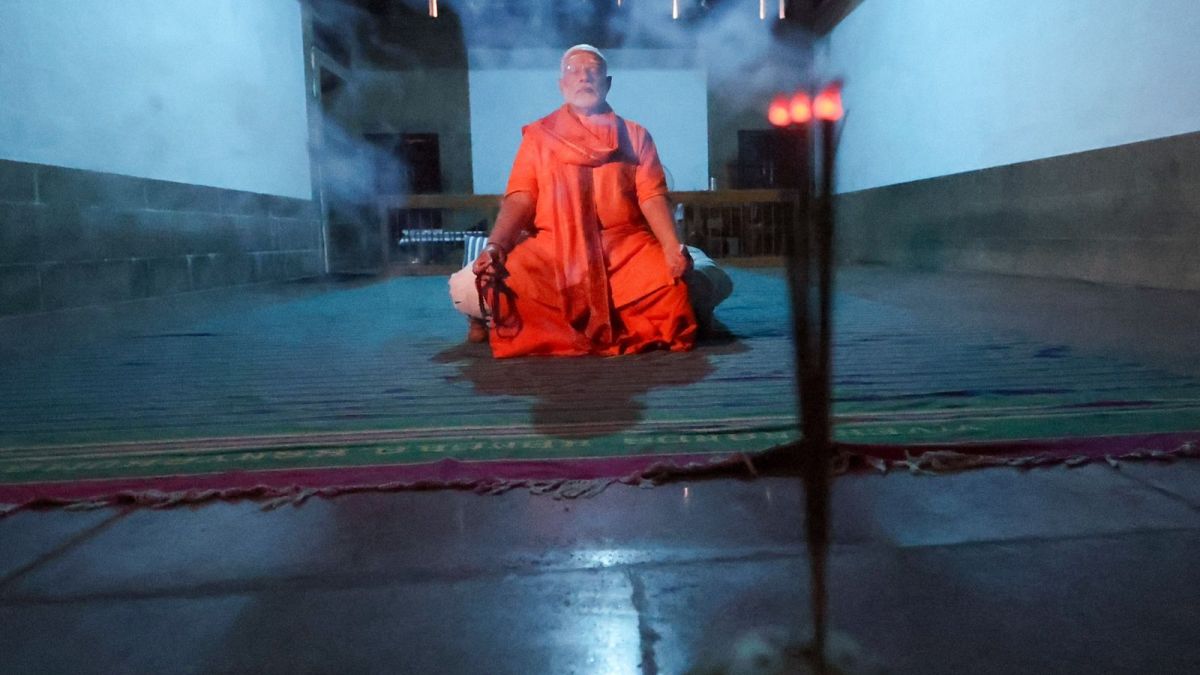
 "Prime Minister Narendra Modi meditates at Vivekananda Rock Memorial in Kanyakumari on Friday. News18")
After wrapping up a hectic Lok Sabha campaign, Prime Minister Narendra Modi is on a meditation break. He reached Kanyakumari on Thursday and began a 45-hour session at Vivekananda Rock Memorial . However, the sojourn has left the Bharatiya Janata Party (BJP) rivals, the Congress and Trinamool Congress, uneasy.
On Wednesday, Congress submitted a complaint to the Election Commission of India (ECI), demanding that the PM’s visit be rescheduled or its broadcast banned keeping in mind the rules under the Model Code of Conduct for the elections.
A delegation of Congress leaders led by national spokesperson Abhishek Singhvi met ECI officials and submitted the complaint. “We told the ECI that no one is allowed to campaign directly or indirectly during the silence period…” The Trinamool Congress also raised the issue.
We take a look at what is the silence period and why an EC action against the PM is unlikely.
What is the silence period?
The silence period comprises 48 hours ending with the hour fixed before the conclusion of the poll during which political parties and candidates are not allowed to campaign.
Under Section 126 of the Representation of People Act, 1951, all election campaigning stops during this time, which ends with the conclusion of voting. Restrictions are imposed so that politicians and the media do not influence voters in any way.
Impact Shorts
More ShortsAccording to a report in The Indian Express, the district magistrate issues a directive banning unlawful assemblies, public meetings, the use of loudspeakers, and restricting gatherings to less than five people. However, door-to-door campaigning is allowed.
Political advertisements through electronic and social media are not allowed.
Is PM Modi violating rules? Will EC take action?
Modi is contesting the Lok Sabha elections from Varanasi which will vote on 1 June. The PM is expected to “stay silent” as he meditates at the Vivekananda Rock Memorial and will not campaign during the 48-hour silence period ahead of the election. This will ensure that Section 126 and the Model Code of Conduct are not violated on technical grounds.
According to a report in The Economic Times (ET), the Prime Minister’s Office (PMO) had informed the Election Commission about Modi’s plans on 29 May.
Another reason that could work in the PM’s favour is the multi-phase nature of the election. The applicability of the silence period was clarified in the poll panel’s note on 2 April on “media coverage during the period referred to in Section 126 of the RP Act, 1951’”. The note said that this was “not applicable in case of multi-phased elections”, reports ET.
What is the Opposition saying?
Congress spokesperson Singhvi, who met the poll panel officials, told the media on Wednesday, “We told the ECI that no one is allowed to campaign directly or indirectly during the silence period. We have no issue with some person or leader doing anything… someone observing a vow of silence. But there should be no indirect campaigning during the silence period…”
“These are ways that you are campaigning or are broadcasting yourself through channels and print media. We have kept two very simple points before the ECI. Either the PM starts this 24-48 hours later. After June 1 evening, he can do it. And if he insists that he will start it… then it is necessary that a ban is imposed on its broadcasting on print and visual media. He is himself a candidate in the last phase. This kind of broadcast should not be allowed,” he added.
The PM started his visit on 30 May and will continue until 1 June.
What did EC say when the PM visited Kedarnath in 2019?
During the 2019 election, the PM made a similar meditation trip to Kedarnath ahead of the last phase when Varanasi was set to go to polls. Several Opposition parties had complained to the ECI back then. However, the poll panel had given the PM a nod for the visit while “reminding” the PMO that the Model Code of Conduct was still in force.
After he spent a night at the cave in Kedarnath, he thanked the poll body for the visit, adding that he got two days of “rest”.
With inputs from agencies