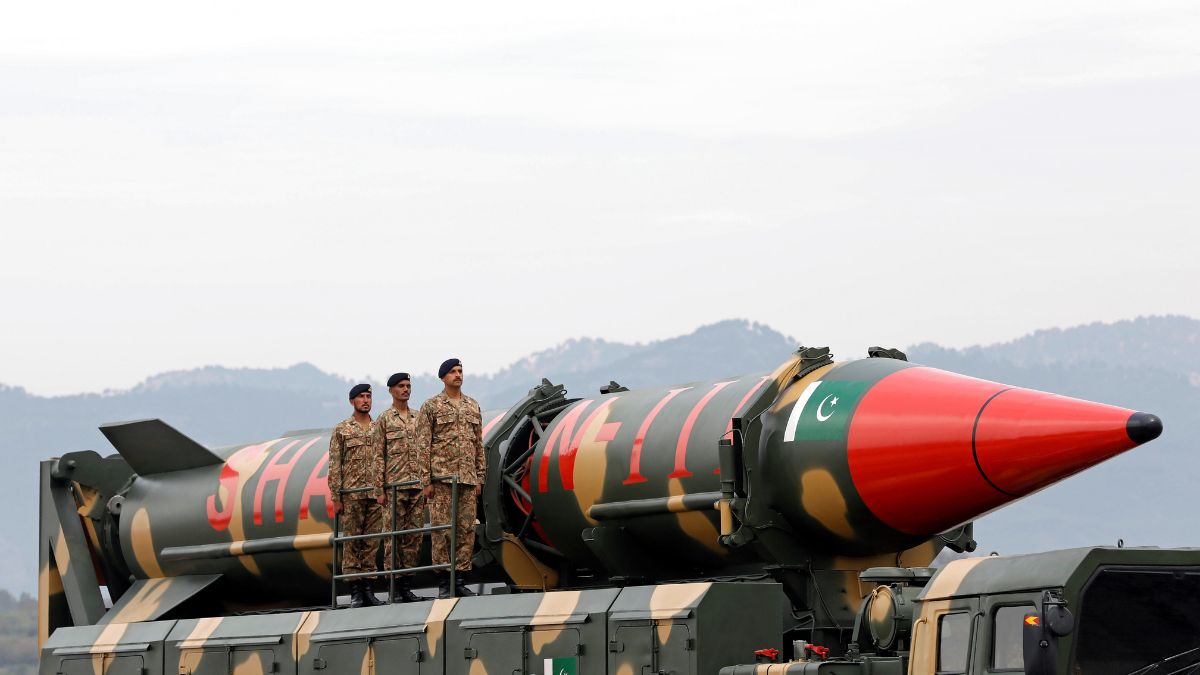
 "Pakistani military personnel stand beside a Shaheen III surface-to-surface ballistic missile during Pakistan Day military parade in Islamabad, Pakistan March 23, 2019. Image used for representational purpose/Reuters")
Pakistan is reportedly developing an intercontinental ballistic missile (ICBM) with the capability to reach the United States. According to a report by Foreign Affairs, the Pakistani military’s move has rung alarm bells in Washington.
Currently, there are only a handful of countries, including the US and Russia, that possess the ICBM. If Pakistan is successful in developing the strategic nuclear missile, it would join the likes of these nations.
Let’s take a closer look.
What are ICBMs?
Intercontinental ballistic missiles, or ICBMs , are self-guided weapons to deliver nuclear warheads over long distances.
Also known as strategic or long-range ballistic missiles, they can travel more than 5,500 kilometres. After being powered by a rocket, these missiles follow an unpowered trajectory toward their targets, as per the Center for Arms Control and Non-Proliferation.
The maximum range of ICBMs varies from 7,000 to 16,000 kilometres. This means some of these weapons can hit targets virtually anywhere in the world, according to the Federation of American Scientists.
ICBMs can be launched in different ways – from underground missile silos, heavy trucks, mobile launchers on rails or submarines.
Is Pakistan developing an ICBM?
Pakistan is developing an ICBM to carry nuclear warheads that could reach the US, as per the Foreign Affairs report.
If Pakistan acquires the long-range ballistic missile, “Washington will have no choice but to treat the country as a nuclear adversary,” the report noted, citing US intelligence sources.
“Although Pakistan claims its nuclear programme is strictly focused on deterring India, which enjoys conventional military superiority, US intelligence agencies have concluded that the Pakistani military is developing an ICBM that could reach the continental United States,” it said.
According to the piece, Pakistan’s motive to develop such a weapon may be to deter the US from either attempting to eliminate its arsenal in a preventive attack or intervening on New Delhi’s behalf in a future Indian-Pakistan conflict.
“Regardless, as US officials have noted, if Pakistan acquires an ICBM, Washington will have no choice but to treat the country as a nuclear adversary—no other country with ICBMs that can target the United States is considered a friend. In short, mounting nuclear dangers now lurk in every region of vital interest to the United States,” the report added.
Pakistan’s nuclear weapons programme kick-started in the early 1970s in the wake of regional tensions, especially after India’s nuclear tests in May 1974.
Within days of India’s subsequent tests in May 1998, Pakistan launched a series of six nuclear tests, officially becoming a nuclear-armed state.
As per an Al Jazeera report, Pakistan has more than 170 nuclear warheads.
Which nations have ICBMs?
Eight nations, including the US, China, France, Israel, Russia, India, the United Kingdom, and North Korea, have acquired intercontinental ballistic missiles, according to the Arms Control Association.
India’s homegrown Agni-5 ICBM successfully took its maiden test flight using the Multiple Independently-targetable Reentry Vehicle (MIRV) technology in March 2024. With this, India entered the league of a select group of countries that can put multiple warheads atop a single intercontinental ballistic missile.
In September 2024, China had said it carried out a test-firing of an intercontinental ballistic missile into international waters, drawing criticism from neighbouring nations.
Last October, North Korea launched a new ICBM, which flew for 86 minutes – the longest flight recorded yet, towards waters off its eastern coast.
With inputs from agencies