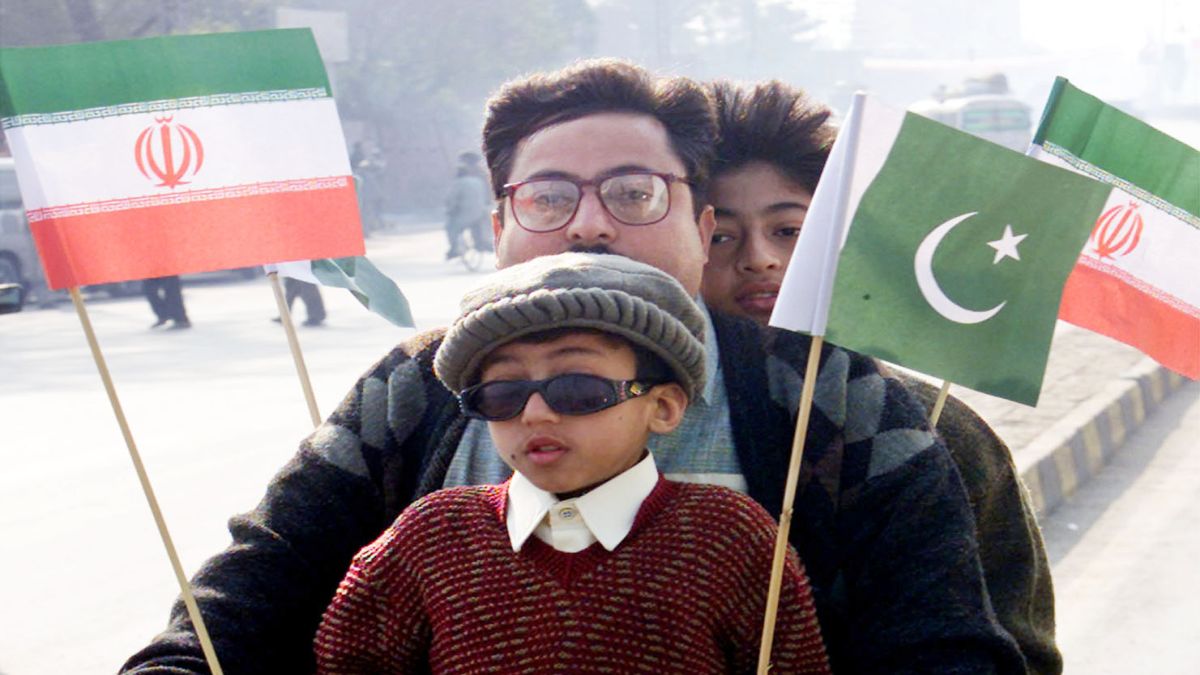
 "A boy holds flags of Iran and Pakistan. As the West Asia conflict drags on, Islamabad has emerged as a key mediator in the conflict. The question is -- can Islamabad broker peace? File image/Reuters")
It’s been a surprise that not everyone is happy about. Since the United States and Israel began attacking Iran on February 28, Pakistan has emerged as a surprising broker of ceasefire negotiations.
In recent days, not only has Pakistan delivered a 15-point proposal from America to Iran, but it has also offered to host peace talks between the two countries, with Pakistan’s Deputy Prime Minister and Foreign Minister Ishaq Dar saying that his nation would be “honoured” to host the two warring sides “in the coming days, for a comprehensive and lasting settlement of the ongoing conflict”.
However, Iran has officially rejected Islamabad’s claim of acting as a mediator between it and the United States to end the West Asia conflict, asserting it has not participated in any such diplomatic initiative even as the crisis enters its second month.
- Catch live updates from the Iran war here
As the situation unfolds at a rapid pace, we try to unpack everything — from how Islamabad has emerged as a possible mediator to where diplomatic negotiations stand, and why a peace deal between Iran and the US is crucial for Pakistan.
Pakistan emerges as mediator between US and Iran
As the war neared its one-month mark, Pakistan suddenly emerged as an intermediary, taking many by surprise. It began to pass messages between Washington and Tehran, offering Islamabad as a neutral venue for talks, and positioning Field Marshal Asim Munir as the back-channel bridge between Trump and a fractured Iranian leadership.
A report by TRT World noted that Pakistan has emerged as a key mediator to end the US-Israel war on Iran, with a summit said to be on the cards.
Reports note that it was Pakistan that delivered the US’s 15-point peace plan to Iran, which included demands of a complete nuclear rollback and opening up of the Strait of Hormuz.
Furthermore, this Sunday (March 29) Islamabad held high-level meetings with Turkey, Egypt, and Saudi Arabia to lay the groundwork for possible talks between Washington and Tehran. According to Dar, the four held “a very detailed and in-depth discussion” on the war, reaffirmed “unity to contain the situation, reduce the risk of military escalations and create conditions for structured negotiations”, and agreed to constitute a Committee of Four senior officials, one from each foreign ministry, to work out the modalities of the process.
Why Pakistan though
But how has Pakistan emerged as the peace broker?
Aqil Shah, the author of the book The Army and Democracy: Military Politics In Pakistan, a professor of political science at McDaniel College, and a visiting faculty member in the security-studies program at Georgetown University, explains Pakistan’s emergence in this conflict, noting in a New Yorker report that the India-Pakistan hostilities of last year helped Islamabad.
During the Pakistan-India crisis last May, when both nuclear-armed countries engaged in limited armed conflict, Islamabad openly embraced Donald Trump’s mediation of the fight, whereas New Delhi rejected the claim completely. However, Pakistan , under Munir, cleverly tapped into Trump’s need for adulation and praise, and the Pakistanis called him a global peacemaker and publicly nominated him for the Nobel Peace Prize.
This has clearly put Pakistan closer to Trump, with the US president stating that Munir is the best field marshal.
Additionally, in terms of the conflict with Iran, Pakistan has always seen itself as a sort of leader of the Muslim world. And so it has used this opportunity, because of its relationship with Trump, and the fact that it borders Iran and is also 15-20 per-cent Shia, to try this balancing act.
Pakistan also has a lot to lose if this conflict keeps going on. Analysts note that if the war drags on, refugees and militants could flood across Balochistan’s already volatile border, compounding the problems for Pakistan’s overstretched army.
Islamabad also has its energy supplies to consider. More than 85 per cent of Pakistan’s energy transits the Strait of Hormuz. The government has already imposed a four-day work week and schools and universities have turned online. Moreover, the Republic Day celebrations were cancelled.
As Michael Kugelman, a senior fellow for South Asia at the Atlantic Council, told the BBC, “Pakistan, I’d argue, more than almost any other country outside of the Middle East has a lot of skin in the game here. “It has a really compelling interest to do what it can to contribute to de-escalation efforts.”
Even Farhan Siddiqi, Professor of Political Science at the Institute of Business Administration, Karachi, agreed, telling the BBC, “If the war continues, the economic pressures in Pakistan will increase tremendously.”
Pakistan also has to consider its defence pact with Saudi Arabia . Last September, Pakistan signed a defence pact with Saudi Arabia, agreeing that “any aggression against either country shall be considered an aggression against both”. This has led to questions about what Pakistan would do if Saudi Arabia joined the war and invoked the pact.
Pakistan is also already in a conflict with the Taliban in neighbouring Afghanistan. As Fatemeh Aman, an Iran-Pakistan expert formerly at the Middle East Institute and Atlantic Council, told DW, “There is urgency. Instability in Iran directly impacts Pakistan — from Balochistan’s security to energy access and domestic stability,” Aman said.
But brokering peace won’t be easy for Pakistan
While Pakistan has offered to play peacemaker in the Iran-US war, it will be far from easy. That’s because analysts note that the positions put forth by both sides remain structurally incompatible.
For instance, the US has demanded that Iran halt all uranium enrichment, restrict its ballistic missile programme, and end its support to regional proxies. In turn, Tehran has called for a halt to aggression and killings, concrete guarantees against recurrence, reparations, an end to hostilities against Iran’s allies, and formal recognition of Iranian sovereignty over the Strait of Hormuz.
Iran’s Ministry of Foreign Affairs spokesperson Esmaeil Baghaei even described the US proposals as “unrealistic, illogical, and excessive”. Baghaei appeared sceptical about the prospects of the Islamabad dialogue yielding a peace deal.
“The meetings that Pakistan has are a framework that they established themselves, and we did not participate in,” he said. “It is good for the countries of the region to be concerned about ending the war, but they should be careful about which side started the war.”
The Consulate General of Iran in Mumbai also issued a clear denial of its involvement in any Pakistani-led efforts. “No direct US talks; only excessive, unreasonable demands via intermediaries. US “diplomacy” flips constantly; our stance is clear. Pakistan’s forums are their own; we didn’t participate. Regional calls to end war are welcome, but remember who started it!” the Consulate General said in a statement.
Pakistan stands to gain from Iran peace talks
While many analysts note that Pakistan’s decision to mediate between the two warring nations is a difficult proposition, if successful would deeply benefit Islamabad.
If Pakistan is able to broker peace between the US and Iran, it’s global standing is certainly going to rise in the region. Michael Kugelman believes the same, telling the BBC, “Pakistan is very sensitive to criticism that it doesn’t have influence on the global stage. I don’t think that’s its main motivation for positioning itself as it has, but it has something to do with this as well.”
And even Maleeha Lodhi, former Pakistan ambassador to the US, UK, and UN, agrees with this assessment. “It’s high-risk and high-reward. If it succeeds, of course, it catapults Pakistan to the top of the global diplomatic game.”
It’s unclear how things might play out, and only time will tell how the situation unfolds.
With inputs from agencies