

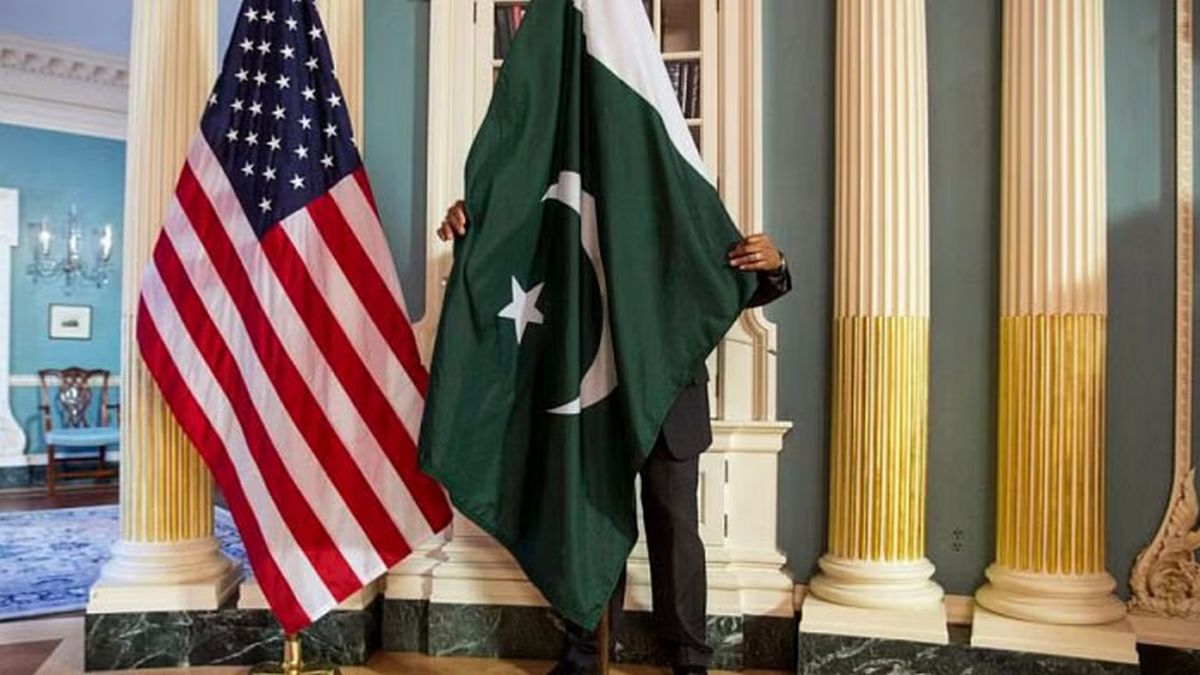
 "Are Pak military leaders' visits to US signs of resetting ties? Should India be bothered?")
In the days after the Pahalgam terror attack, the United States stood firmly by India’s side; US President Trump strongly condemned the terror attack and expressed full support to India to bring to justice the perpetrators of the “heinous attack”. Then, US spy chief Tulsi Gabbard added that her country would back New Delhi as it hunts down the perpetrators, while US House Speaker Mike Johnson said that America would make every effort to help India in its fight against terrorism.
However, actions speak louder than words, and the US actions are quite telling for India. In the past two weeks, the US leadership has met with the top echelons of the Pakistani military — first Trump met Pakistan Army chief Asim Munir on June 18, and now Pakistan’s Chief of the Air Staff Zaheer Ahmed Baber Sidhu met with officials at the Pentagon, State Department and Capitol Hill on Wednesday (July 2).
So, what’s brewing? Is the US looking at a reset of its military ties with Islamabad? And what does that mean for New Delhi?’
Pakistan Air Force chief in US
On Wednesday (July 2), Pakistan Air Force Chief Zaheer Ahmed Baber Sidhu visited Washington, holding high-level meetings at the Pentagon, State Department and Capitol Hill to “further enhance bilateral defence cooperation and mutual interest”.
Sidhu’s meetings at the Pentagon included high-level talks with US Air Force Chief of Staff General David W Allvin and Secretary of the Air Force for International Affairs Kelli L Seybolt, focusing on joint operational training, technology sharing, and institutional ties and future cooperation.
Similarly, at the State Department, Sidhu met Brown L Stanley of the bureau of political and military affairs and Eric Meyer of the bureau of South and Central Asian affairs. The Pakistan Air Force chief also met some prominent members of the US Congress, including Mike Turner, Rich McCormick, and Bill Heizenga.
A Pakistan Air Force (PAF) statement read, “This high-level visit is a strategic milestone in the Pak-US defence partnership. The visit will play a significant role in addressing key regional and global security issues as well as building institutional ties.”
Many analysts pointed that Sidhu’s visit, which comes nearly two months after India’s Operation Sindoor, was with the aim of acquiring American military hardware. Pakistan hopes to acquire the American-built F-16 Block 70 fighter jets, AIM-7 Sparrow air-to-air missiles, and batteries of the US-made High Mobility Artillery Rocket System (HIMARS).
This comes as India’s missiles and drones bypassed Pakistans China-supplied defence systems to strike military targets deep inside the country. Moreover, it is reported that Chinese-made HQ-9P and HQ-16 missile defence systems were destroyed in Indian counterstrikes.
Pakistan’s Munir lunches with Trump
What is most interesting about the Pakistan air force chief’s visit to Washington is that it comes just weeks after Pakistan Army chief General Asim Munir travelled to the US for a luncheon with President Donald Trump.
On June 18, Trump hosted Munir at the White House for a closed-door luncheon. It is not clear what transpired in the meeting between Trump and Field Marshal Munir.
White House spokeswoman Anna Kelly was quoted as saying that the meeting between the two came after the Pakistan army chief pitched Trump for the Nobel Peace Prize for his role in preventing a nuclear war between India and Pakistan.
Ever-changing US-Pakistan military ties
The Trump-Munir lunch, the visit of the Pakistan army chief to Washington, and the US army general Michael Kurilla’s reference to Islamabad as a “phenomenal partner in countering terrorism” during an appearance at a hearing of the US House Armed Services Committee last month all signal a change in the US-Pakistan military ties.
And it’s quite a dramatic reset; dramatic because seven years ago, Trump accused Pakistan of giving the US “nothing but lies and deceit” and safe havens to terrorists – and one that his immediate successor Joe Biden called “one of the most dangerous nations”.
But just how have ties changed between the two countries?
In 1947, soon after Pakistan was formed, US concerns about Soviet expansionism in the region and Islamabad’s desire for security assistance against a perceived threat from India prompted a military alliance between the two countries.
Seven years later, Washington and Islamabad signed a mutual defence assistance agreement and soon military aid started flowing into Pakistan. In 1964, Pakistani President Mohammed Ayub Khan even wrote in an article for Foreign Affairs that Islamabad is “America’s most allied ally in Asia”.
It is reported that between 1953 and 1961, Pakistan received a whopping $2 billion in aid from Washington, with a huge chunk of it going towards military support. However, following the 1965 India and Pakistan war, the US imposed a ban on the transfer of weapons to both New Delhi and Islamabad.
It was the USSR invasion of Afghanistan that changed America’s view towards Pakistan. It became a key partner in the supply of the Afghan mujahideen, which took the fight to the Soviets in Afghanistan, supported by the US and Saudi Arabia, notes the American think tank C_ouncil on Foreign Relation_s. It was around this time that the US also approved the sale of F-16 fighter jets to Pakistan.
But, in 1990, with the end of the Cold War, US President George HW Bush again suspended American military assistance to Pakistan, withholding roughly 28 F-16s that Islamabad purchased in 1989.
The terrorist attacks of September 11, 2001, shifted relations once again; a Congressional Research Service report reveals that between 2002 and 2020, Pakistan received over $34 billion in aid from the US. Roughly $23 billion of American aid was security related, with $8.2 billion being directly related to military aid, while a further $14.5 billion were “Coalition Support Fund” reimbursements, for offering key support to US military operations.
It all turned to naught in 2018 amid Trump’s first tenure; he suspended security aid to Pakistan, stating that Islamabad had failed to take action against terror groups. Trump even tweeted, “The United States has foolishly given Pakistan more than “$33 billion in aid over the last 15 years, and they have given us nothing but lies & deceit. They give safe haven to the terrorists we hunt in Afghanistan, with little help. No more!”
But just this year, Trump authorised the release of funds to Pakistan, including $397 for maintaining its F-16 fighter jet fleet.
Experts note that these ebbs and flows in the US-Pakistan military ties is grounded in tactical necessity and overlapping security interests. While Islamabad needs Washington to continue providing aid and military hardware, the US needs Pakistan as a means to counter China as well as the terror groups in Afghanistan.
India should pay heed to US-Pak ties
But should the US tilt to Pakistan, especially in the backdrop of Operation Sindoor, be a concern to India?
The answer is a mixed one. In the aftermath of the 9/11 attacks, there was a de-hyphenisation between India and Pakistan. However, with the Trump administration interacting with Pakistan’s military, there’s a chance of a re-hyphenation in ties. Moreover, India can’t afford to have Islamabad currying much favour with Washington as well as Beijing. This puts the country in a difficult position on the global stage.
But experts also note that India is now America’s partner of choice not only in South Asia but the Indo Pacific. As the Hudson Institute notes, it would take much more than a few high-level visits by Pakistani military officials to restore American trust in Pakistan, which remains strategically aligned with America’s rival, China.
India’s Lt General Syed Ata Hasnain (retired) explains it the best in an Indian Express column, “Trump’s outreach to Pakistan should not be read as a betrayal or a shift away from India. It is better understood as tactical engagement driven by geography, legacy relationships, and evolving regional threats. Pakistan will always offer America access, whether for leverage in Kabul, observation posts against Iran, or to counter Chinese expansion. But such engagement is opportunistic, not strategic.”
With inputs from agencies


 "'Indian food, our pride': $200k settlement in Palak Paneer case a moral victory against racism in the west")
 "India’s air dominance in Operation Sindoor forced Pakistan to seek ceasefire, European report says")
 "How Pakistan’s support may have led Bangladesh towards a very costly mistake")
 "India vs New Zealand Live Score 3rd T20: Abhishek slams second fastest 50 by an Indian in T20Is")
 "'Indian food, our pride': $200k settlement in Palak Paneer case a moral victory against racism in the west")
 "India’s air dominance in Operation Sindoor forced Pakistan to seek ceasefire, European report says")
 "How Pakistan’s support may have led Bangladesh towards a very costly mistake")
 "India vs New Zealand Live Score 3rd T20: Abhishek slams second fastest 50 by an Indian in T20Is")



