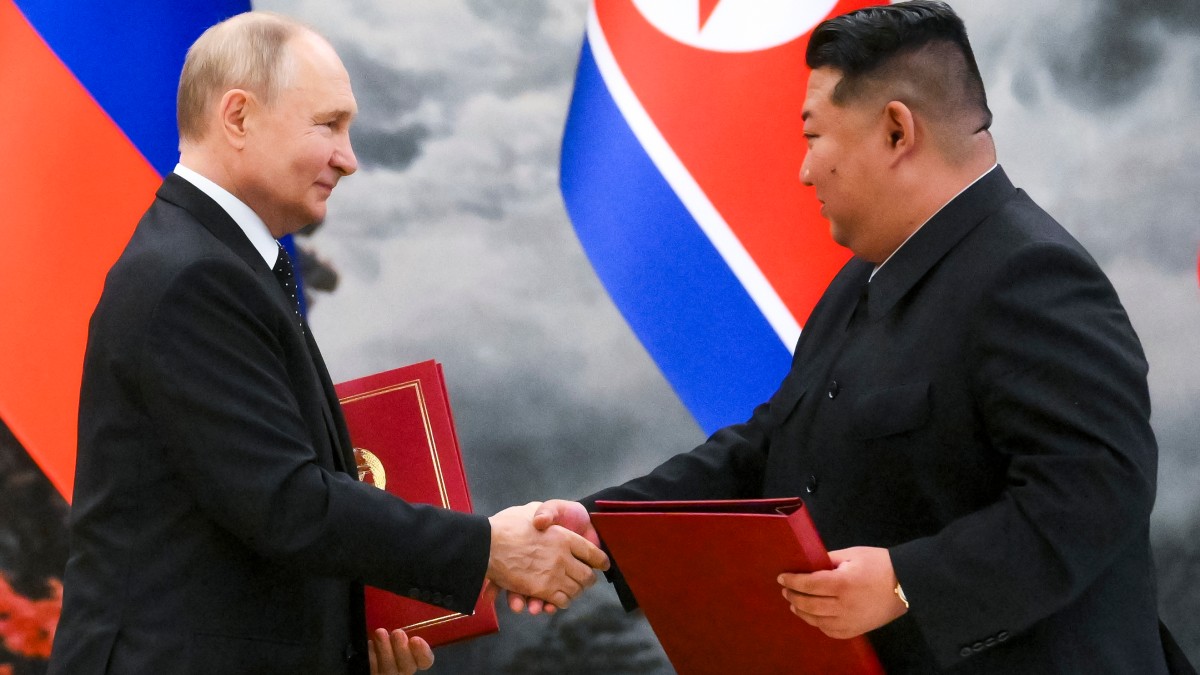
 "Russian President Vladimir Putin, left, and North Korea's leader Kim Jong Un shake hands after a signing ceremony of the new partnership in Pyongyang, North Korea, on Wednesday, 19 June 2024.")
The strategic alliance North Korean leader Kim Jong Un and Russian president Vladimir Putin signed on Wednesday is hailed as a historic moment.
But neither side has released the text of the agreement that resulted from their summit in Pyongyang.
Thus, its consequences for the near and long term are uncertain.
The sprawling Russia and tiny, isolated North Korea, both nuclear powers, have seen significant progress in their relations in recent years due to Russia’s mounting tension with the West over the invasion of Ukraine and the repression of all internal opposition.
The new deal may strengthen their relationship while presenting fresh difficulties for the global community.
What’s in the new partnership, according to Kim and Putin:
Aggression
Putin told a briefing after signing the deal that “the comprehensive partnership agreement provides, among other things, for the provision of mutual assistance in the event of aggression against one of the parties to this document.”
Many questions are raised by that sentence.
A possible definition of “aggression” is the first.
Historically, both sides have used the word to criticise activities that are not quite as serious as physical or cyberattacks.
North Korea has an exceptionally wide perspective.
The joint military drills between the US and South Korea are frequently referred to as “aggression” by Pyongyang, characterising them as invasion rehearsals.
As a kind of tit-for-tat response, it often launches its own missiles or puts on other military exhibitions.
Furthermore, the so-called aggressions do not have to manifest in actual acts.
Impact Shorts
More ShortsAs “the main means of aggression, together with military threat, (that) the DPRK will have to take into consideration the resolute and decisive option for defending the sovereignty and security of the state in an all-around way,” it has blasted U.S. criticism of North Korea’s human rights record.
The Democratic People’s Republic of Korea, or DPRK, is the official name of the nation.
Russia has justified the conflict in Ukraine on purported intentions by NATO to launch an attack on its territory.
Putin also once called the 2014 demonstrations that ousted Ukraine’s Russia-friendly president as aggression
Response
The kind of help that was promised in the agreement was not specified, in contrast to the NATO charter’s Article 5, which mandates that member states take any required measures.
Neither Kim nor Putin made it clear in their descriptions of the deal whether assistance would come from troops, supplies, or other forms of aid.
What if there’s no aggression?
North Korea and Russia may not find a reason to claim any commission of aggression against them, but they say they will help each other’s militaries.
Putin essentially linked such military cooperation with North Korea to Western supplies of weapons to Ukraine, referring to high-precision weapons systems, warplanes and other high-tech weapons.
“The Russian Federation does not exclude the development of military-technical cooperation with the Democratic People’s Republic of Korea in accordance with the document signed today,” Putin said.
That statement, in effect, formalises what Western countries claim is already happening.
The United States and other allies allege that Russia has received ballistic missiles and ammunition from North Korea as the Ukraine war depletes Moscow’s inventory and that Russia has made technology transfers to Pyongyang that could enhance the threat posed by Kim’s nuclear weapons and missile programme.
The economic aspect of the pact
The partnership also calls for developing economic ties, an especially important issue for North Korea as it suffers under an array of international sanctions.
North Korea needs goods and materials, and, in turn, can supply Russia’s war-depleted workforce with labour; those workers in turn could convert wages in rubles to dollars or euros and send hard currency back home.
Putin said the Russian-North Korean trade turnover has risen ninefold over the past year, but admitted that the amount itself remains “modest.”
With inputs from The Associated Press