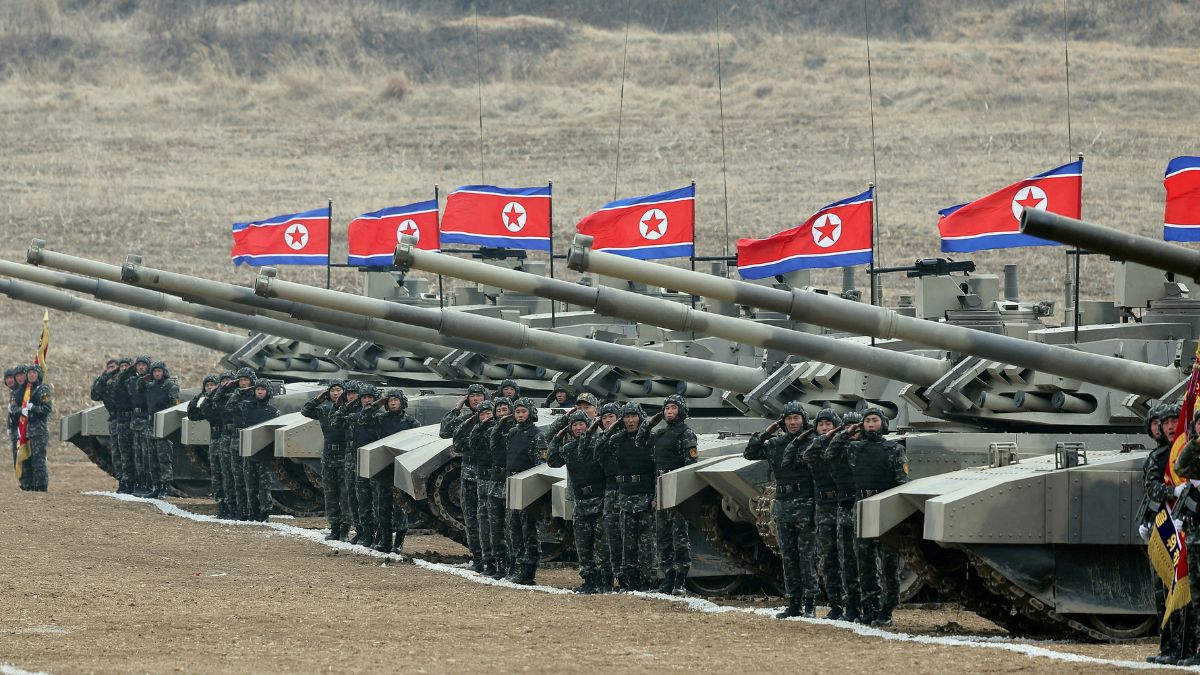
 "Military members salute during a military demonstration involving tank units, guided by North Korean leader Kim Jong Un (not pictured), in North Korea, March 13, 2024 in this picture released on March 14, 2024, by the Korean Central News Agency. File Image/KCNA via Reuters")
Reports from Ukraine suggest that North Korean soldiers deployed by Russia are resorting to suicide tactics to avoid capture.
Ukrainian Special Operations Forces recently reported an incident in the Kursk region where a North Korean soldier detonated a grenade, killing himself to evade being taken prisoner.
According to Ukrainian and Western intelligence, approximately 11,000 North Korean soldiers have been deployed to support Russia in its fight against Ukraine, with over 3,000 reportedly killed or injured.
The deployment marks North Korea’s most significant military involvement in an international conflict since the Korean War (1950-53). The soldiers, operating in Russia’s western Kursk region, are believed to have been instructed to prioritise suicide over capture, a tactic that aligns with North Korea’s military doctrine and propaganda.
Are North Korean soldiers being brainwashed?
Witnesses and defectors have shed light on the psychological conditioning of North Korean soldiers, many of whom are indoctrinated to view capture as treason.
“Self-detonation and suicides: that’s the reality about North Korea,” Kim, a 32-year-old former North Korean soldier who defected to South Korea in 2022, told Reuters. Kim explained that soldiers are taught to sacrifice themselves for leader Kim Jong-un and to view capture as a betrayal of their country and family.
One South Korean intelligence report detailed a chilling incident where a North Korean soldier, upon realising he was about to be captured, shouted “General Kim Jong-un” before attempting to detonate a grenade. Memos retrieved from slain North Korean soldiers show a preference for self-destruction over surrender.
Such tactics not only demonstrate loyalty to the regime but also serve to protect their families from potential persecution back home.
How has North Korea helped Russia?
North Korea’s military deployment to Russia signifies a major shift in its international military engagement. Historically, Pyongyang’s involvement in foreign conflicts has been limited, with smaller contingents sent to the Vietnam War and the Syrian Civil War.
However, its contribution to Russia’s war effort in Ukraine — reportedly sanctioned under an agreement between Moscow and Pyongyang — has been substantial.
Despite initial denials, Russian President Vladimir Putin and North Korean officials have since implied that the deployment is legitimate. The soldiers are said to operate alongside Russian units, often wearing Russian military uniforms and carrying fake IDs.
Also Watch:
Intercepted communications reveal their North Korean origins, with troops reportedly using their own weapons and adapting to modern warfare tactics, including drone countermeasures.
With over 380 square miles of Russian territory in the Kursk region under Ukrainian control, the strategic importance of the area remains high. Analysts believe that the influx of North Korean troops has been crucial to Russia’s efforts to hold the line in Kursk, but their heavy casualties — reportedly exceeding 3,000 — highlight the costs of this strategy.
What does the Russia-North Korea partnership in Ukraine mean?
The involvement of North Korean troops in Ukraine poses significant geopolitical risks. Analysts warn that the combat experience gained by these soldiers could strengthen North Korea’s military capabilities, potentially escalating regional tensions in East Asia.
Dorothy Camille Shea, the US deputy ambassador to the United Nations, has cautioned that the war in Ukraine is providing Pyongyang with valuable battlefield knowledge and military technology, which could be leveraged to enhance its own arsenal or sold internationally.
Ukraine’s President Volodymyr Zelenskyy has highlighted the brutality of the tactics employed by North Korean and Russian forces. In one instance, Zelenskyy claimed that wounded North Korean soldiers were executed by their own comrades to prevent capture.
Ukraine has captured only two North Korean soldiers so far, one of whom reportedly expressed a desire to stay in Ukraine rather than return to Pyongyang.
As the war grinds on, the use of North Korean soldiers as “cannon fodder” raises troubling questions about the lengths to which both Moscow and Pyongyang are willing to go to achieve their objectives.
With inputs from agencies