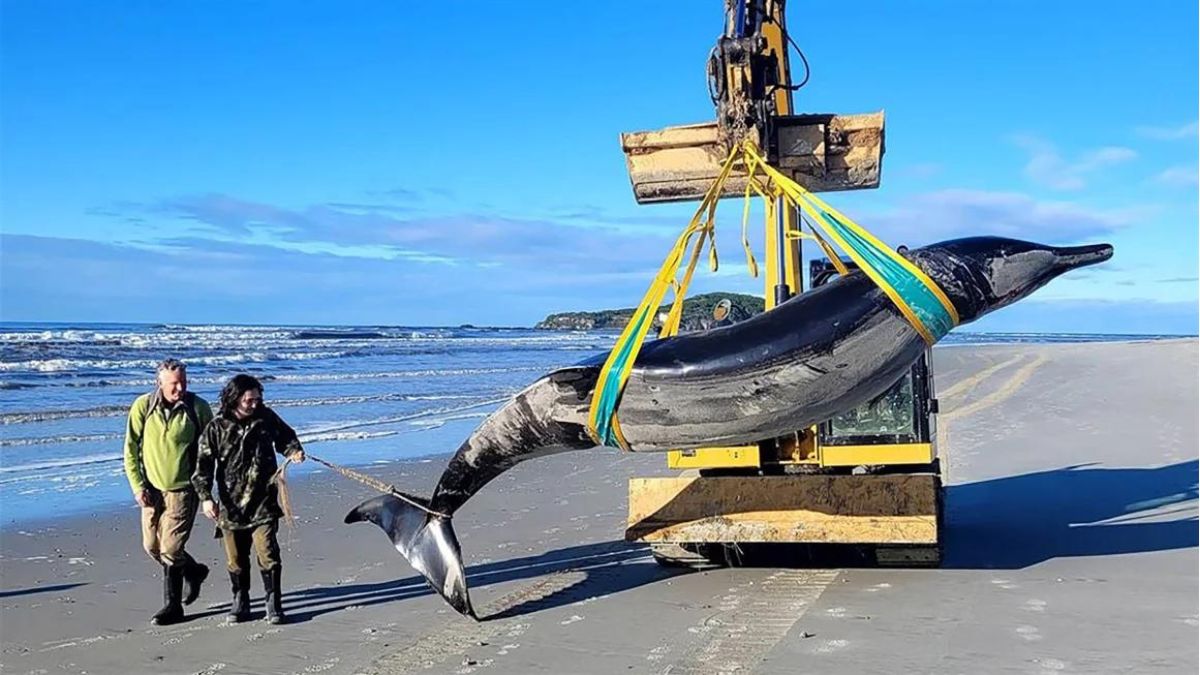
 "Spade-toothed whales are one of the most poorly known large mammalian species of modern times. Department of Conservation (NZ)")
A five-metre-long beaked whale washed ashore near Taiari Mouth, Otago, New Zealand on July 4, prompting a flurry of scientific interest. The Department of Conservation (DOC) in New Zealand was alerted and quickly consulted marine-mammal experts from DOC and Te Papa.
Upon inspection, it was suggested that this creature could be a spade-toothed whale, one of the rarest and least known large mammalian species on the planet.
Why is this potential find so special?
Gabe Davies, DOC Coastal Otago operations manager, expressed the significance of this find in a press release on July 15: “Spade-toothed whales are one of the most poorly known large mammalian species of modern times. Since the 1800s, only six samples have ever been documented worldwide, and all but one of these was from New Zealand. From a scientific and conservation point of view, this is huge.”
The spade-toothed whale was first described in 1874 from a lower jaw and two teeth collected on Pitt Island in the Chatham Islands. Subsequent skeletal remains from New Zealand and Chile confirmed the existence of this elusive species.
Until now, knowledge of the spade-toothed whale has been limited to these few scattered remains, making each new discovery incredibly valuable.
Also Read | Killer whale eats great white shark: Why scientists are worried
In 2010, the first intact specimens were found when a mother and calf stranded in the Bay of Plenty, New Zealand. Another specimen was discovered in 2017 in Gisborne (northeastern NZ), further adding to the limited collection of known spade-toothed whale samples.
Impact Shorts
More ShortsThe recent discovery near Taiari Mouth offers the first opportunity ever for scientists to dissect a relatively fresh specimen.
What kind of scientific opportunities does the find present?
The spade-toothed whale’s remains present a unique opportunity for scientific study. Anton van Helden, a science advisor at DOC’s marine species team, who has been instrumental in identifying previous spade-toothed whale specimens, highlighted the importance of this discovery. “There is no doubt that that is what it is," he told UK-based news outlet The Guardian.
Hannah Hendriks, a technical advisor at DOC, added, “This whale species is extremely rare, so this opportunity may allow us to learn more about how and where the animal lived and what it ate. If we are able to learn more about these aspects, we get closer to understanding whether the species is threatened and what threats it might face.”
The DOC aims to learn as much as possible from this specimen, including details about its diet and health. Hendriks told CNN, “We would also be looking out for any indications as to why the whale might have died such as ingestion of foreign material, high parasite loads, or signs of disease.”
Where is the whale now?
Moving and preserving the whale was a significant challenge. At 9:30pm (local time) on the night the whale was found, Trevor King, a local contractor who owns a Earthmoving business received a call from DOC.
He quickly mobilised his team to move the whale from the beach to a cold storage facility in Dunedin, a task that involved navigating tight spaces and ensuring the whale remained intact.
Watch: Whole Pod of 77 Whales Die in Mass Stranding in Scotland
Jim Fyfe, a coastal marine ranger, coordinated the operation on-site. He described the whale as looking “like a massive giant dolphin.” Fyfe’s quick actions and coordination with Van Helden were crucial in securing the whale for scientific study, reported The Guardian.
Genetic samples were sent to the University of Auckland’s Cetacean Tissue Archive, but it could take weeks or even months for the DNA results to confirm the species definitively.
What is the cultural significance behind this find?
New Zealand’s Māori people regard whales as sacred treasures, or taoka. Nadia Wesley-Smith, chair of Te Rūnanga ō Ōtakou, highlighted the importance of respecting this cultural heritage: “It is important to ensure appropriate respect for this taoka is shown through the shared journey of learning, applying mātauraka Māori as we discover more about this rare species.”
The Māori have a long-standing relationship with whales, which have provided food and materials for utensils, as well as played significant roles in tribal traditions. Whales are often depicted as guardians on the ancestors’ canoe journeys to Aotearoa (Māori-language name for New Zealand). Oral histories recount various interactions between people and whales, reflected in tribal stories, carvings, specialised language, and place names. Additionally, there is a rich body of tribal knowledge about whales.
Te Rūnanga ō Ōtakou will work closely with the DOC to decide the next steps for the whale’s remains. The Guardian reported that Māori leaders conducted a ceremony to acknowledge Tangaroa, God of the Sea, and the whale’s journey, tying a harakeke, a woven rope, around the whale’s tail as a mark of respect.
With inputs from agencies