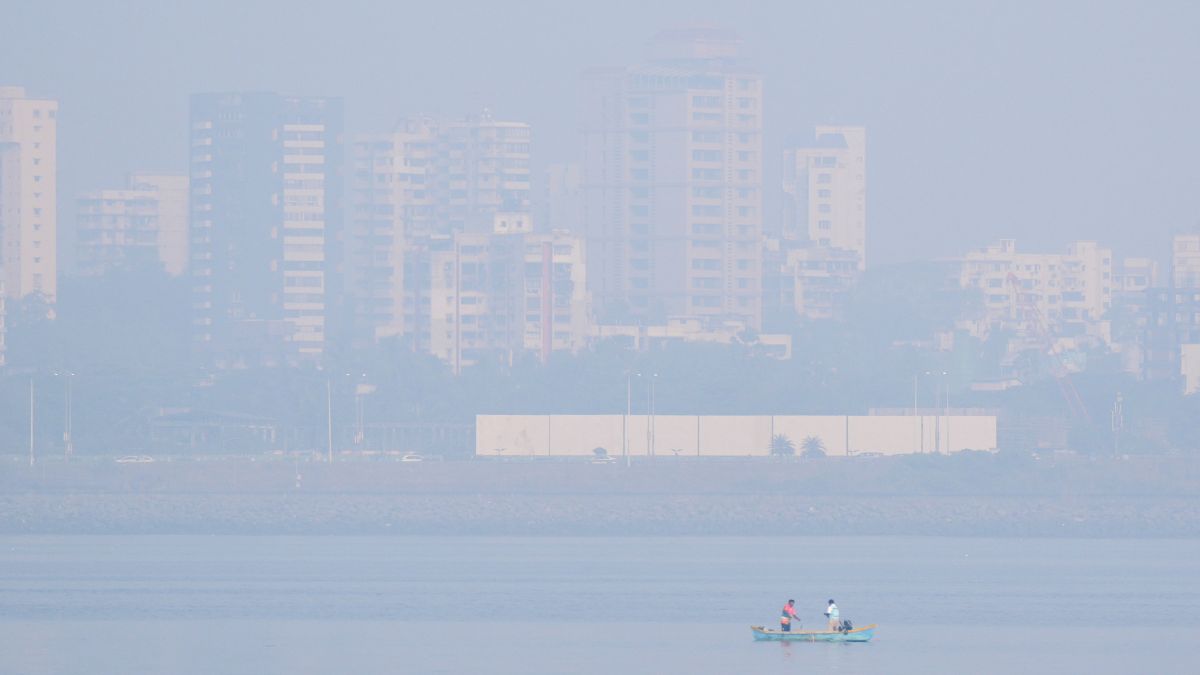
 "A layer of smog shrouds the city, in Mumbai, November 28, 2025. PTI")
Two major metro cities in India are staring at a pollution crisis. People in Delhi and Mumbai are breathing toxic air, as thick layers of haze envelop both cities. The Air Quality Index (AQI) in Delhi and Mumbai remained hazardous on Monday (December 1).
Mumbai has implemented the Graded Response Action Plan-4 (Grap-4) measures, while Delhi revoked Grap-3 restrictions last week despite having worse air quality than India’s financial capital. How do the pollution levels compare in the two cities?
We take a look.
Toxic air chokes Mumbai
A thick layer of smog engulfed Mumbai on Monday, even as the air quality “improved” in the city. According to the Central Pollution Control Board (CPCB) data, the AQI fell in the ‘moderate’ category today, with a reading of 111.
On Sunday, Mumbai’s overall AQI was 103. The financial capital witnessed its worst air quality of the season on Friday, as the air quality in key areas deteriorated to ‘poor’ at 222.
The Brihanmumbai Municipal Corporation (BMC) imposed Grap-4 restrictions in certain areas of Mumbai after AQI crossed the ‘very poor’ and ‘severe’ categories. The air quality in Mazgaon, Deonar, Malad, Borivali East, Chakala-Andheri East, Navy Nagar, Powai, and Mulund declined to these levels.
Mumbai’s civic body has stopped construction and dust-generating activities in these areas. Stop-work/shutdown notices have been issued to over 50 construction sites, reported NDTV.
Small industries, including bakeries and marble-cutting units, have been asked to adopt cleaner methods.
BMC has deployed flying squads, comprising engineers, police personnel and GPS-tracked vehicles, in every ward to enforce pollution control measures and keep an eye on emissions.
Quick Reads
View AllSpeaking to Hindustan Times (HT), a civic official said the BMC inspected 70 construction sites across Mumbai. Stop-work notices were issued at 53 of them until November 26 after they were found violating the dust-control rule.
Junior supervisors from the BMC’s solid waste management department will monitor polluting activities, such as the open burning of garbage.
Delhi engulfed in smog
Delhi woke to reduced visibility as a toxic layer of smog blanketed its skies.
The air quality in the city plunged on Monday to the ‘very poor’ category, with an AQI reading of 301, driven by PM 2.5 and PM 10 levels.
This comes after the AQI had “improved” to the ‘poor’ category with a reading of 279 a day before.
Despite reporting 24 days of ‘very poor’ air, the Commission for Air Quality Management (CAQM) revoked stage 3 restrictions under the Graded Response Action Plan across Delhi- National Capital Region (NCR) last week.
With this, the ban on plying BS-III petrol and BS-IV diesel vehicles was officially lifted.
Delhi’s pollution crisis is annual. Before the onset of winter, NCR’s air quality starts deteriorating, with people struggling to breathe amid toxic air.
The health impact of such air is severe, with an analysis blaming pollution for 17,188 deaths, or one in seven, in Delhi in 2023.
Why Delhi is more polluted than Mumbai
Delhi was the most polluted city between 2015 and November 2025, a new analysis has found.
The ‘Air Quality Assessment of Major Indian Cities (2015–2025)’ analysis, released by Climate Trends, studied the annual mean AQI data of 11 cities: Ahmedabad, Bengaluru, Chandigarh, Chennai, Delhi, Kolkata, Lucknow, Mumbai, Pune, Varanasi, and Visakhapatnam, as per an Indian Express report.
The annual mean AQI levels were highest in the national capital in 2016 — more than 250, but have seen a dip since 2019. In 2025, the mean AQI stood at 180.
Delhi was followed by Lucknow, Varanasi, Ahmedabad, and Pune in experiencing high levels of AQI for prolonged periods. On the other hand, Mumbai, Chennai, Chandigarh and Visakhapatnam reported better air quality, ranging between 80 and 140.
Bengaluru witnessed the best air quality among these 11 cities, logging AQI levels of between 65 and 90 for the most period.
The analysis affirmed that northern cities in India record worse air quality than western and southern cities. This is mainly due to the region’s geography.
Northern cities are landlocked, as the Indo-Gangetic Plain is encircled by the Himalayas. This leads to pollutants getting trapped, unable to disperse. Moreover, “within cities, dense urban structures create additional “surface roughness,” a frictional effect that further slows wind speeds and limits dispersion,” Indian Express reported, citing the analysis.
During the summer and monsoon, rain and strong westerly winds help disperse pollutants. The situation worsens in winter, with Delhi especially affected due to its location. The city lies in the middle of a vast, flat basin bound by the Himalayas to the north.
“During winters (December-February), the air in the planetary boundary layer (the lowest part of the atmosphere) is thinner as the cooler air near the Earth’s surface is denser. The cooler air is trapped under the warm air above, forming a kind of atmospheric ‘lid’. This phenomenon is called winter inversion. Since the vertical mixing of air happens only within this layer, the pollutants released lack enough space to disperse in the atmosphere,” according to the analysis.
Delhi’s pollution woes have stirred a political row, with the opposition targeting the Central government over the crisis.
With inputs from agencies