

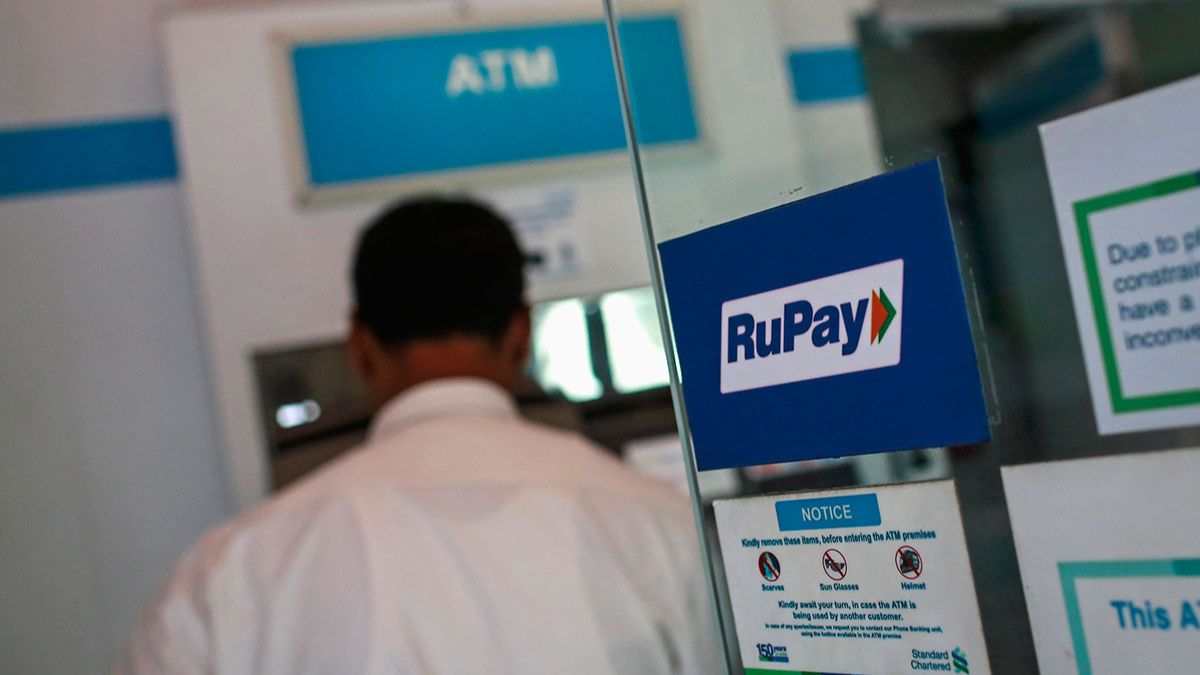
 "Muizzu in India: Now RuPay launched in Maldives. Which other countries can you use it in?")
India on Monday launched its RuPay card in the Maldives, marking a new era in financial cooperation between the two nations.
This comes on the heels of recent talks between Prime Minister Narendra Modi and Maldivian President Mohamed Muizzu, which focused on mending and strengthening bilateral relations between the two countries, which had been somewhat strained due to political differences in recent years, including Muizzu’s prior ‘India Out’ stance.
Currently, President Muizzu is on his first official visit to India since assuming office last November and the introduction of RuPay will help simplify transactions for both tourists and locals, supporting the island nation’s economy across various sectors.
Earlier this year, a senior minister in the Muizzu-led government noted that this introducing RuPay “will bolster the Maldivian Rufiyaa.”
With the mission now accomplished, the two leaders also witnessed the first-ever transaction conducted using a RuPay card, reported ANI.
#WATCH | Delhi: RuPay card payments introduced in Maldives. Prime Minister Narendra Modi and Maldives President Mohamed Muizzu witness the first such transaction. pic.twitter.com/zuYbuFAsVL
— ANI (@ANI) October 7, 2024
With the launch, Maldives now joins seven other nations that have adopted India’s homegrown payment system. But what makes RuPay so appealing on a global scale? Why are countries keen to adopt it, and who has already done so? Let’s take a closer look.
All about RuPay
The RuPay card, launched by the National Payments Corporation of India (NPCI) in 2012, is India’s first domestic debit and credit card network.
It was designed to give India a homegrown presence in the global payments arena. In May 2014, former President Pranab Mukherjee officially dedicated RuPay to the nation.
Initially referred to as “India Pay,” the name “RuPay” was ultimately chosen, blending “rupee” and “payment” to represent an entirely Indian approach to card transactions. The card was developed as an alternative to international giants like Mastercard and Visa after the Reserve Bank of India observed that most card transactions in India were domestic.
For Indian banks, affiliating with these global networks came with high costs. RuPay addressed this, enabling electronic payments across Indian banks and financial institutions at a lower transaction cost than foreign schemes.
To expand globally, NPCI partnered with international networks. According to NPCI, RuPay Global cards are accepted at over 1.9 million ATMs and 42.4 million point-of-sale locations globally.
Which countries have launched RuPay?
Numerous countries have launched the Indian payments system in recent years.
Singapore
The RuPay card scheme made its debut in Singapore in May 2018.
It was launched by PM Modi alongside related services introduced by the NPCI like the Unified Payments Interface (UPI) and the Bharat Interface for Money (BHIM).
The State Bank of India was the first to issue RuPay cards in Singapore, which were integrated with the country’s 33-year-old NETS (Network for Electronic Transfers) system. This integration allowed RuPay users to make seamless payments at all NETS acceptance points throughout Singapore.
Bhutan
Following its success in Singapore, RuPay cards made their way to Bhutan in December 2018 following Bhutanese Prime Minister Lotay Tshering’s India visit. The official launch of RuPay in Bhutan took place in August 2019, with PM Modi making the first transaction using the card.
To facilitate smooth cross-border transactions, the Reserve Bank of India (RBI) and the Bhutan National Bank Ltd (BNBL) announced plans to integrate the financial systems of both countries.
Bhutan 🇧🇹 : NPCI international payments limited (NIPL) an arm of National Payment Corportion of India 🇮🇳 (NPCI) issue more than 10,000 Rupay cards in Bhutan 🇧🇹 .
— Resonant News🌍 (@Resonant_News) July 25, 2023
● Bhutan National Bank limited is the only bank in Bhutan currently issuing Rupay Cards .
● BNBL Rupay debit card… pic.twitter.com/ocUTFyLbVc
And RuPay cards proved to be a hit. According to a 2022 Business Standard report citing NPCI, Bhutan has issued over 10,000 RuPay cards. These debit cards are widely accepted, with access to more than 265,994 ATMs and 7.9 million point-of-sale terminals for cash withdrawals, balance inquiries, and payments.
UAE
The UAE was the first country in the Middle East to launch the RuPay card during PM Modi’s visit in August 2019, following a memorandum of understanding (MoU) between the National Payments Corporation of India (NPCI) and UAE’s Mercury Payments Services.
Three banks in the UAE—Emirates NBD, Bank of Baroda, and First Abu Dhabi Bank—issue RuPay cards.
“By becoming the first country in the region to introduce the RuPay card, we expect that each of these elements of tourism, trade, and the Indian diaspora will benefit,” Navdeep Singh Suri, Indian Ambassador to the UAE, in an interview with Emirates News Agency, WAM, said.
The acceptance of RuPay in the UAE lowers charges for Indian tourists, as they save on exchange rate fees, enhancing their travel experience.
VIDEO | PM Modi and UAE President Sheikh Mohammed Bin Zayed Al Nahyan introduce UPI service in Abu Dhabi. pic.twitter.com/24JKrjD77I
— Press Trust of India (@PTI_News) February 13, 2024
Bahrain
The NPCI signed an MoU with the National Electronic Payments Network (BENEFIT), a leading company in Fintech and electronic financial transactions service in Bahrain, to felicitate the launch of the RuPAY card in the Gulf nation.
In 2021, RuPay the collaboration between the two enabled Indian travellers to transact via their RuPay cards across 515 ATMs and 40,000 PoS terminals in Bahrain the country, the NPCI said.
Saudi Arabia
In 2019, Saudi Arabia became the fifth country to launch the RuPay card, aimed at benefiting Indian tourists visiting popular destinations like Dubai, as well as pilgrims traveling to Mecca and the large Indian expatriate community.
Following the Prime Minister’s visit in October 2019, a memorandum of understanding (MoU) was signed between the National Payments Corporation of India (NPCI) and Saudi Payments for RuPay acceptance.
Nepal
In 2022, Nepal joined the list of countries using the RuPay card. The decision was made during talks between Prime Minister Modi and Nepalese Prime Minister Sher Bahadur Deuba, where they jointly launched the Indian electronic payment system in the Himalayan country, as reported by PTI.
“Introduction of RuPay card in Nepal will add a new chapter to our financial connectivity,” Modi stated.
People familiar with the matter told the news agency Nepal SBI Bank (NSBL), a subsidiary of SBI and the largest international bank in Nepal, worked on this initiative for over a year with support from Nepal’s Central Bank.
Sri Lanka and Mauritius
Earlier this year, Prime Minister Modi launched RuPay and UPI services in Mauritius and Sri Lanka during a virtual ceremony, calling it a “special day” for the three friendly countries in the Indian Ocean Region.
With the adoption of RuPay technology, Mauritius’s MauCAS card scheme will allow local banks to issue RuPay cards domestically, enabling cardholders to make secure payments in both countries.
This initiative makes Mauritius the first country outside Asia to issue cards using RuPay technology.
With input from agencies

 "Russian drones over Poland: Trump’s tepid reaction a wake-up call for Nato?")
 "As Russia pushes east, Ukraine faces mounting pressure to defend its heartland")
 "Why Mossad was not on board with Israel’s strike on Hamas in Qatar")
 "Turkey: Erdogan's police arrest opposition mayor Hasan Mutlu, dozens officials in corruption probe")
 "Russian drones over Poland: Trump’s tepid reaction a wake-up call for Nato?")
 "As Russia pushes east, Ukraine faces mounting pressure to defend its heartland")
 "Why Mossad was not on board with Israel’s strike on Hamas in Qatar")
 "Turkey: Erdogan's police arrest opposition mayor Hasan Mutlu, dozens officials in corruption probe")



