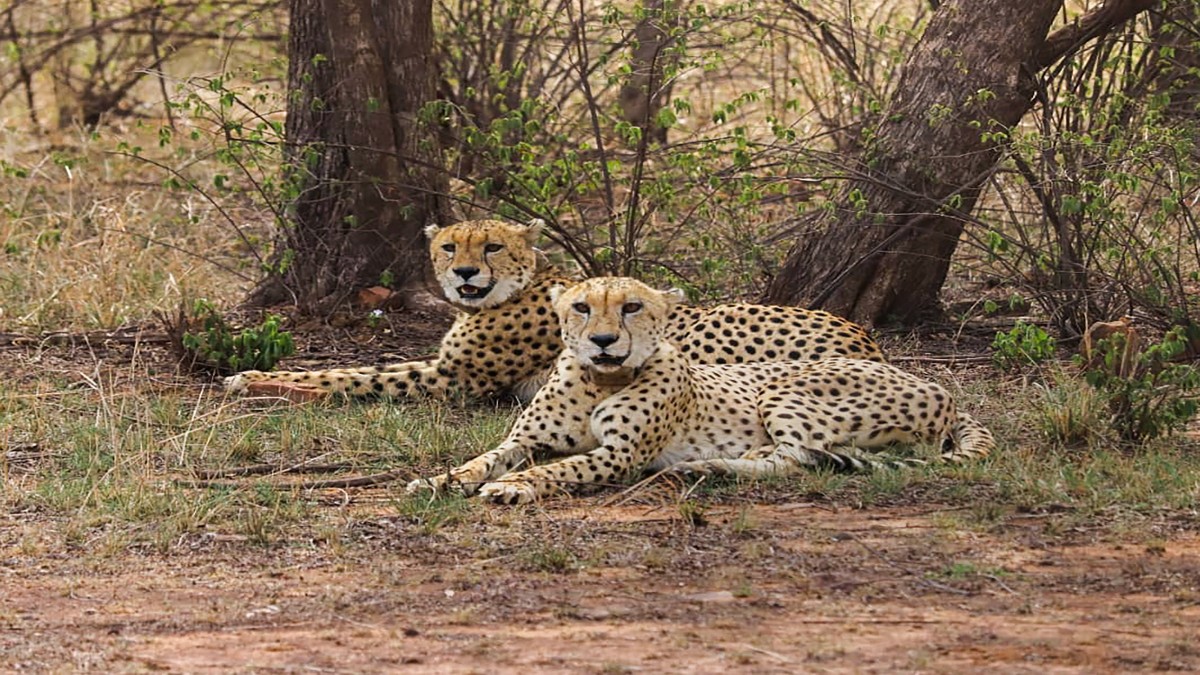
 "In this file image, Cheetahs at Kuno National Park (KNP) in Madhya Pradesh's Sheopur district. Namibian cheetah Shaurya died at the national park on Tuesday, state Forest Minister Nagar Singh Chouhan said, making it the 10th such fatality since the reintroduction of African big cats in India in 2022. PTI")
Cheetahs are now walking free in India for the first time in many years.
However, concerns have been voiced about the cheetahs’ living conditions in the Sheopur district of Madhya Pradesh’s Kuno National Park.
This time, however, the issue is distinct, even if the park has encountered numerous difficulties related to ecology and adaptation.
With serious claims against the administration, cheetah trackers employed in Kuno have gone on strike.
Here’s why.
Cheetah-trackers on strike
About 30 villagers who were employed to track and monitor cheetahs 24x7 have gone on strike.
Each tracker is given a particular cheetah to watch its behaviour inside the enclosure to enable more thorough surveillance and possibly develop a degree of trust.
This entails keeping an eye on food schedules, seeing to the cheetah’s welfare, and offering recreational activities as needed.
The Times of India report quoted its source as saying that although developing close connections with wild animals is difficult, intimacy can help cheetahs adjust and gather information.
“The trackers stopped working and came to Kuno four days ago. They went straight to the Chief Minister’s office instead of raising the issue with park or wildlife headquarters first,” an officer told the newspaper.
That being said, the unexpected strike has hampered the cheetah monitoring initiative.
“Currently, most cheetahs are within the secure enclosures and our existing staff can manage them. The villagers’ absence won’t significantly impact cheetah tracking and monitoring,” the officer said.
Impact Shorts
More ShortsRefusal of animal slaughter
Soft-release bomas (SRBs) are unique enclosures where big cats are kept.
Most cheetah-trackers refuse to kill animals for their food.
According to NDTV, these locals were chosen primarily from the Gurjar and Yadav communities due to their familiarity with the terrain of the area.
But killing goats and buffaloes for the cheetahs is against their religious beliefs.
According to a TOI report, they have even turned down training provided by the park administration.
“We’re on strike and haven’t heard back from park officials. Our demands are clear: we can’t participate in the animal preparation for cheetah feeding,” a tracker said.
Low pay
Another reason for the strike is extremely low pay.
Trackers operate in shifts and are paid approximately Rs 9,000 per month.
The forest is dangerous, according to the cheetah trackers, and they have to spend three to four days a week tracking the big cats.
The protesters claim that their religious beliefs are not being taken into consideration and that nothing is being done in the name of security.
A villager named Rajveer Gurjar claimed the government ought to assist them more, as per NDTV.
Sitaram Yadav, another villager, said they are paid very little for their exhausting work.
According to TOI, insurance coverage and exemption from slaughtering duties are two important reasons that their representatives brought up when they visited the office of Chief Minister Dr Mohan Yadav to request action.
Although they were unable to see the CM, they were able to present their case to his OSD, SK Tiwari, who then followed up with concerned staff to get more information.
The cheetah trackers are looking for full insurance to be covered for any risks related to their employment in the park, such as runs-ins with wild animals or accidents received while tracking.
Challenges for cheetah trackers
The cheetah trackers have faced numerous challenges when it comes to doing their job.
Veera, the female cheetah, had ventured outside the park boundaries once. She reached Baghwala village, which is close to the Gwalior-Morena boundary. The trackers and officers had been up at all hours trying to recover it, as per TOI.
Earlier, there were reports of Pawan, another cheetah, venturing outside the park’s boundaries. He was recently recovered from the Karoli region of Rajasthan.
In one of the incidents, the trackers sent to find a cheetah that had left the park were attacked by residents of Burakheda town in Morena.
Given their attire and midnight presence, the villagers assumed the team was a group of cattle thieves and attacked them with guns firing. There were no reported significant injuries.
Kuno National Park in tough spot
The strike exposes a possible dispute between efforts to conserve wildlife and traditional values.
In their haste to find alternatives, Kuno Park officials are thinking about outsourcing the tendering process for the purchase of pre-cut meat from authorised vendors.
The first batch of cheetahs were relocated from Namibia in September 2022 and released into enclosures by Prime Minister Narendra Modi.
The park is currently home to 26 cheetahs, half of them cubs.
Cheetah Gamini earlier gave birth to five cubs, bringing the total number of Indian-born cheetahs to 13.
With inputs from agencies