 "Are Kashmir’s donations for Iran being misused for ‘anti-India’ activities?")
Kashmiris have poured out their hearts for Iran, which is engaged in a war with the United States and Israel. They have donated generously to the Islamic Republic, expressing overwhelming solidarity with the country amid the conflict in West Asia.
However, some of these donations have come under scrutiny by the Indian security establishment. Intelligence agencies fear there could be misappropriation and misuse of funds for anti-India activities.
We take a look.
Kashmir donates to Iran
Kashmiris have shown genuine solidarity with Iran as it battles the US and Israel.
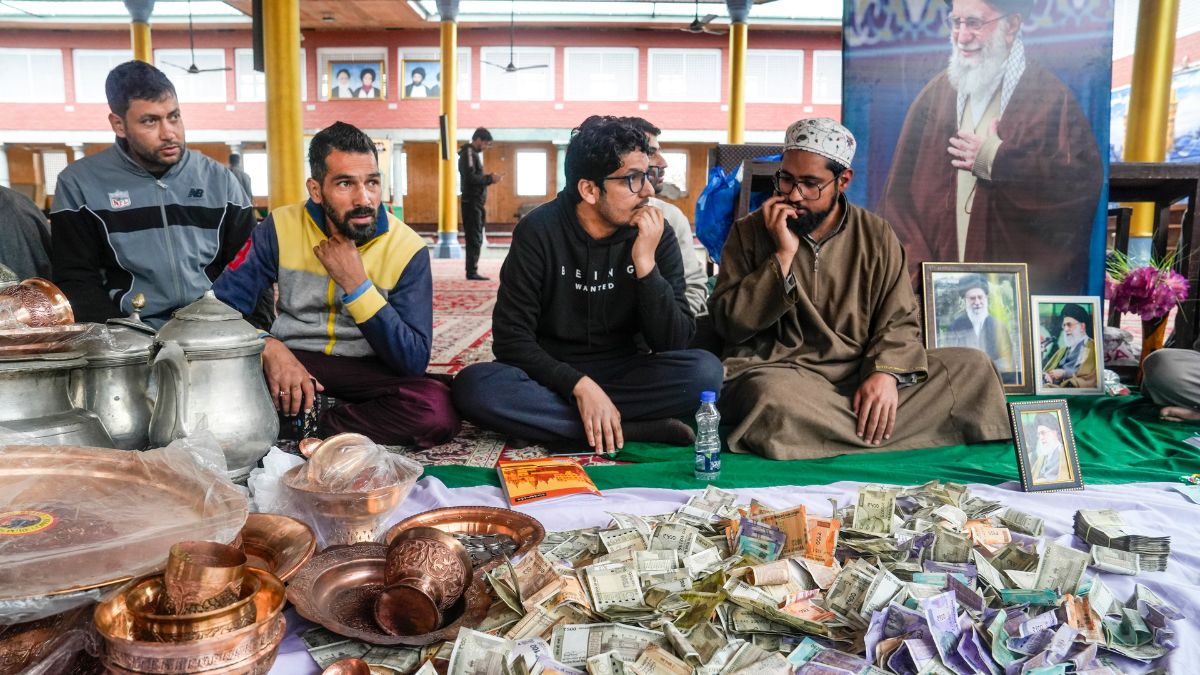
On March 14, the Embassy of the Islamic Republic of Iran in New Delhi made an appeal for humanitarian assistance on X, sharing an account number for voluntary contributions. This led to a torrent of support from Kashmir, including financial and material donations. People donated cash, copper, gold and even livestock for the cause.
Following the Iranian embassy’s appeal, many drives were organised across the Kashmir Valley, including donation stalls and door-to-door collection. Those without digital payment systems donated cash, as per ThePrint report.
The Jammu and Kashmir Police estimates that about Rs 17.91 crore, along with significant amounts of gold and other valuables, have been raised through donations.
This is in addition to the amount directly deposited in the Iranian embassy’s account, with people in Budgam alone donating Rs 9.4 crore, followed by Baramulla (Rs 4.5 crore) and Srinagar (around Rs 2 crore), the digital outlet reported, citing sources in the Indian security establishment.
As per a source, the donations took a religious turn, with many feeling obliged to contribute as part of Zakat and Sadaqah al-Fitr to support Iranians impacted by the conflict.
Quick Reads
View All“Cash, gold and silver valuables have been collected. Notably, a large portion of the donations, especially jewellery, has come from economically weaker sections, driven more by emotional and ideological motivations than financial capacity,” the source said.
Kashmir’s Iran aid drive under scanner
Indian investigation agencies are closely watching the large-scale donations made from Kashmir to Iran.
Officials from the State Investigative Agency (SIA) suspect that several middlemen and some dubious organisations are exploiting public sentiments to misappropriate funds.
These people are allegedly siphoning off crores in cash and valuables from innocent civilians, especially those in the Shia community, for their personal gains or to fan potential separatist activities in the Kashmir Valley.
“Most people, whether rich or poor, are donating out of genuine goodwill. Those who are directly donating the money to the Iranian embassy should not be worried, as it will reach Iran. However, many middlemen and dubious organisations are collecting funds in cash, which may not reach the embassy,” an agency official told India Today.
Sources told ThePrint that the involvement of these “opaque actors” could lead to these funds reaching the wrong hands, potentially supporting militant or separatist activities. “There are intelligence inputs that certain unauthenticated, profit-seeking individuals are collecting funds in the name of humanitarian aid for Iran but diverting them for personal gain. There are also reports of individuals with past links to separatism being involved in organising and collecting these donations, which makes the situation more sensitive. Some have already been identified,” the source said.
The central enforcement agencies, as well as those in J&K, are keeping a close vigil on these donations. Those who do not exercise caution while making donations could also face legal action.
“People are not just donating cash but also gold saved for their daughters’ weddings, even livestock. And these are not people with significant means — they are giving out of genuine emotion. But there is no structured monitoring framework for these door-to-door collections, which has created significant accountability gaps. It is difficult to verify the actual volume of funds collected and how they are ultimately used,” a source was quoted as saying by ThePrint. “This is why this has become a major concern that needs to be watched closely.”
VIDEO | Donations for war-ravaged Iran poured in from across Kashmir on Monday, with residents, cutting across sectarian lines, contributing money and valuables to the relief effort.
— Press Trust of India (@PTI_News) March 23, 2026
Posters calling for contributions were visible throughout Jammu and Kashmir as people came… pic.twitter.com/Grx816zZXy
According to a March 24 classified report from the J&K Police, accessed exclusively by CNN-News18, there is a “conduit" system involving people allegedly linked to Iran’s Islamic Revolutionary Guard Corps (IRGC) and separatist elements.
Hakeem Sajad of Bagwanpora in Srinagar has been identified as a “primary distributor” of Iranian funds to local clerics. Another name to have cropped up is that of Syed Ruhollah Rizvi, a former resident of Ganderbal, who is currently based in Iran.
Rizvi, who is also the brother-in-law of Hakeem Sajad, is suspected of having played a pivotal role in the financial network.
Agencies believe that almost half of the funds collected are being diverted to sustain a “payroll" of recipients within Kashmir to fuel separatist activities.
A similar tale triggers caution
In a recent case, a local preacher in southern Kashmir used funds collected for humanitarian needs to allegedly promote anti-India activities.
In March 2023, the State Investigation Agency found that the cleric Sarjan Barkati generated over Rs 1.5 crore through crowdfunding by making emotional appeals to the public for humanitarian needs.
Barkati had come to the spotlight for inciting violence through his anti-India speeches following the death of Burhan Wani in 2016.
Investigative agencies alleged the cleric raised funds and laundered money from unknown sources, with connections to militant outfits.
“Under this pretext, large amounts of money were generated and then laundered, allegedly used to sustain secessionist and militant activities,” a source told ThePrint.
“People must be careful to ensure that their donations do not land in the wrong hands. Our teams are keeping a close watch on this,” they added.
With inputs from agencies

 "US-Israel-Iran War Live Updates: US bases in Kuwait, Qatar and Saudi Arabia hit in fresh Tehran strikes")
 "Not Kharg alone: Could Iranian islands, Larak and Abu Musa, be next US targets?")
 "'We get things done': Trump hails partnership with PM Modi, says looking forward to 'stronger' tiles")
 "Putin turns to oligarchs for budget support as Ukraine war strains Russia’s finances")
 "US-Israel-Iran War Live Updates: US bases in Kuwait, Qatar and Saudi Arabia hit in fresh Tehran strikes")
 "Not Kharg alone: Could Iranian islands, Larak and Abu Musa, be next US targets?")
 "'We get things done': Trump hails partnership with PM Modi, says looking forward to 'stronger' tiles")
 "Putin turns to oligarchs for budget support as Ukraine war strains Russia’s finances")