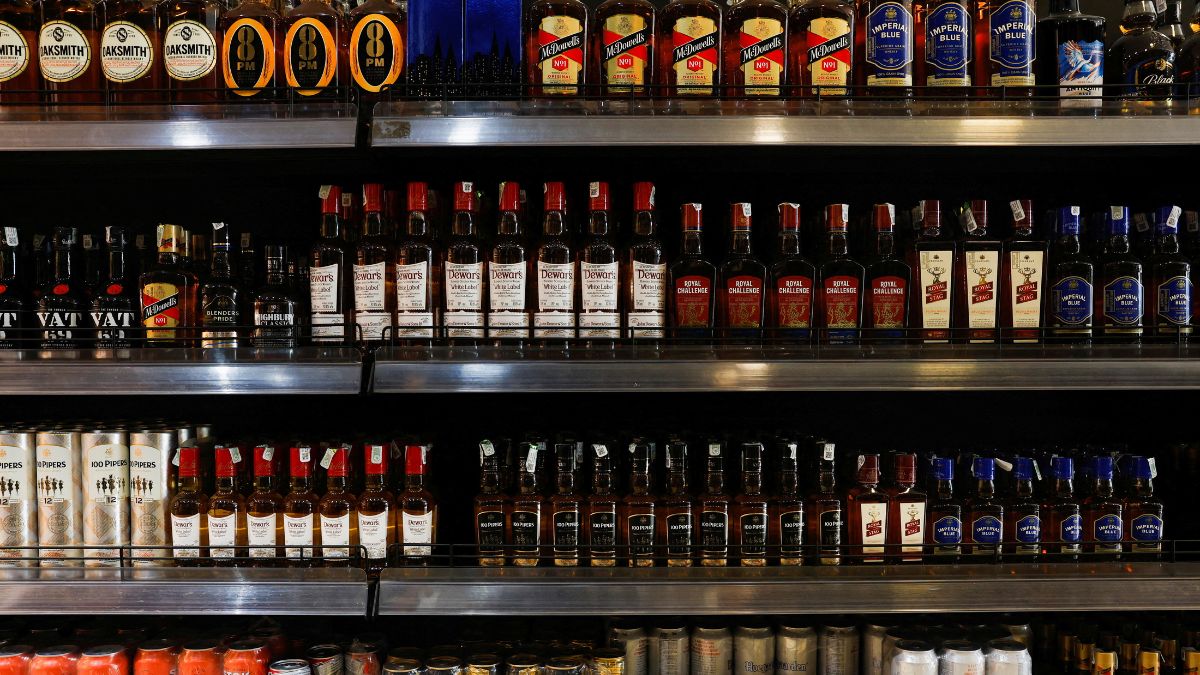
 "Karnataka to link excise duty to alcohol content: Will liquor get cheaper?")
Karnataka is revamping its liquor policy that would make alcohol cheaper for young professionals in the southern state. The Siddaramaiah-led government on Friday (March 6) announced scrapping state control over liquor pricing.
The current system will be replaced with a new alcohol-in-beverage (AIB)-based excise duty system from April. With this, Karnataka would become the first Indian state to link liquor taxation directly to alcohol content.
Let’s take a closer look.
Karnataka’s new liquor taxation scheme
Karnataka Chief Minister Siddaramaiah announced major reforms in the state’s liquor taxation and regulatory framework on Friday.
Presenting the state budget in the Karnataka Assembly, he said the government will introduce an alcohol-in-beverage-based excise duty structure.
The CM said the state will adopt a globally recognised taxation system that links excise duty to the alcohol content of beverages.
“An Alcohol-in-Beverage based excise duty structure is globally recognised as the gold standard for alcohol taxation, as it directly targets the alcohol content which is the primary source of negative externalities,” Siddaramaiah reportedly said.
The new system, which will be implemented from April 2026, links tax rates directly to the amount of alcohol in a drink. Instead of the total volume of the beverage, the excise duty will be calculated on the alcohol content per litre.
In India, typical beer alcohol by volume (ABV) ranges from four per cent to eight per cent, with strong variants at eight per cent. Whiskey usually has 36 per cent to 50 per cent ABV.
Under the new system, liquor with higher strength will be taxed more, which could push the tipplers to opt for lower-alcohol alternatives, as per Times of India (TOI).
Quick Reads
View AllDeregulate liquor pricing system
The Karnataka government plans to cut down pricing categories to eight from 16 and allow producers to decide on prices.
Under the new framework, the state will deregulate government price fixation. The state has proposed implementing a uniform level of excise duty.
The additional excise duty will be levied within a defined range depending on the ex-factory price slab basis, the CM said.
The uniform excise duty based on the alcohol content per litre will be rolled out in stages in the next three to four years, Siddaramaiah said. He added that these changes would be gradual to avoid disruption in the market.
“Under the new policy, the government-administered price fixation will be completely deregulated. Product placement within slabs will be left to the producers based on market considerations,” he said, as per PTI.
“To simplify the structure further, the number of pricing slabs for alcoholic beverages will be reduced significantly. Pricing slabs will be rationalised and reduced to eight slabs from the existing 16 slabs,” CM Siddaramaiah added.
The Karnataka government controls retail alcohol pricing. Manufacturers declare ex-factory prices, based on which the state decides the maximum retail price.
With the excise policy reforms, the southern state will change how alcohol prices are determined.
With this, the government aims to modernise the decades-old excise system, improve transparency, simplify pricing and promote ease-of-doing business.
Alcohol tourism, tech boost
The Karnataka government will focus on promoting alcohol-linked tourism. This will include allowing tasting sessions and on-site sales at distilleries. Distilleries and breweries could be permitted to operate for 24 hours, while beer labels will not be required to mandatorily disclose malt and sugar content.
Karnataka has set an ambitious excise revenue target of Rs 45,000 crore for the 2026–27 financial year.
The state government will also bring technology-driven systems to curb leakages and improve tracking of liquor movement across the state.
Geofenced e-lock systems will replace physical escorts for dispatches. These steps will ensure transparency and enable real-time oversight, the chief minister said.
Siddaramaiah also underlined administrative reforms within the Excise Department to enhance transparency.
He said the Resource Mobilisation Committee constituted by the government will soon submit a draft report laying down a modern excise taxation and alcohol regulatory framework for the state.
He said the draft report would be placed in the public domain for consultations before taking legislative measures.
“Beyond the measures rolled out above, those reforms that require legislative approval will be introduced in the form of a new and comprehensive Excise Bill,” he said.
Stakeholders, market react
The alcohol industry has hailed the Karnataka government’s sweeping reforms to the excise policy.
The Brewers Association of India (BAI) called the shift to the new excise duty structure transformative. “It (the new system) reflects the global gold standard in alcohol taxation, where the tax is levied on the alcohol content rather than the water in the beverage. No state has adopted such a structure so far. If implemented in line with this principle, beer and wine could become cheaper,” Vinod Giri, BAI director general, was quoted as saying by Hindustan Times (HT).
A spokesperson for United Breweries applauded “the government’s intent to strengthen the regulatory and policy framework for the sector”.
Sanjit Padhi, CEO of International Spirits and Wines Association of India, also welcomed the move to end liquor price control. “Reducing slabs to eight offers brands flexibility to set prices. While the final tax structure is pending, we hope a stable policy could boost investment and premiumisation, shifting consumers from lower-end products toward higher-value options,” he said, as per TOI.
Shares of Indian alcohol makers, including United Breweries, Tilaknagar Industries and Radico Khaitan, surged following the policy announcement, reported Reuters.
The stocks of United Spirits, owned by Diageo, soared 5.4 per cent and United Breweries, backed by Heineken (HEIN.AS), climbed 2.6 per cent.
With inputs from agencies


 "UAE News Live Updates: Dubai airport 'partially' reopens after temporary suspension amid Iran strikes")
 "‘FAA, Boeing knew fuel switch issues’: Lawyer representing AI171 crash victims questions pilot error narrative")
 "Iran’s president apologises to West Asian neighbours, says ‘will not strike’ unless attacked")
 "India vs New Zealand Final Press Conference Live Updates, T20 World Cup: SKY expected to address media at 5:45 PM")
 "UAE News Live Updates: Dubai airport 'partially' reopens after temporary suspension amid Iran strikes")
 "‘FAA, Boeing knew fuel switch issues’: Lawyer representing AI171 crash victims questions pilot error narrative")
 "Iran’s president apologises to West Asian neighbours, says ‘will not strike’ unless attacked")
 "India vs New Zealand Final Press Conference Live Updates, T20 World Cup: SKY expected to address media at 5:45 PM")